 Chord Lens
Chords and keys · 01 of 07
COMMON CHORD PROGRESSIONS, EXPLAINED. a handful of patterns, a thousand songs
The short answer
A chord progression is the order a song’s chords move in. Musicians number them by scale step so one pattern works in every key. The most common are I–V–vi–IV (C, G, Am, F in C), I–IV–V, I–vi–IV–V, ii–V–I and the 12-bar blues. Learn those and you can follow most pop, rock, folk and worship songs.
01 / 07 · NUMBERS
Name the step, not the chord.
Take the major scale of any key and build a chord on each of its seven notes. You get the same pattern every time: three major chords, three minor chords and one diminished chord. Musicians number them by the scale step they start on, in Roman numerals, with capitals for major and small letters for minor: I, ii, iii, IV, V, vi and vii°.
In C major that gives C, Dm, Em, F, G, Am and Bdim. In G major it gives G, Am, Bm, C, D, Em and F♯dim. The letters change with the key; the numbers don’t. That is the whole point. When a guitarist says a song goes “one, five, six, four”, every player in the room knows the chords, whatever key the singer wants.
The Nashville number system writes the same idea with ordinary numbers, 1 to 7, and adds an m for minor: 1, 2m, 3m, 4, 5, 6m. This page uses Roman numerals because they’re the more common way to write progressions down, but the two say the same thing.
Why do so few patterns cover so many songs? Because the I, IV and V chords between them hold every note of the scale, and the vi is the I’s relative minor, sharing two of its three notes. Those four chords can harmonise almost any melody in the key. The progressions below are the orders that sound best, and the ones your ear has been hearing since childhood.
02 / 07 · THE COMMON ONES
Five patterns that cover a lot of songs.
I–V–vi–IV. C, G, Am, F in C; G, D, Em, C in G. The best-known progression in pop. It lifts, dips into the minor and settles back, and it loops forever without sounding finished, which is why so many choruses run on it.
vi–IV–I–V. Am, F, C, G in C. The same four chords started from the minor one. Starting on vi makes the song sound darker and more yearning, even though nothing else has changed.
I–IV–V. C, F, G in C; G, C, D in G; A, D, E in A. The three-chord trick of folk, country, rock and roll and campfire songs. The V chord pulls hard back to I, so a phrase that ends on V sounds like a question and one that ends on I sounds like the answer.
I–vi–IV–V. C, Am, F, G in C. The doo-wop and fifties ballad progression. Swap the IV for a ii (C, Am, Dm, G) and you have the same feel with a slightly smoother bass.
ii–V–I. Dm, G, C in C, usually played as Dm7, G7, Cmaj7. The backbone of jazz standards, and a common way to arrive anywhere: put the ii and V of a chord in front of it and the ear hears that chord as a destination.
The 12-bar blues. Four bars of I, two of IV, two of I, then V, IV, I and a final bar of V (or I) to turn round. In A: A A A A, D D A A, E D A E. Countless blues and rock songs use this frame, often with every chord played as a seventh.
Learn each progression in two keys, C and G. Then try it in the key of a song you know and listen for it.
03 / 07 · MINOR
Darker colours, same idea.
Minor keys have their own numbering, counted from the minor home chord: i, ii°, III, iv, v, VI and VII. In A minor that is Am, Bdim, C, Dm, Em, F and G, the same chords as C major with a different home. The v is very often played major (E instead of Em in A minor) to pull harder back to the i.
i–VI–III–VII. Am, F, C, G in A minor. The same chords as vi–IV–I–V in C, heard with Am as home. It’s all over rock and film music.
i–VII–VI–V. Am, G, F, E. Often called the Andalusian cadence, a bass line stepping down to a major V that leans back to the start. You hear it in flamenco and in plenty of rock songs.
I–♭VII–IV. D, C, G in D. The ♭VII is borrowed: C isn’t in D major, but it sounds right in a riff-based rock song. Borrowed chords like this, the ♭VII, the ♭VI and the minor iv, are how songs add colour without changing key.
04 / 07 · BY EAR
Hear the pattern, then name it.
Once you know a few progressions, you start hearing them everywhere, and working a song out gets much faster: you recognise the pattern and fill in the chords from the key. Here is how to practise that.
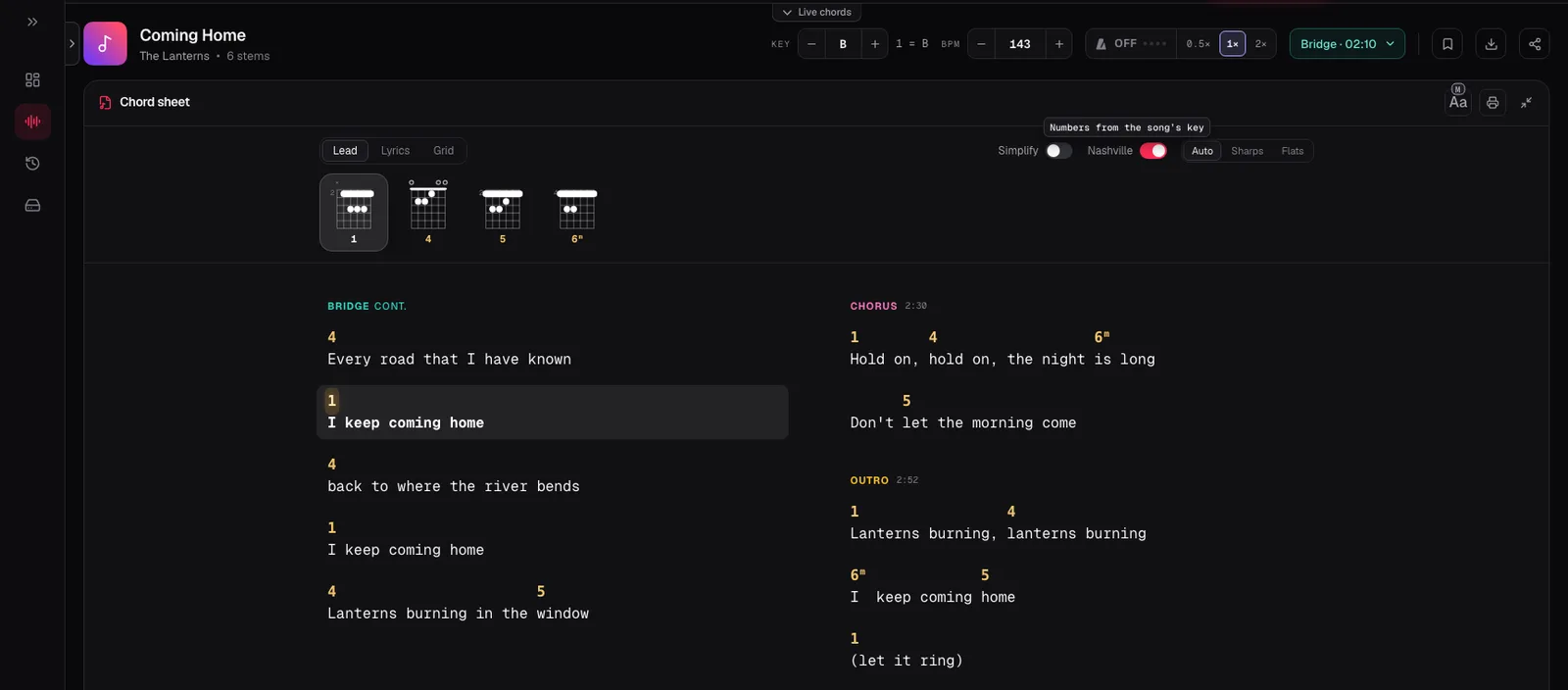
In the Chord Lens Studio you can check yourself. Open a song, turn on Nashville in the chord sheet, and every chord on the chart becomes its number in the song’s key, with “1 = B” (or whatever the key is) beside the key. The demo song in the screenshot runs 1, 4, 6m, 5 in its chorus: I, IV, vi, V in Roman numerals.
Find the home chord
Listen for the chord the chorus rests on. That is your I (or your i in a minor key).
Follow the bass
Loop one section and write down the bass note at each chord change.
Count up from home
For each bass note, count the scale steps up from the home note. The 5th step above home is V, the 6th is vi.
Match the pattern
Compare your numbers with the progressions above. If it’s I, V, vi, IV, you already know the rest of the song.
05 / 07 · USE THEM
One pattern, every key.
Because a progression is just numbers, you can play it in any key. A song that goes I–V–vi–IV in E (E, B, C♯m, A) has awkward shapes for a beginner; the same song in G (G, D, Em, C) is all open chords. Moving a song like that is called transposing, and our guide on how to transpose chords walks through it. Change Song Key does it for the recording and the chart together.
Writing your own songs, the same patterns are a starting point, not a cage. Take I–V–vi–IV and change one chord: swap the V for a iii, end on the IV instead of returning home, or borrow a ♭VII. Small changes to a familiar shape are how a lot of memorable songs are written.
To find the progression of a song you have as a file, drop it into the AI Chord Finder and read the chart, with Nashville on if you want the numbers. For a song on YouTube, paste the link into YouTube to Chords. Then check it by ear: the pattern you hear should match the numbers you read.
06 / 07 · Do it in one click
AI Chord Finder
Drop in a song file and read its chords in time, as letters or as numbers in its key.
01What is the most common chord progression?
I–V–vi–IV is the best known in pop: C, G, Am, F in C. I–IV–V is the most common in folk, country and early rock and roll.
02What does I–V–vi–IV mean?
The chords built on the 1st, 5th, 6th and 4th notes of the key’s scale. Capitals are major, small letters minor. In G it is G, D, Em, C.
03What are the chords in a 12-bar blues?
Only I, IV and V. Four bars of I, two of IV, two of I, then V, IV, I and a final V or I. In A: A, D and E, often as sevenths.
04What is a ii–V–I?
The 2nd, 5th and 1st chords of a key: Dm, G, C in C, usually with sevenths. It is the most common way jazz arrives at a chord.
05Are minor-key progressions different?
They use the same chords as the relative major, with the minor chord as home. Am, F, C, G is vi–IV–I–V in C or i–VI–III–VII in A minor.
06Can Chord Lens show chords as numbers?
Yes. Turn on Nashville in the Studio’s chord sheet and every chord shows as its number in the song’s key, with the key’s 1 beside it.