 Chord Lens
Backing track maker
Backing track maker: the real band, minus you
Make a backing track from any song you upload: split it into six parts, mute the one you play, and play along with the original recording. Slow it down, loop the hard bars and change the key. Upload an MP3, WAV or M4A in the Studio. Free to try: Free splits a 2-minute part.
Last updated
The short version
At a
glance.
play it with the band
Chord Lens splits the song into six stems so you can mute your instrument and play its part over everyone else, with the chords in time. Everything else on this page is the detail.
- Six stems from one songvocals, drums, bass, piano, guitar, other
- Mute or solo any of themtake out the part you play
- Rhythm onlyone press: just drums and bass
- Chords in timesee what to play as it comes
- Slow it downpractise at your speed, in the same key
- Change the keythe whole band moves
- A click on the beatthe Studio’s metronome
- Your own audioupload an MP3, WAV or M4A in the Studio
- Free to trya 2-minute part on Free
01 / 10 · What it is
The band.
Your part.
A backing track is the song with one part missing, the part you’re going to play. Most are re-recorded by someone else, in their arrangement, and only for songs popular enough to bother with.
Chord Lens makes one from the original recording. It splits the song into six stems and lets you mute yours, so you play along with the actual band, the actual groove and the chords in time on screen.
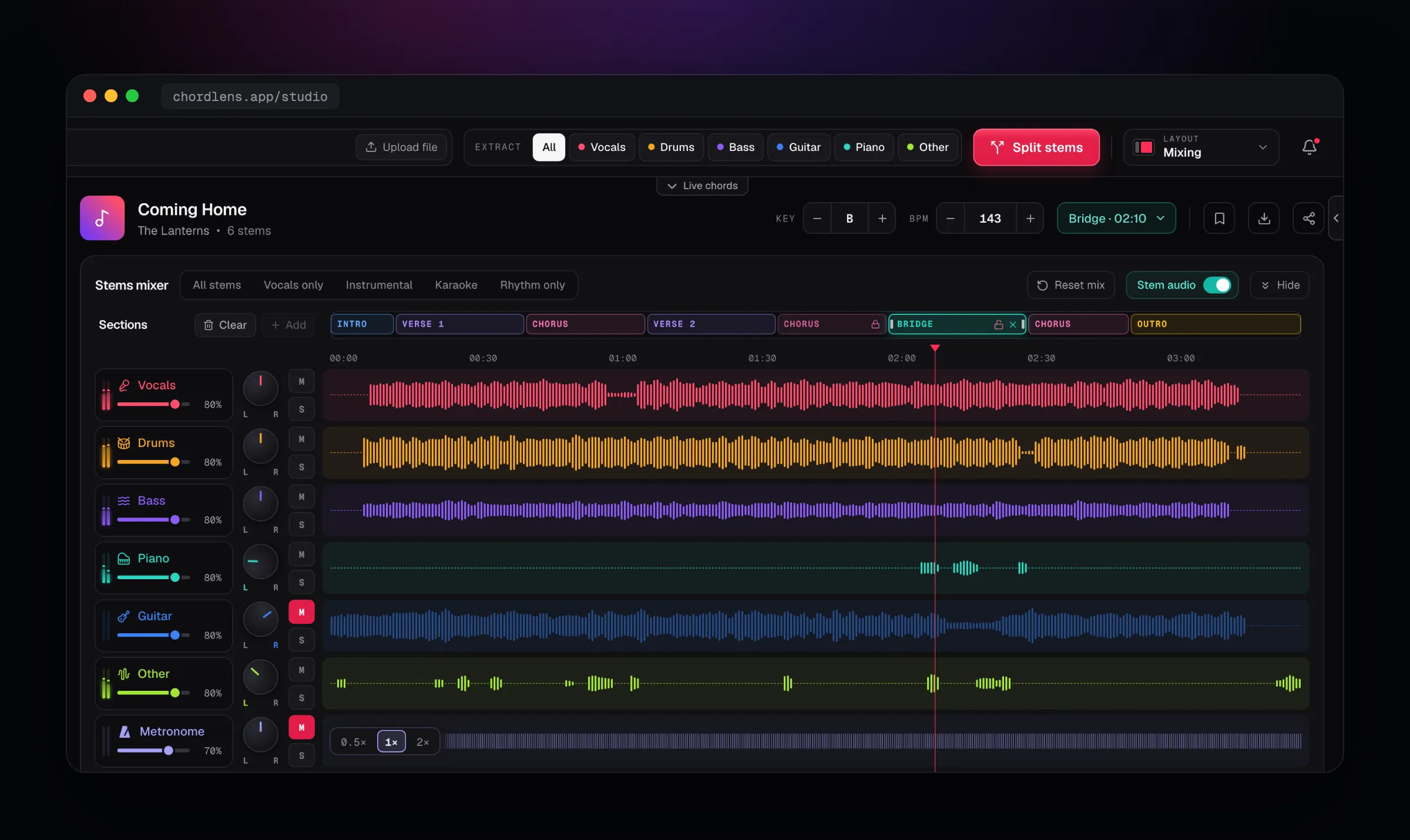
It happens where you already are. Under a YouTube video, the Chrome extension splits the song and puts a mute, a solo and a fader on each stem beside the chords. In the Studio, the stems mixer gives every stem a row of its own, with its waveform, so you can see the part you took out.
It suits a guitarist learning a cover, a bassist who wants the drummer without the bass line, a singer who wants the band without the voice, and a drummer who wants the band without the kit. Each of them gets the same record with their own part taken out.
Have the song as a file? The Studio makes backing tracks from MP3, WAV and M4A the same way.
Backing track sites
Sell re-recorded versions of popular songs, one track per song, in the arrangement they chose.
The real recording
Mutes your part from the song itself, any song you can open, with the chords on screen.
02 / 10 · How to
Make a backing track
in four steps.
just open the song
Open the song
Upload an MP3, WAV or M4A file in the Studio, up to 50 MB. On YouTube, Chord Lens in Chrome listens to the song as it plays.
Split the song
Press Split. On Free, pick the 2 minutes you want to play.
Mute your part
Press M on your instrument, or Rhythm only to keep just drums and bass.
Play along
Read the chords in time and play your part with the band.
On the Mac? The Chord Lens app runs the same Studio.
Get the Mac appThe chords are there from the first note; the backing track needs a split first. Under the video, sign in and split it; in the Studio, upload a file. The split runs while you watch, and the stems are ready to mute as soon as it’s done.
03 / 10 · Your part
Mute yours.
Keep everyone else.
Every split gives you six stems, each with a mute, a solo and a fader. Take out the part you play, or keep only the rhythm section and play everything else.
- Vocals
- Drums
- Bass
- Piano
- Guitar
- Other
Guitarists
Mute Guitar and play the part over the band.
Bass and drums
Mute your stem and be the rhythm section.
Keys and singers
Mute Piano or Vocals and take the lead.
Above the faders sit mixes you can reach in one press: All stems, Vocals only, Instrumental, Karaoke and Rhythm only, which solos the drums and bass together. A mix only sets mute and solo, so the levels you set stay where you put them. Mute more than one stem if you like: a guitarist and a singer can take out both their parts and play the song as a duo over the rest.
04 / 10 · Practise it
Loop it.
Slow it. Move it.
the band follows
- Loop
- A–B
- Loop the bars you’re learning and play them until they sit.
- Speed
- 0.75×
- Slow the band down to learn a fast part; the pitch stays put.
- Key
- −2
- Move the whole band to a key you can play in.
Loop, speed and key all work over the split, so the part you muted stays out while the rest of the band slows down or moves key, and every chord on the chart is re-spelled for the new key. Key and speed are free in Chrome and, once you sign in, in the Studio, for the whole song up to your plan’s song-length limit. For a closer look at the speeds and loops, see Slow Down Songs.
05 / 10 · Where it runs
Split on your
own computer.
The split runs in your browser on your own computer, not in a queue somewhere. The first time, Chord Lens sets the splitting engine up once; after that a song splits while you watch. Splitting needs a computer: phones get the chords, not the split.
06 / 10 · How clean
Clean enough to play over.
Honest about the rest.
Drums, bass and vocals usually come out clean, so muting one leaves a tight band to play over.
Parts that share the same space are harder. Two guitars, or a piano under a pad, can bleed into each other, so a muted guitar may leave a faint trace. It’s a practice tool, not a studio backing track.
Still hear your part?
- Pull its neighbour down too: a second guitar often sits in Other.
- Play louder than it: you’re playing over it, not mixing.
- Solo the part to learn it first, then mute it.
- Try a studio version: live takes split less cleanly.
07 / 10 · Compared
Chord Lens vs
other backing tracks.
Three ways to get a backing track for a song you want to play, and where they differ.
| Backing track sites | Jam track videos | Play over the record | Chord Lens | |
|---|---|---|---|---|
| Any song you can open | Only those sold | Only those made | Yes | Yes |
| The original band | Re-recorded | Re-recorded | Yes | Yes |
| Your part muted | Yes | Usually | No | Any part |
| Chords in time | No | Sometimes | No | Yes |
| Slow, loop, key | No | No | Speed only | Built in |
| Cost | Per song | Free, with ads | Free | Free to try |
A good backing track site earns its place for a standard you play every week, and a jam track is fine for practising over a groove. Chord Lens is for the song you just heard: the original recording, your part out, and the chords there in time while you play.
08 / 10 · How players use it
Four ways
players use it.
Learn a song for a gig
Mute your part and run the set with the real band.
Lock in with a drummer
Keep Rhythm only and play everything else over the groove.
Practise a solo
Mute the guitar, loop the solo bars, slow them, play.
Rehearse at home
Each band member mutes their own part and practises alone.
Teachers mute the student’s instrument so the lesson has a band behind it. Worship teams learn a new song in the key they’ll lead it in. Singers who want the band without the voice will find more on the YouTube Vocal Remover page, and anyone who wants every stem on its own can start at the YouTube Stem Splitter. For a routine to rehearse on your own, read how to practice without a band.
09 / 10 · What it won’t do
What it
won’t do.
so you know before you split
Downloads, for your own study
On Free the stems play in Chord Lens. Premium downloads the stems, or your mix of them, as MP3 and Pro adds WAV, for your own personal study and practice, not to share or publish.
No split on phones
Splitting needs a computer. On a phone you still get the chords.
No private videos
Private, age-restricted, members-only and removed videos can’t be opened.
Not a studio stem
Some bleed between parts is normal; it’s made for practice.
Chord Lens is for practising and studying a song yourself: learning it, working out a part, playing along. That kind of personal use is broadly considered fair use under US copyright law, with similar rules elsewhere. Stem downloads on Premium and Pro are for that same personal study, not to share, sell or publish. To publish a cover, use the original audio under YouTube’s licensing, or get a sync license.
10 / 10 · Plans
Free to try.
Free splits a 2-minute part of a song, the part you choose. Premium and Pro split the whole song. Chords and the lyrics a song already has are free on every plan; key and speed are free in Chrome and, once you sign in, in the Studio, for the whole song up to your plan’s song-length limit.
See plans and prices01How do I make a backing track from a song?
Upload the song in the Chord Lens Studio, split it, then mute your instrument. The rest of the band keeps playing with the chords in time.
02Which parts can I mute?
Any of the six stems: vocals, drums, bass, guitar, piano and other. Each has its own mute, solo and fader, so you can take out one part or several.
03Can I keep only the drums and bass?
Yes. Press Rhythm only and you hear just the drums and bass, so you can play everything else over the groove.
04Can I slow the backing track down?
Yes. Slow it down and the pitch stays put, so the band stays in the key you play in. Loop the hard bars and drill them at the speed you can play.
05Can I change the key?
Yes. Move the key and the whole band moves with it, and every chord on the chart is re-spelled for the new key. Key and speed are free in Chrome and, once you sign in, in the Studio, for the whole song up to your plan’s song-length limit.
06Is it the original recording?
Yes. Chord Lens splits the song itself, so you play along with the original band, not a re-recorded version of it.
07Why can I still hear a bit of my part?
Parts that share the same space can bleed into each other, like two guitars, or a piano under a pad. Pull the neighbouring stem down too: a second guitar often sits in Other.
08Is it free?
Free to try. Free splits a 2-minute part of a song, the part you choose; Premium and Pro split the whole song. Chords and the lyrics a song already has are free on every plan.
09How much of a song can I play on Free?
A 2-minute part, the part you pick before you split. Premium and Pro split the whole song.
10Can I do it on my phone?
Not the split: splitting needs a computer, because it runs in your browser on your own machine. On a phone you still get the chords.
11Can I save the backing track?
On Premium you can download the stems, or your mix of them, as MP3 from the Studio, and Pro adds WAV. Downloads are for your own personal study and practice, not to share, sell or publish. On Free the stems play in Chord Lens.
12Can I use Chord Lens on my own files, or only YouTube?
Both. The Chrome extension works right on the YouTube video you’re watching, listening to the song as it plays. To split stems, upload your own audio in the Studio (MP3, WAV or M4A, up to 50 MB). Premium exports stems as MP3 and Pro adds WAV, for your own study and practice.
13Do the chords show?
Yes. The chart follows the song as you play: the chord on the beat lights up, and the words run underneath where the song has lyrics.
14Can I add a metronome?
Yes, in the Studio. The metronome has its own row in the mixer and clicks on the song’s own beat, so it slows with the song.
15Is this different from the stem splitter?
It’s the same split, used one way. The YouTube Stem Splitter page is about the six stems themselves; this page is about muting your part and playing along with the rest.
In short
The whole page
in four lines.
Six stems.
Split from the original song.
Mute yours.
Play your part with the real band.
Chords in time.
Loop, slow and change the key.
Free to try.
A 2-minute part on Free; the whole song on Premium and Pro.