 Chord Lens
Chords and keys · 02 of 07
THE NASHVILLE NUMBER SYSTEM. one chart, every key
The short answer
The Nashville number system writes chords as numbers for their place in the key: in G, the G chord is 1, C is 4, D is 5 and Em is 6m. Because the numbers don’t change with the key, one chart works for every singer, and a band can move a song up or down without rewriting a thing.
01 / 07 · WHAT IT IS
Chords counted from home.
Every major key has seven notes. Number them from the key’s home note, 1 to 7, and number each chord by the note it’s built on. In the key of C: C is 1, D is 2, E is 3, F is 4, G is 5, A is 6 and B is 7. A C chord is a 1, an F chord a 4, a G chord a 5.
Studio players in Nashville made this the standard way to write charts because sessions move fast. A singer walks in and wants the song a tone lower. With letter chords, every chart in the room has to be rewritten. With numbers, nobody touches a pen. The 1 is wherever the new key says it is, and the chart still reads 1, 4, 5.
It also trains your ear. Once you think in numbers you stop hearing “G to C” and start hearing “1 to 4”, a move that sounds the same in every key. That is the skill behind playing a song you’ve never heard after one listen: you hear the 4 coming, whatever its letter.
You don’t need to read music to use it. If you can count up a scale from the home note, you can read a Nashville chart.
02 / 07 · READ IT
Read one in five steps.
A Nashville chart is a few lines of numbers with the key written at the top. Customs vary from one studio or band to the next, so treat the marks below as the common ones, not a law.
Find the key
It’s written at the top of the chart: “Key of G”. That note is your 1.
Count up the scale
In G: 1 is G, 2 is A, 3 is B, 4 is C, 5 is D, 6 is E, 7 is F♯. Each number is the chord built on that note.
Read the quality
A plain number is a major chord. Add m (or a minus sign) for minor: 6m is Em in G. A small 7 after it makes a seventh: 5⁷ is D7.
Count the bars
Each number usually fills one bar. Two or more numbers underlined or boxed together share one bar.
Play the sections
Sections are labelled (verse, chorus, bridge) and played in order. A repeat sign or “x2” means play the line again.
03 / 07 · DETAILS
The marks that make it a real chart.
Minor chords. In a major key the 2, 3 and 6 chords are naturally minor, so you’ll see 2m, 3m and 6m all the time. In G that’s Am, Bm and Em. A 1m or 4m is a minor chord where you’d expect a major one, a borrowed colour.
Sevenths and other colours. These go after the number, usually raised: 5⁷ for a dominant seventh, 1maj7 for a major seventh, 4sus for a suspended chord, 2m7 for a minor seventh. The number is still the root; the rest is colour on top.
Slash chords. When the bass plays a note other than the root, write the bass as a number too: 1/3 means the 1 chord over the 3rd note in the bass. In G, 1/3 is G/B. It’s how charts write the walking bass lines that join chords smoothly.
Chords outside the key. A flat or sharp before the number moves its root: ♭7 in G is F, ♭3 is B♭, ♯4 is C♯. Borrowed chords like the ♭7 are common in rock and worship songs.
Minor keys. Here charts differ. Many Nashville players number a minor-key song from its relative major, so a song in A minor is charted in C, and its home chord reads 6m. Others write the minor home as 1m. Check which way a chart was written before you play.
Rhythm marks. Charts add symbols for feel: a diamond around a number means hit the chord and let it ring, and a small arrow or caret above it means a push, the chord landing just before the beat. These vary more than anything else, so ask the band.
The number never changes with the key. Only the letter it stands for does.
04 / 07 · WRITE IT
From a chord sheet to numbers.
Turning a letter chart into numbers takes a few minutes. Find the key first; our guide on how to find the key of a song covers it. Write the key at the top. Then go chord by chord and write the step it sits on: in the key of D, D is 1, G is 4, A is 5 and Bm is 6m.
Write one line per phrase, usually four bars, so the chart looks like the song sounds. A verse that goes D, D, G, A becomes 1 1 4 5. If a bar holds two chords, put them together and underline them. Label each section and note any repeats, then play through the chart with the record to check it.
A finished chart fits on a single page for most songs. Hand it to a bassist, a pianist and a guitarist with a capo, and they can all play from the same paper in whatever key the night needs.
05 / 07 · IN THE STUDIO
Turn the chart into numbers in one click.
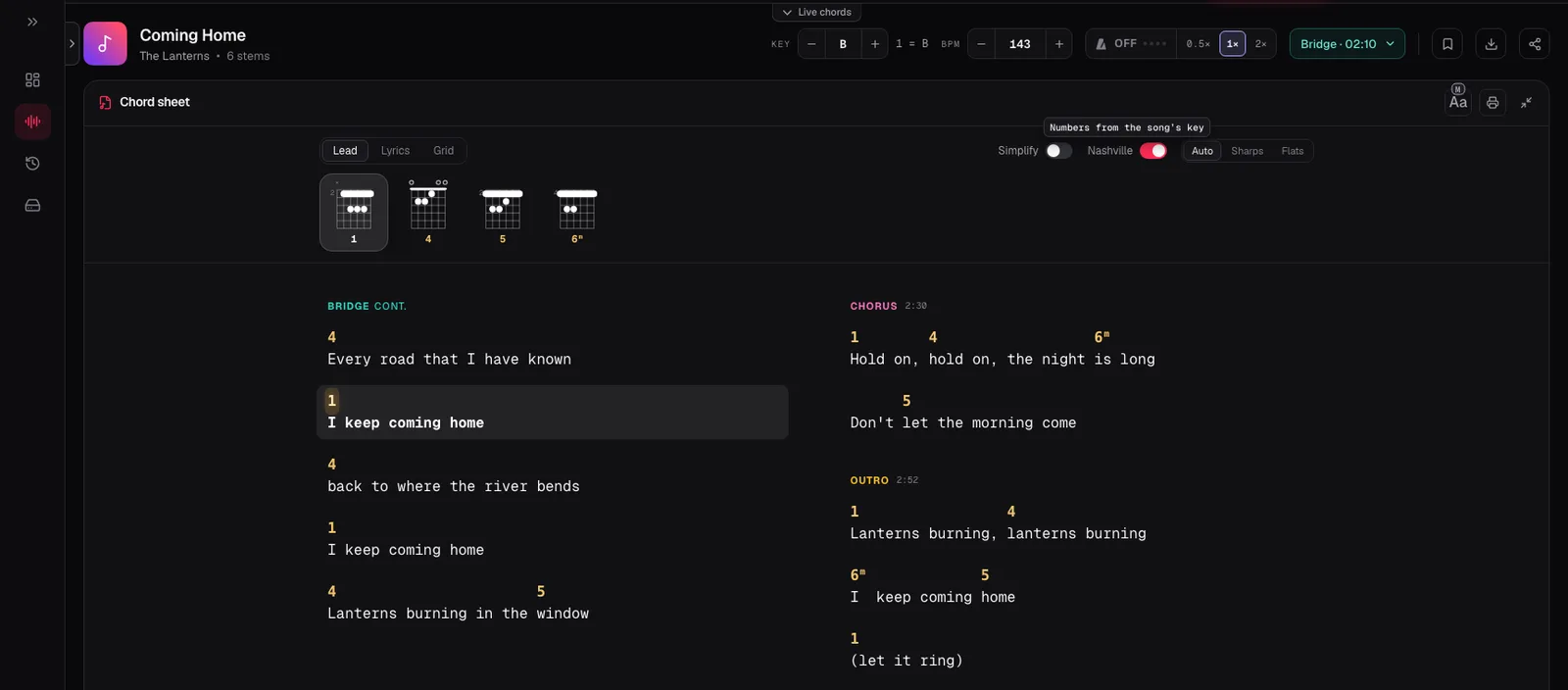
The Chord Lens Studio can show any song’s chart as Nashville numbers. Open a song, from a YouTube link or your own file, and switch on Nashville in the chord sheet’s toolbar (the switch is also in the live chords panel). Every chord on the chart, and every shape above it, turns into its number in the song’s key, and “1 = B” (or the song’s own key) appears beside the Key control so you know where 1 is.
A few details match the way charts are written by hand. Minor chords show an m: 6m. Sevenths and other colours sit raised and smaller after the number, so a G7 in C reads 5⁷, not 57. Slash chords number their bass too. Notes outside the key are written as flats, ♭3, ♭6, ♭7, except the ♯4. A minor-key song counts from its relative major, so Am in A minor shows as 6m.
Move the key, or set a capo, and the numbers stay exactly where they were: only the “1 =” beside the key changes. That is the Nashville idea in action, and a quick way to make a chart for a band that plays the song in a different key from the record. Our guide on common chord progressions shows the number patterns you’ll spot most.
06 / 07 · Do it in one click
AI YouTube to Chords
Paste a YouTube link and read its chords in time, as letters or as Nashville numbers.
01What is the Nashville number system?
A way of writing chords as numbers for their place in the key. In C, C is 1, F is 4 and G is 5. The chart works in any key without rewriting.
02How is it different from Roman numerals?
It says the same thing with ordinary numbers and an m for minor: 6m instead of vi. Nashville charts also carry bars, sections and rhythm marks, so they are played from directly.
03How do you write a minor chord?
Add m or a minus sign after the number. In G, 6m is Em and 2m is Am.
04How do minor keys work?
Two ways. Many players chart a minor song from its relative major, so the home chord is 6m; others write it as 1m. Chord Lens counts from the relative major.
05What does 1/3 mean?
The 1 chord with the 3rd note of the key in the bass. In G, that is G/B.
06Can Chord Lens show a song in Nashville numbers?
Yes. Switch on Nashville in the Studio’s chord sheet. The chords and shapes show as numbers in the song’s key, with the key’s 1 beside the Key control.
07Do the numbers change if I move the key?
No. That is the point of the system. In the Studio, moving the key or setting a capo changes only the “1 =” beside the key.