 Chord Lens
YouTube vocal remover
AI YouTube Vocal Remover: karaoke or acapella, from a link
Take the singer out of any song you upload and keep the band for a karaoke track, or keep only the voice for an acapella. Upload an MP3, WAV or M4A in the Studio. The words run in time, and you can move the key to your voice. Free to try.
Last updated
The short version
At a
glance.
one fader, two ways
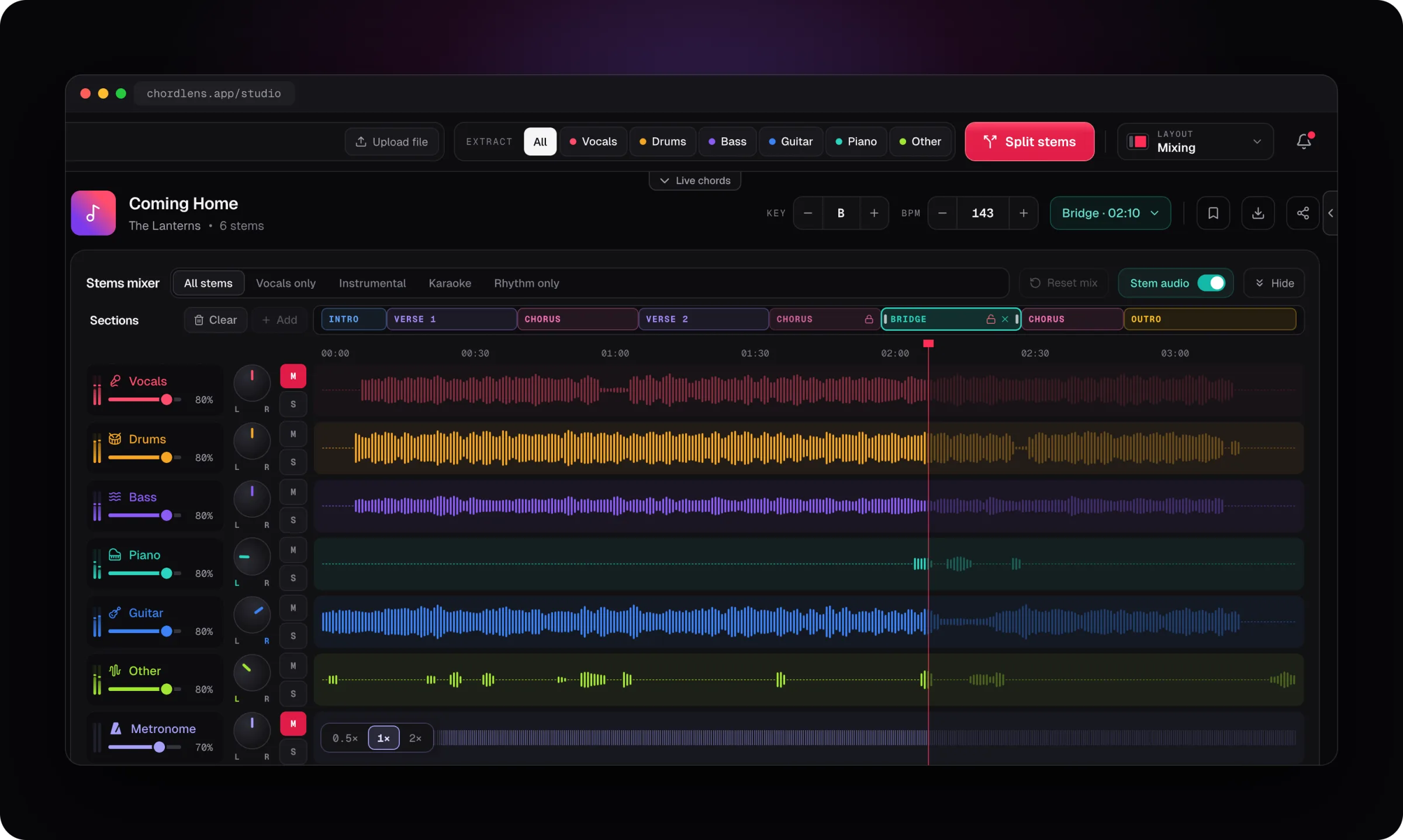
Chord Lens splits the song into six stems, so the voice is a fader: off for karaoke, alone for acapella, low for a guide. Everything else on this page is the detail.
- Vocals off for karaokethe band keeps playing
- Vocals only for acapellahear every word on its own
- Runs on your computerthe split happens in your browser
- Words in timethe lyric line lights up as it’s sung
- Move the key to your voicethe backing moves with it
- Loop the chorussing the hard part again
- Chords for the playeraccompany yourself
- Your own audioupload an MP3, WAV or M4A in the Studio
- Free to trya 2-minute part of a song on Free
01 / 10 · What it is
Take the singer out.
Keep the band.
A vocal remover takes a finished song and separates the singer from the band. Mute the voice and you have a karaoke track; keep only the voice and you have an acapella. The useful ones let you do it on the song you’re already listening to, without a detour through files and editors.
Chord Lens does it in the Studio, from a file you upload. Drop in an MP3, WAV or M4A and split. Covers, live takes and new releases split the same way as hits, because Chord Lens works from the audio you give it.
Old vocal removers cancelled out whatever sat in the middle of the stereo mix, and took the bass and the kick drum with the voice. Chord Lens splits the song into six stems instead, so the band stays whole when the singer goes: drums, bass, piano, guitar and the rest, each on its own fader.
It suits a singer rehearsing for a gig, a choir member learning a harmony, a guitarist who sings and plays, and anyone who wants a karaoke night with songs the karaoke catalogue never had.
Watching on YouTube? The Chrome extension works right on the video, listening to the song as it plays.
Upload-a-file removers
Hand back files you load into another player before you can sing along.
Sing where you play
Splits the song you upload and keeps it in one place: the vocal fader, the words in time, the key, the loop and the speed.
02 / 10 · How to
A karaoke track
in four steps.
nothing to install in the Studio
Open the Studio
Go to chordlens.app/studio on a computer and sign in with Google.
Upload your song
Drop in an MP3, WAV or M4A file, up to 50 MB.
Split the song
Press Split stems. On Free, place the 2-minute window over the part you want to sing. The first split sets the engine up once.
Mute Vocals and sing
Press M on Vocals or pick Karaoke for a backing track, or pick Vocals only for an acapella. The words run in time on the chart.
Rather stay on YouTube? Add Chord Lens to Chrome and open any video: it listens to the song as it plays and shows the chords and the words under the video.
Add to ChromeThe chart comes first because it’s quick: the server listens to the song and sends the chords and the words back. The split comes second because it happens on your own machine, and you can read the lyrics or set the key while it runs. A song you split stays split in the Studio, so next time the backing track is ready when you are.
03 / 10 · Karaoke or acapella
Karaoke or acapella.
Or anywhere between.
The vocal is one of six stems, so you choose how much of the singer stays: all of it, none of it, or just enough to follow.
- Karaoke
- Acapella
- Guide vocal
Karaoke
Vocals muted, band intact. Sing the lead with the words in time on the chart.
Acapella
Vocals only. Hear the harmonies, learn a part, or check the words.
Guide vocal
Pull the vocal fader down, not off, and sing along with a quiet guide.
Above the faders sit one-click mixes. Instrumental mutes the lead vocal and leaves everything else. Karaoke mutes the vocals and the Other stem together, because backing voices and stray vocal lines tend to land in Other; pick it when Instrumental still sounds sung. Vocals only plays the voice alone. A mix only sets mute and solo, so your levels stay where you put them, and Reset mix brings the whole song back.
Singing it yourself? The YouTube Karaoke Maker guide
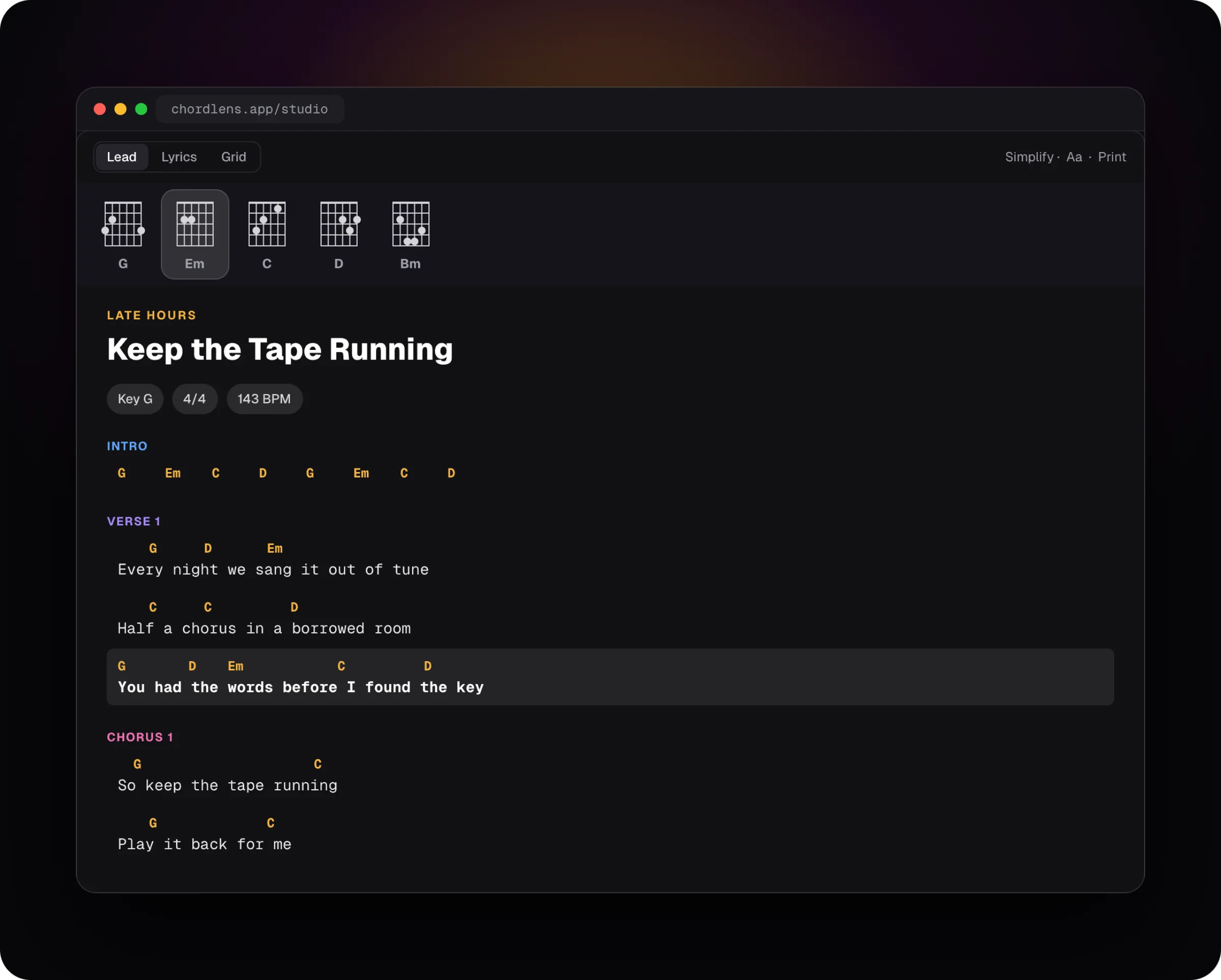
The words come with the song where it has lyrics, free on every plan, and the line being sung lights up as the song plays. For many songs that have no lyrics, Premium can write them.
04 / 10 · Your key
Your key.
Your range.
the band follows
- Key
- −2
- Move the song up or down, up to 12 semitones in the Studio or 6 in the extension. Every stem moves with it and every chord is re-spelled.
- Loop
- Bars 9–12
- Loop the line you’re learning and sing it until it sits.
- Speed
- 0.75×
- Slow the split song down, anywhere from half speed to double, to learn a fast verse. The pitch stays put.
A song written for a voice that isn’t yours? Take it down two semitones and the whole band comes down with you, not just a chord chart. Small moves sound cleanest: a step or two is hard to tell from the record, while a long way up or down on a dense mix sounds processed.
Turn on the metronome and it clicks on the song’s own beat, so you can count yourself in after a slow practice pass and keep time through a quiet bridge.
05 / 10 · On your computer
Split on your
own computer.
The split runs in your browser on your own computer, not in a queue somewhere. The first time, the Studio sets the splitting engine up: it downloads once, about 140 MB, and you see “Setting up splitting…” and then “Ready to split”. After that a song splits while you watch the progress, and the engine stays ready for the next one.
Splitting needs a computer, in Chrome or Edge, with the browser’s hardware acceleration on. Phones and tablets don’t give a web page enough memory to split a song, so on a phone you still get the chords, the words and the sections, but not the split.
06 / 10 · How clean
Clean enough to sing over.
Honest about the rest.
On most songs the voice comes away cleanly. A muted singer leaves the band intact, and an acapella is clear enough to hear the words and the harmonies.
Some songs are harder. A vocal drenched in reverb or echo leaves a trace in the other stems, backing voices can land in Other, and a choir or a crowd singing along is hard to pull apart from the lead. Old mono recordings and heavy distortion split less cleanly too. It’s a practice tool, not a studio master.
When you sing over it, a faint ghost of the original rarely matters: your own voice covers it. It shows most in a quiet bridge or an acapella of a busy chorus.
Still hear a ghost of the singer?
- Pick Karaoke: it mutes Other too, where a ghost vocal often hides.
- Sing louder than it. You’re practising over it, not mixing a record.
- Pull a neighbouring stem down a little instead of muting it.
- Try a studio version: live takes split less cleanly.
07 / 10 · Compared
Chord Lens vs
the other ways.
There are a few common ways to get a karaoke track or an acapella of a song you want to sing. Each has its place; here is where they differ.
| Upload-a-file removers | Karaoke versions | Audio editor | Chord Lens | |
|---|---|---|---|---|
| Any song, cover or live take | If you have the file | Only songs someone made one for | If you have the file | Yes, from your file |
| Words in time | Rarely | Usually | No | Yes, where the song has lyrics |
| Your key | Another app | Sometimes | Another app | Built in, ±12 semitones |
| Karaoke and acapella | Often both | Karaoke only | In an audio editor | Both, and a guide vocal |
| Works on phones | Some do | Yes | Rarely | Words yes, split no |
| Cost | Per file or subscription | Free with ads, or paid | Your time | Free to try |
A karaoke version made by hand is hard to beat when one exists for your song. Chord Lens is for every song that doesn’t have one: the cover you found last night, the live take you love, the song in a language the karaoke catalogue skipped.
08 / 10 · How singers use it
Four ways
singers use it.
Practise a song for a gig
Mute the vocal, move the key to your range, loop the bridge.
Learn the harmony
Keep the vocals only and hear the backing parts the lead hides.
Play and sing
Mute the vocal and the guitar, and accompany yourself from the chords.
Karaoke night
Any song you have as a file, the band without the singer, words on screen.
Worship teams use it to learn a new song in the key their singer needs. Teachers use the acapella to show a student how a phrase is shaped, then the karaoke track for the student to try it. Choirs use Vocals only to pick out a harmony line, slowed down and looped.
09 / 10 · What it won’t do
What it
won’t do.
so you know before you split
Stem downloads, for your own study
On Free the backing track plays in Chord Lens. Premium downloads the stems as MP3 and Pro adds WAV, for your own personal study and practice, not to share or publish.
No split on phones
Splitting needs a computer. On a phone you still get the chords and the words.
No private videos
Private, age-restricted, members-only and removed videos can’t be opened.
Not a studio master
It’s made for practice: a trace of the singer is normal on some songs.
Chord Lens is for practising and studying a song yourself: learning the melody, working on your range, singing along. That kind of personal use is broadly considered fair use under US copyright law, with similar rules elsewhere. Stem downloads on Premium and Pro are for that same personal study, not to share, sell or publish. To publish a karaoke cover, use the original audio under YouTube’s licensing, or get a sync license.
10 / 10 · Plans
Free to try.
Free splits a 2-minute part of a song, the part you choose, a few times a day. Premium splits up to 8 minutes of a song and Pro up to 12; a longer song gets a window of that length, placed where you want it. Chords and the lyrics a song already has stay free on every plan, with no ads; key and speed are free in Chrome. Premium also writes lyrics for many songs that have none.
See plans and prices01How do I remove the vocals from a song?
Open the Chord Lens Studio on a computer, upload the song as an MP3, WAV or M4A file, and split it. Then press M on Vocals, or pick Karaoke, and the band plays on without the singer.
02Can I use Chord Lens on my own files, or only YouTube?
Both. The Chrome extension works right on the YouTube video you’re watching, listening to the song as it plays. To split stems, upload your own audio in the Studio (MP3, WAV or M4A, up to 50 MB). Premium exports stems as MP3 and Pro adds WAV, for your own study and practice.
03How do I make a karaoke track from a song?
Split the song, then pick Karaoke above the faders: it mutes the vocals and the Other stem, where backing voices usually sit. The words run in time on the chart while you sing.
04What’s the difference between karaoke and acapella?
Karaoke is the song without the singer, for you to sing over. Acapella is the singer without the song, the voice on its own. Chord Lens gives you both from one split.
05Can I keep only the vocals?
Yes. Pick Vocals only, or press S on Vocals, and you hear the voice alone, harmonies included.
06Can I change the key to fit my voice?
Yes. Move the key up to 12 semitones either way in the Studio, or 6 in the extension. The backing moves with it and every chord is re-spelled; a step or two sounds cleanest.
07Why can I still hear a little of the singer?
Some of a voice can bleed into another stem, most often Other, and reverb makes it harder to pull apart. Pick Karaoke to mute Other as well, pull a neighbouring stem down a little, or try a studio version of the song.
08Do the lyrics show while I sing?
Yes, where the song has lyrics: the line lights up as it’s sung, free on every plan. For many songs without lyrics, Premium can write them.
09Is it free?
Yes, to try. Free splits a 2-minute part of a song, the part you choose, a few times a day. Chords and the lyrics a song already has are free on every plan, with no ads; key and speed are free in Chrome and, once you sign in, in the Studio, for the whole song up to your plan’s song-length limit.
10How long a song can I use?
Free splits 2 minutes of a song, Premium up to 8 minutes and Pro up to 12. A longer song gets a window of that length, placed where you want it. Every plan also has a longest song it will open.
11Can I do it on my phone?
No. Splitting needs a computer, in Chrome or Edge, because phones and tablets don’t give a web page enough memory. On a phone you still get the chords and the words.
12Does it work on live versions and covers?
Yes. Chord Lens splits the recording you upload, so a cover or a live take splits the same way as a hit. Live recordings tend to leave more of the singer behind.
13Can I use my own files?
Yes, in the Studio: upload an MP3, WAV or M4A file (up to 50 MB) and it splits the same way, with chords.
14Can I save the karaoke track?
On Premium you can download the stems, or your mix with the vocals muted, as MP3 from the Studio, and Pro adds WAV. Downloads are for your own personal study and practice, not to share, sell or publish. On Free the backing track plays in Chord Lens.
15Is it legal to isolate stems from copyrighted music?
Practising and studying a song yourself (learning the melody, working on your range, singing along) is broadly considered fair use under US copyright law, and similar rules apply elsewhere. That is what Chord Lens is for. Stem downloads on Premium (MP3) and Pro (WAV) are for your own personal study only, not to share or publish. To publish a karaoke cover, use the original audio under YouTube’s licensing, or get a sync license.
16Is this different from the stem splitter?
It’s the same split. The stem splitter page is about all six stems; this page is about the vocals, for karaoke and acapella. Both open in the same Studio.
In short
The whole page
in four lines.
Vocals off or on.
Karaoke, acapella, or a quiet guide.
On your computer.
The split runs in your browser, nothing to install.
Words stay on.
The lyric line lights up as it’s sung.
Free to try.
A 2-minute part on Free; longer on Premium and Pro.