 Chord Lens
Start here · 01 of 06
HOW TO LEARN ANY SONG BY EAR. one short phrase at a time
The short answer
To learn a song by ear, work in short phrases. Loop a few seconds, slow it down without changing the pitch, sing the line until you can hum it alone, then find those notes on your instrument. Start with the melody or the bass, add the chords last, and play along with the record at full speed.
01 / 07 · START
Your ears already know the song.
Learning by ear means working a part out from the recording instead of reading it from a chart or a tab. It sounds like a gift some players are born with. It isn’t. It is a skill made of small, plain steps: hear a short bit, hold it in your head, find it on your instrument, check it against the record. Anyone who can hum a tune back can learn it.
You already do half of it. If you can sing the chorus of a song in the shower, you have the melody stored, note for note. The work is getting from “I can hum it” to “I can play it”, and that gap shrinks every song you do.
The payoff is bigger than one song. Players who learn by ear hear chord changes coming, keep their place when a singer goes off script, and pick up a new tune at a rehearsal without waiting for a chart. Charts and tabs are still useful. They just stop being the only way in.
The one thing that makes it hard is speed. Recorded music moves fast, and a phrase is gone before you’ve heard it twice. So the method below is mostly about slowing the song down and holding still the few seconds you’re working on.
02 / 07 · METHOD
Learn it in six steps.
This is the loop a teacher would walk you through. Run it on one phrase, then the next, and stitch them together.
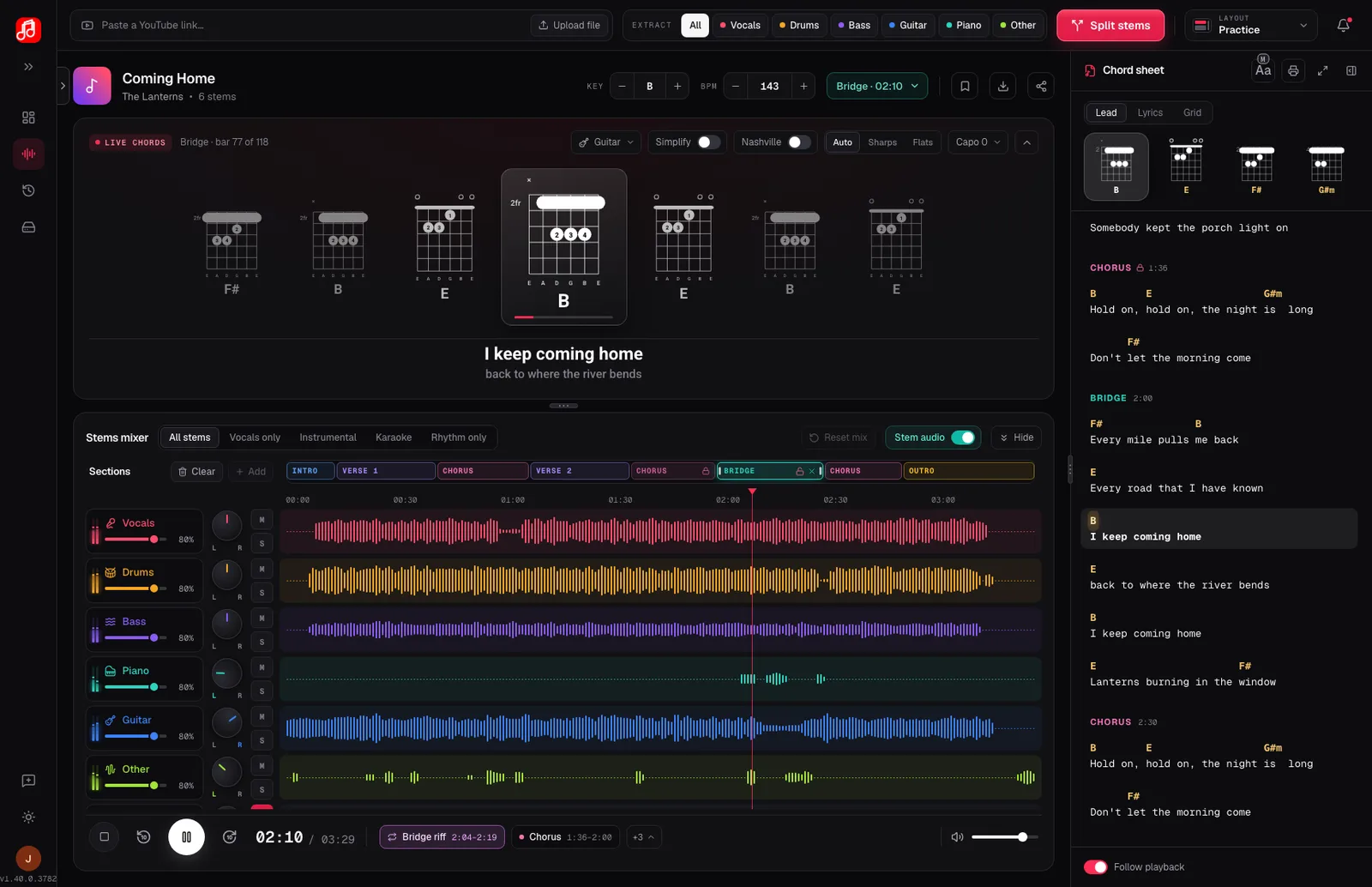
The bar in step 2 is short on purpose. Four seconds is about the most you can hold in your head clearly, and a loop that small comes round often enough that you hear it a dozen times in a minute. In the Chord Lens Studio you set a loop over the bars you’re on and save it, so the hard part is one click away next time. Free keeps 3 saved loops per song.
Step 3 matters more than it looks. Slowing a recording the old way, like a tape machine, also lowers its pitch, and then nothing on your instrument matches. The Studio’s BPM stepper slows the song anywhere down to half its tempo and keeps the pitch where the record has it, so a song in G is still in G at 0.75×. See Slow Down Songs for the details.
Listen to the whole song first
Two or three times, without your instrument. Notice the sections: intro, verse, chorus, bridge. You’ll learn it in that order later.
Loop one short phrase
Pick two to four seconds: one line of melody, one riff, one bar of the bass. Loop just that.
Slow it down
Drop the speed to 0.75×, or lower for a fast run. The pitch stays the same, so your instrument still matches.
Sing it back
Hum the phrase with the loop, then without it. If you can’t sing it alone yet, you haven’t heard it yet. Keep listening.
Find it on your instrument
Start from the first note. Try a fret or key, compare it with your voice, move up or down. Then the next note, and the next.
Bring it back to speed
Play along with the loop, raise the speed a step each time it’s clean, then join it to the phrase before.
03 / 07 · MELODY
Start with the line you can sing.
Begin with whatever you can already hum: the vocal melody, a guitar riff, the hook of an intro. A single line is far easier than a chord, because you only have to find one note at a time and your voice can check every one.
Find the first note by matching. Hum it, then play notes on your instrument until one sounds the same as your voice. You’ll often land a note too high or too low first; that’s useful, because now you know which way to move. After the first note, listen for direction. Does the next one go up or down? A small step or a jump? Most melodies move by step, so try the neighbouring notes first.
When a line is buried under the band, split the song into stems. The stem splitter gives you six: vocals, drums, bass, piano, guitar and everything else, each with its own mute and solo. Solo the guitar to learn a riff with nothing on top of it, or the vocals to hear every turn of the melody. The split runs in your browser on a computer; Free splits a 2-minute window of the song that you choose, which is plenty for one section.
Write down what you find, even roughly: note names, fret numbers, or the numbers of the scale. You will forget more than you think by tomorrow, and a scribbled line saves you working it out twice.
Stuck on one note? Sing it, then sing the note before it. The jump between them is easier to find than the note alone.
04 / 07 · CHORDS
Follow the bass to the chords.
Chords feel harder because several notes sound at once. The trick is to hear one of them clearly: the bass. In most pop, rock, folk and worship songs the bass plays the root of each chord on the beat where it changes. Find the bass note and you have the chord’s name, or very nearly.
So work in two passes. First, loop a section and follow the bass line, writing down each note where it changes. Soloing the bass stem makes this far easier. Second, for each bass note try the major chord and the minor chord built on it, and keep the one that sounds right against the record. A small handful of songs need more than that, and our guide on how to find the chords of a song covers sevenths, slash chords and the rest.
It helps a lot to know the key first, because a key narrows the likely chords down to about six. Finding the key of a song takes a few minutes by ear, and the Studio shows it above the chart as soon as a song is open.
05 / 07 · PRACTICE
Little and often beats once and long.
Ten minutes a day of ear work does more than an hour on Sunday. Your ear improves the way your hands do: with repetition and rest in between. Pick songs you like, keep sessions short, and finish each one with something you can play.
Choose songs that help. Clear recordings with a steady beat and a few chords are the easiest place to start; many folk, pop and worship songs are perfect. Save dense jazz, heavy distortion and muddy live takes for later. They are harder for everyone, people and software alike.
Check yourself against the record, not against a chart. Play along at full speed and listen: if your part sits inside the band, you have it. If something rubs, loop that bar and find the note that’s off. Learning by ear is mostly the habit of checking with your ears.
Use help without leaning on it. Reading the chords from YouTube to Chords after you’ve tried a section yourself is a good way to check your work and learn what you missed. Reading them first and never trying is how you stay dependent on charts.
06 / 07 · Do it in one click
Slow Down Songs
Slow the song, keep the pitch, and loop the bars you’re learning, with the chords in time.
01Can anyone learn songs by ear?
Yes. If you can hum a tune back, you can learn it by ear. It is a skill built from short, repeated steps, and it gets faster with every song.
02Do I need perfect pitch?
No. Almost every player who learns by ear uses relative pitch: hearing whether the next note goes up or down, and by how much. That comes with practice.
03What should I learn first, melody or chords?
The melody or a riff. A single line can be checked note by note with your voice. Then follow the bass to the chords.
04How slow should I go?
Start at 0.75×. Go to half speed for a fast run, then step it back up as it gets clean. In the Studio the pitch stays the same at every speed.
05Does slowing a song down change its key?
Not in Chord Lens. The song is stretched in time and every note stays where it was, so the chords you play still match the record.
06How do I hear the bass or the guitar on its own?
Split the song into stems in the Studio and solo the part you want. Splitting needs a computer; Free splits a 2-minute window of each song that you choose.
07How long does it take to learn a song by ear?
A simple song with a few chords can take an evening the first time and minutes once your ear is trained. Work phrase by phrase and it adds up quickly.