 Chord Lens
Chords and keys · 03 of 07
HOW TO TRANSPOSE CHORDS. count the steps, move them all
The short answer
To transpose chords, count how many semitones the new key is from the old one, then move every chord root by that same number, keeping each chord’s quality. G, C, D and Em up two semitones become A, D, E and F♯m. Spell the result with the sharps or flats the new key uses.
01 / 08 · WHY
Same song, a better key.
Transposing means moving a whole song up or down to a new key, with every chord moved by the same amount. The song keeps its shape: the melody, the progression and the feel are all the same, just higher or lower.
There are three common reasons to do it. A singer needs it: a song written for one voice can sit too high or too low for another, and a step or two can make all the difference. A player needs it: a song in E♭ or B is full of barre chords on guitar, while the same song in D or G is open shapes. And a band needs it: songs in a set sound better when the keys flow, and a horn or a capo might want a particular key.
You don’t need much theory to transpose. You need the twelve notes in order and the ability to count. The method below works for any chord in any key.
02 / 08 · METHOD
Transpose in four steps.
All of Western music uses the same twelve notes, each a semitone (one fret on a guitar, one key on a piano, black keys included) from the next. After the twelfth note the cycle starts again:
C, C♯/D♭, D, D♯/E♭, E, F, F♯/G♭, G, G♯/A♭, A, A♯/B♭, B, then C again.
Note that there is no sharp between E and F, or between B and C. Those pairs are already a semitone apart. Most mistakes in transposing come from forgetting that.
Count the distance
Find the old key and the new key on the twelve-note list and count the semitones between them. G to A is 2 up; G to E is 3 down.
Move each root
Move the root of every chord by that same number. With 2 up: G → A, C → D, D → E, E → F♯.
Keep the quality
Whatever comes after the root stays: Em becomes F♯m, D7 becomes E7, Csus4 becomes Dsus4.
Move the bass too
A slash chord moves both notes. G/B up 2 becomes A/C♯.
03 / 08 · EXAMPLES
Three moves you’ll make often.
G to A, up 2 semitones. G, C, D, Em becomes A, D, E, F♯m. Common when a singer wants a song a little brighter.
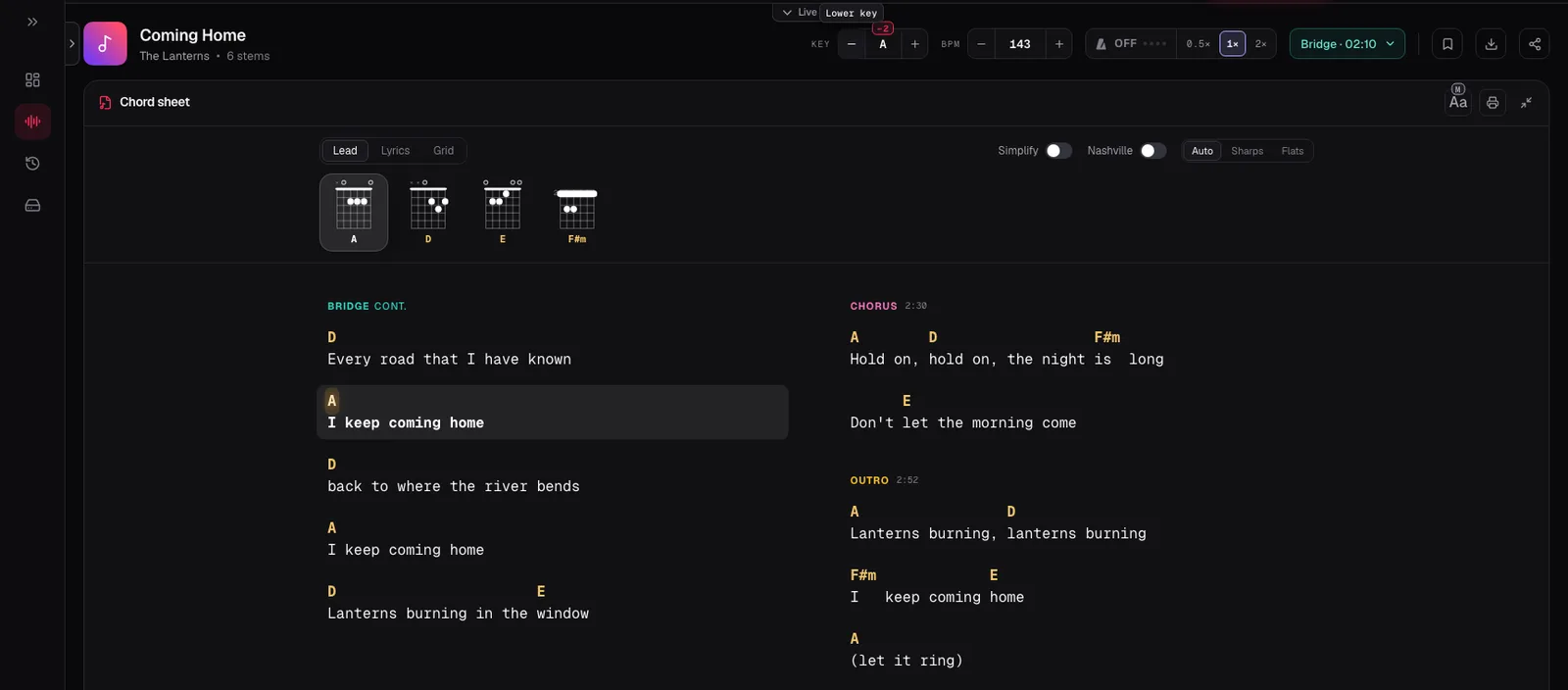
B to A, down 2 semitones. B, E, F♯, G♯m becomes A, D, E, F♯m. The screenshot shows exactly this: the Studio’s demo song is in B, and two clicks on the Key control’s minus move it to A, with every chord on the chart re-spelled.
E to G, up 3 semitones. E, B, C♯m, A becomes G, D, Em, C. A guitarist’s favourite move: four barre-heavy chords turn into four open ones.
Going down a long way? It can be easier to go up the other way. Moving down 5 semitones lands on the same note names as moving up 7, just an octave apart. For chord names, they’re the same.
04 / 08 · FOR SINGERS
Find the key that fits, then move.
If you’re transposing for a voice, the hard part is choosing the new key, not moving the chords. Sing the highest line of the song, usually the end of the chorus or the bridge, along with the record. If you strain, the key needs to come down. If the verses sit so low they mumble, it needs to come up.
Move one semitone at a time and sing that same line again. Most people find a key that suits them within two or three semitones of the original. Go too far and the song loses its character: a bright anthem dropped five semitones can sound sleepy.
Write the new key at the top of the chart once you’ve found it, so the band knows. And if the song changes key partway, move both keys by the same amount: a lift from G to A becomes a lift from F to G when you take the song down two.
05 / 08 · SPELLING
Spell it the way the key does.
Every black key has two names: C♯ is also D♭. After transposing you’ll often have to choose. The rule of thumb is to use the names the new key uses. Keys of G, D, A, E and B use sharps, so write F♯m and C♯m. Keys of F, B♭, E♭ and A♭ use flats, so write B♭ and E♭, not A♯ and D♯.
A good check: in a major key each letter A to G appears once in the scale. If your chart has both an A and an A♯ in a key that should have a B♭, you picked the wrong name.
Chord Lens spells chords for the key automatically when you move it, and you can override it: the chord sheet has Auto, Sharps and Flats.
Changing key changes the letters, never the numbers. A 1–4–5 stays a 1–4–5 in every key.
06 / 08 · SHORTCUTS
Let the capo or the Studio do the counting.
On guitar, ukulele or mandolin, a capo transposes for you. Each fret raises everything one semitone, so you keep the shapes you know and the sound moves up. Playing G shapes with a capo on the 2nd fret sounds in A. Our capo chart lists every fret and key.
In the Chord Lens Studio, Change Song Key does the whole job at once. Press plus or minus on the Key control and the song moves a semitone at a time, up to 12 either way. The recording moves with it, so you hear the new key while you play, and every chord on the chart and every shape above it is re-spelled. Set a capo in the chord panel on guitar, ukulele or mandolin and the shapes change to match while the key stays put.
If you think in numbers, the Nashville number system makes transposing almost free: the chart never changes, only the key at the top.
07 / 08 · Do it in one click
Change Song Key
Move a song up or down by semitones; the recording follows and every chord is re-spelled.
01How do I transpose chords up a step?
A whole step is two semitones. Move every chord root up two on the twelve-note list and keep each chord’s quality: G becomes A, Em becomes F♯m.
02How do I know how many semitones to move?
Count from the old key to the new one on the twelve notes. Remember there’s no sharp between E and F or between B and C.
03Do minor chords stay minor?
Yes. Transposing moves the root; the quality stays the same. Am up 2 is Bm, and Dm7 up 2 is Em7.
04Should I write sharps or flats?
Use the ones the new key uses. Sharp keys like D and A take sharps; flat keys like F and B♭ take flats.
05Can I use a capo instead?
On guitar, ukulele or mandolin, yes. Each fret raises the sound one semitone while you keep your shapes. A capo only moves up, though.
06How do I transpose a song for my voice?
Sing the highest line with the record. If you strain, move the key down a semitone and try again; if the low parts mumble, move it up. Most voices settle within two or three semitones.
07What is the difference between transposing and a key change?
Transposing moves the whole song, every chord by the same amount. A key change, or modulation, is a move written into the song itself, often a lift for the last chorus.
08Can Chord Lens transpose a song for me?
Yes. In the Studio, move the Key control up or down, up to 12 semitones either way. The recording moves with it and every chord is re-spelled.