 Chord Lens
Song key finder
Song key finder: the key and the BPM of any song
Drop in a file or open a YouTube video with the Chrome extension, and Chord Lens tells you the song’s key and its tempo in BPM, with the time signature when it was measured, before you press play.
Last updated
The short version
At a
glance.
key, tempo, time
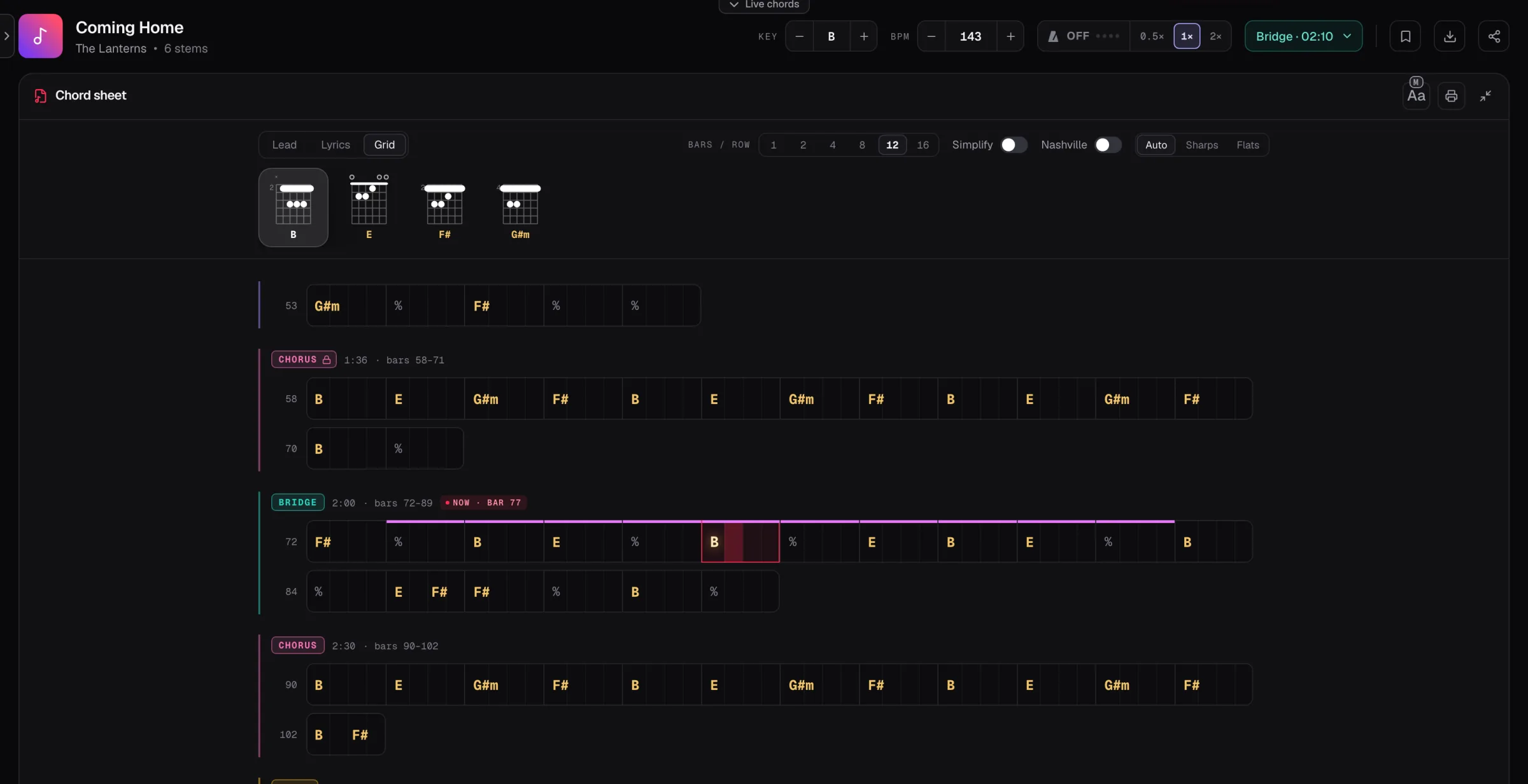
Chord Lens listens to a song, finds its chords and beats, and from them the key and the tempo in beats per minute, with the time signature when it was measured. You see them with the chart, and you can move the key or the tempo from there.
- The keymajor or minor, from the chords
- The tempoin BPM, from the song’s beats
- Time signature4/4, 3/4 and more, when measured
- Any songa YouTube video or your own file
- With the chordsthe whole chart, in that key
- Move the keythe chart re-spells itself
- Move the temposlower or faster, same pitch
- In Chrome toobeside the video on YouTube
- Free to startkey and BPM with every chart
01 / 10 · What it is
What key is it in?
Now you know.
Before you play along, sing it or set a capo, you need the key. Before you set a click or a loop, you need the tempo. A key database helps with famous songs, if its version is the one you hear.
Chord Lens works it out from the song itself. It finds the chords and the beats, then names the key and counts the tempo, for the exact recording you’re listening to.
Want to move the song to another key? That’s Change song key.
Key databases
A listed key and BPM, for the version someone else looked up.
This recording
The key and tempo of the song you’re playing, from its own chords and beats.
02 / 10 · How to
Find the key
in four steps.
nothing to install
Open the Studio
Go to chordlens.app/studio and sign in with Google.
Drop in a file
An MP3, WAV or M4A from your computer, up to 50 MB.
Read the key and BPM
They sit at the top of the song, with the chart below.
Play in it
Change the key or the tempo, or loop a part.
Watching on YouTube? The Chrome extension shows the key and BPM beside the video.
Get the extension03 / 10 · What you get
Key, tempo
and time.
One song gives you the three things to play by, and the chart that goes with them.
- Key
- BPM
- Time signature
- Chords
- Sections
- Beats
The key
Root and major or minor, worked out from the song’s chords.
The tempo
Beats per minute, from the beats Chord Lens tracks.
The time signature
Beats per bar, shown when it was measured.
04 / 10 · Move it
Found it.
Now move it.
same song, your way
- Key
- +2
- Move the song up or down; the chords are re-spelled in the new key.
- Tempo
- 0.75×
- Slow it down to learn it, without changing the pitch.
- Capo
- Capo 2
- Play the new key with the shapes you already know.
05 / 10 · Where
On YouTube
or in the Studio.
In Chrome, the Chord Lens extension shows the key and BPM beside a YouTube video. In the Studio, on the web or in the Mac app, they head the chart of your own file. Key and speed are free in Chrome and, once you sign in, in the Studio, for the whole song up to your plan’s song-length limit.
06 / 10 · How accurate
Right on most songs.
Honest about the rest.
Songs with a clear band and steady harmony get the right key most of the time. The tempo comes from the beats, so a steady groove helps.
The key is a best guess from the chords, and a song gets one key: a song that changes key shows its main one. A tempo that drifts, or a song with no clear beat, is harder.
The key looks wrong?
- Read the chart: the first and last chords often name the key.
- Listen for a key change partway through.
- Loop a bar and listen at a slower speed.
- Try a cleaner recording of the same song.
07 / 10 · Compared
Chord Lens vs
key and BPM sites.
Three ways to find a song’s key and tempo, and where they differ.
| Key databases | Tap tempo | By ear | Chord Lens | |
|---|---|---|---|---|
| Works on any recording | Famous songs | Tempo only | Yes | Yes |
| Key | Listed | No | With practice | From the chords |
| Tempo (BPM) | Listed | Tap it | Count it | From the beats |
| Camelot, relative key | Often | No | — | No |
| Chords and sections too | No | No | No | Yes |
| Cost | Free, with ads | Free | Your time | Free to start |
08 / 10 · How players use it
Four ways
players use it.
Pick a capo
Know the key, then pick the capo that suits your voice.
Set the band’s click
Know the tempo before rehearsal starts.
Plan a set
Line up songs by key and tempo.
Sing it in your key
Find the key, then move it to fit your voice.
09 / 10 · What it won’t do
What it
won’t do.
so you know before you start
No Camelot or relative key
Keys are named by letter, not by Camelot code.
One key per song
A song that changes key shows its main key.
No tap tempo
The tempo comes from the song, not from tapping.
No confidence score
It shows its best guess, not how sure it is.
10 / 10 · Plans
Free to start.
Key and BPM come with every chart, Free included. Signing in is free; Free has a set number of new songs each month, and Premium and Pro have more. Key and speed are free in Chrome and, once you sign in, in the Studio, for the whole song up to your plan’s song-length limit.
See plans and prices01How do I find the key of a song?
Open the Chord Lens Studio and drop in an MP3, WAV or M4A file. The key and the tempo in BPM show at the top of the song, with its chords in time below.
02How do I find the BPM of a song?
The same way: open the song in the Studio, or a YouTube video with the Chrome extension. The tempo shows in BPM beside the key, counted from the beats Chord Lens tracks through the song.
03Does it show the time signature?
When it was measured. A song whose time signature was measured, such as 3/4 or 6/8, shows it with the key and BPM at the top of the sheet. Otherwise the song is counted in four and no time signature is shown, rather than a guess.
04How does it work out the key?
From the chords. Chord Lens finds the song’s chords first, weighs how long each of their notes sounds across the whole recording, and names the major or minor key that fits it best.
05How accurate is it?
Songs with a clear band and steady harmony get the right key most of the time. The tempo comes from the beats, so a steady groove helps; a tempo that drifts, or a song with no clear beat, is harder. Check it by ear.
06What if the song changes key?
It shows one key for the whole song: the key the whole recording sounds most like. The chart shows the chords where the song moves, so you can hear the change yourself.
07Does it show the Camelot key?
No. Keys are named by letter, such as B or Em, not by Camelot code.
08Does it show the relative minor or major?
No. It names the one key it found, major or minor, and not its relative.
09Can I tap the tempo?
No. The tempo comes from the song’s own beats, so there is nothing to tap.
10Does it work on my own files?
Yes. Sign in and drop an MP3, WAV or M4A into the Studio or the Mac app; the key and BPM come with its chords.
11Does it work on YouTube?
Yes. Open the video in Chrome with the Chord Lens extension, which shows the key and BPM beside it.
12Is it free?
Yes, to start. The key and BPM come with every chart, Free included; Free has a set number of new songs each month, and Premium and Pro have more. Key and speed are free in Chrome and, once you sign in, in the Studio, for the whole song up to your plan’s song-length limit.
13Can I change the key once I’ve found it?
Yes. Move the key up or down and every chord on the chart is re-spelled in the new key, with a capo to match. Key and speed are free in Chrome and, once you sign in, in the Studio, for the whole song up to your plan’s song-length limit.
14Can I slow the song down?
Yes. Step the tempo down and the song plays slower at the same pitch, with the chords still in time. Key and speed are free in Chrome and, once you sign in, in the Studio, for the whole song up to your plan’s song-length limit.
15Is this different from Change song key?
Yes. This page is about finding the key and the tempo a song is in. To move it to another key, with the capo to match, use Change song key.
In short
The whole page
in four lines.
Any song.
A YouTube video or your own file.
Its key.
From the chords, major or minor.
Its tempo.
In BPM, with the time signature when measured.
Free to start.
Key and BPM with every chart.