 Chord Lens
Chords and keys · 04 of 07
CAPO CHART: THE KEY YOU’RE REALLY IN. shapes you know, any key you need
The short answer
Each capo fret raises the sound one semitone while you keep your shapes. Add the fret number to the shape’s key: G shapes with a capo on 2 sound in A, C shapes on 3 sound in E♭, D shapes on 2 sound in E. To play in a key, pick a shape key below it and capo the difference.
01 / 06 · HOW IT WORKS
One fret, one semitone.
A capo clamps across the strings and acts like a new nut. Everything you play sounds one semitone higher for every fret it moves. Your fingers still make a G shape, so a chart might call it G, but the sound is higher: with the capo on the 2nd fret it’s an A.
That gives you two names for every chord: the shape you play and the chord that sounds. Players talk about both, and mixing them up is the most common capo mistake. If a singer asks for the song in A, they mean the sound. If a chart says “Capo 2, G”, it means the shape.
The chart below goes up to the 7th fret. Above that the neck gets cramped, and most players reach for a different shape instead. The same chart works for ukulele and mandolin shapes: the arithmetic is the same on any fretted instrument.
02 / 06 · THE CHART
Shape plus fret equals key.
Find the shapes you’re playing on the left, then read along to the fret. The note you land on is the key you sound in. Each fret is one semitone higher than the one before.
C shapes: capo 1 = C♯/D♭, 2 = D, 3 = E♭, 4 = E, 5 = F, 6 = F♯, 7 = G.
A shapes: capo 1 = B♭, 2 = B, 3 = C, 4 = C♯/D♭, 5 = D, 6 = E♭, 7 = E.
G shapes: capo 1 = A♭, 2 = A, 3 = B♭, 4 = B, 5 = C, 6 = C♯/D♭, 7 = D.
E shapes: capo 1 = F, 2 = F♯, 3 = G, 4 = A♭, 5 = A, 6 = B♭, 7 = B.
D shapes: capo 1 = E♭, 2 = E, 3 = F, 4 = F♯, 5 = G, 6 = A♭, 7 = A.
Minor keys work the same way from the minor shape. Am shapes with a capo on 2 sound in Bm; Em shapes on 2 sound in F♯m; Dm shapes on 3 sound in Fm.
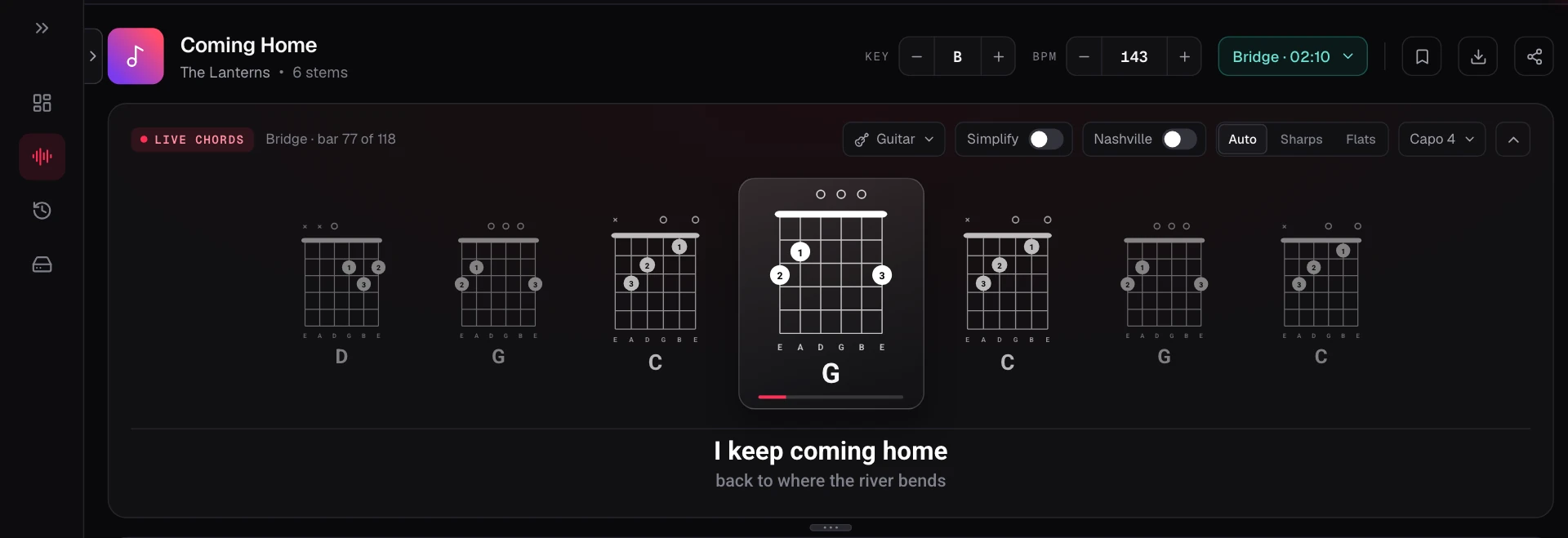
Every chord in the song moves together. In G shapes with a capo on 4, the G, C, D and Em you’re fretting sound as B, E, F♯ and G♯m. The screenshot shows this in the Studio: the song stays in B, and the shapes become G, C, D and Em.
03 / 06 · BACKWARDS
Need a key? Here’s where to put it.
Most of the time you know the key you need and want the easiest way to play it. Read the chart backwards: pick a shape key a few semitones below and capo the difference.
A: G shapes, capo 2. B: A shapes, capo 2, or G shapes, capo 4. B♭: A shapes, capo 1, or G shapes, capo 3. E♭: D shapes, capo 1, or C shapes, capo 3. F: E shapes, capo 1, D shapes, capo 3, or C shapes, capo 5. F♯: E shapes, capo 2, or D shapes, capo 4. A♭: G shapes, capo 1, or E shapes, capo 4. C♯/D♭: C shapes, capo 1, or A shapes, capo 4.
When there are two choices, the lower capo keeps more of the guitar’s low end; the higher one sounds brighter and more like a mandolin. Two guitars often play the same song in different shapes, one open and one capoed high, so they don’t blur together.
A capo only moves up. To play lower than the shapes you know, change shape key instead.
04 / 06 · IN THE STUDIO
Set the capo, read the shapes.
In the Chord Lens Studio, pick guitar, ukulele or mandolin in the live chords panel and set a capo from 0 to 9. The song stays in its key, and every shape on the chart changes to the one you play with that capo, so you can see which fret gives you open chords. On a phone, the Studio’s Instrument sheet suggests the capo that turns the most of a song’s chords into open shapes.
Want the song in another key as well? Change Song Key moves the recording and the chart, and the capo shapes follow. Our guide on how to transpose chords explains the arithmetic, and how to find the key of a song tells you where you’re starting from.
05 / 06 · Do it in one click
Change Song Key
Move the song into your key and set a capo; the chart shows the shapes to play.
01What key is capo 2 with G shapes?
A. Each fret adds a semitone, and A is two semitones above G.
02What key is capo 3 with C shapes?
E♭. C up three semitones is C♯, D, E♭.
03How do I play in B without barre chords?
Use A shapes with a capo on 2, or G shapes with a capo on 4.
04Does a capo change the chord names?
It changes the sound, not the shape. A chart may name the shape (G) or the sound (A); check which one it means.
05Can I use a capo to go down a key?
No. A capo only raises the pitch. To go lower, use a lower shape key, or tune down.
06Does Chord Lens show capo shapes?
Yes. On guitar, ukulele or mandolin, set a capo from 0 to 9 in the Studio and the chart shows the shapes for that fret, with the song still in its key.