 Chord Lens
Chords and keys · 05 of 07
MAJOR OR MINOR? HEARING THE DIFFERENCE IN A KEY. it’s all in the third
The short answer
A major key sounds bright because its third note is the major third, four semitones above home; a minor key sounds darker because its third is the minor third, three semitones up. To hear which a song is in, find the chord it rests on at the end, play it major and minor, and keep the one that fits.
01 / 08 · THE DIFFERENCE
One note makes the difference.
Every key has a home: a note and a chord the music keeps returning to and settles on. Call it the tonic. Whether the key is major or minor depends on what sits a third above that home note.
In a major key, the third is four semitones above the tonic. In C major that is E: count C, C♯, D, D♯, E. In a minor key, the third is three semitones up. In C minor that is E♭. Play C and E together, then C and E♭, and you hear the whole difference in two notes: the first sounds open and settled, the second darker and more tense.
The same note decides the chords. A major chord is the root, the major third and the fifth: C E G. A minor chord is the root, the minor third and the fifth: C E♭ G. The fifth doesn’t move; only the middle note does. So the tonic chord of a major key is a major chord, and the tonic chord of a minor key is a minor chord.
The scales differ in more places than the third. The major scale climbs in steps of whole, whole, half, whole, whole, whole, half. The natural minor goes whole, half, whole, whole, half, whole, whole, which also lowers the sixth and the seventh. But the third is the one your ear grabs first, and it is the one to test.
02 / 08 · METHOD
Hear major or minor in five steps.
You don’t need to name intervals to do this. You need a song, your instrument, and a few minutes of stopping and starting.
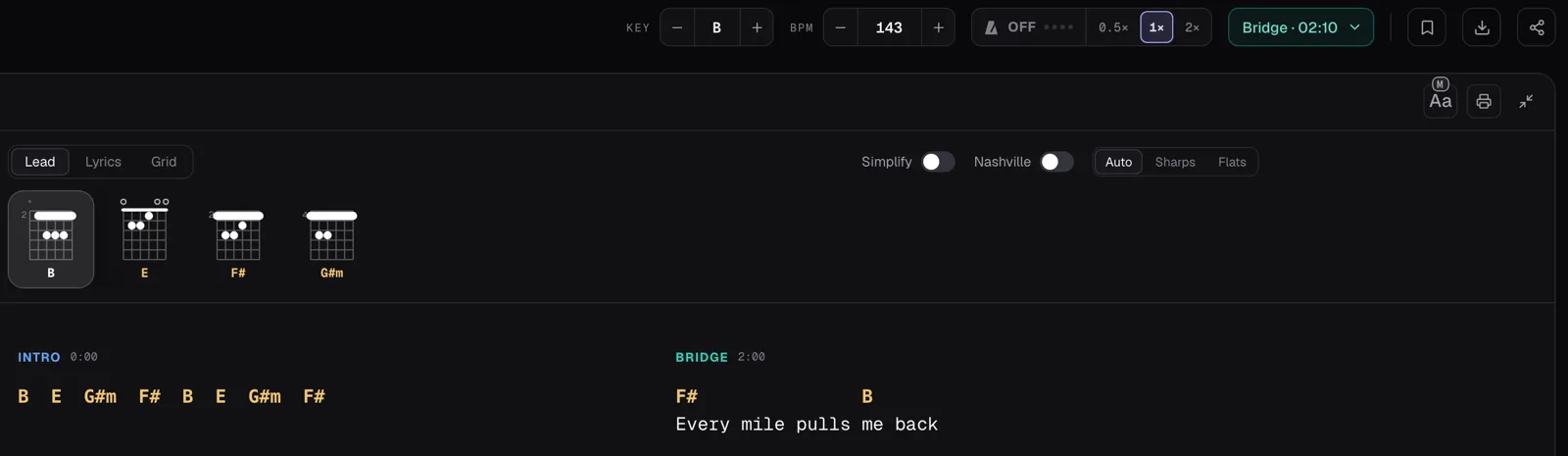
In the screenshot the demo song Coming Home reads B in the Key control, which means B major: Chord Lens writes a minor key with an m, as in G♯m. Its four chords are B, E, G♯m and F♯. Three are major and one is minor, and that minor chord is G♯m, the relative minor of B, built on the sixth note of the scale.
Find home
Play the song and stop at the end of a chorus or the final bar. Hum the note that sounds finished. That is your tonic.
Find the chord on it
Look at the chord the song ends on or keeps landing on. Its root is usually the note you hummed.
Play it both ways
Play a major chord on that note, then a minor one, over the recording. One blends in; the other clashes.
Check the third
Sing the tonic, then the note three or four semitones above it. The one that matches the melody tells you major or minor.
Rule out the relative
If you are torn between a major key and the minor key three semitones below it, ask which chord the song comes to rest on.
03 / 08 · RELATIVE KEYS
Same notes, different home.
Here is what makes the question hard. Every major key shares all seven of its notes with one minor key, its relative minor, whose tonic sits three semitones lower. C major and A minor use the same white keys on a piano. B major and G♯ minor share the same five sharps. Same notes, same key signature, same chords. The only difference is which chord feels like home.
That is why reading a key signature, or counting sharps in a chart, can’t settle it. A song that uses C, F, G and Am could be in either key. The test is where it rests. If the chorus resolves to C and the last chord is C, it’s C major with Am as a colour chord. If phrases keep sinking back to Am and the song ends there, it’s A minor.
The four-chord loop shows this well. Am, F, C, G and C, G, Am, F are the same four chords in a different order. Start and end on Am, lean on it, and the loop sounds minor. Start on C and come back to C, and the very same chords sound major. Many pop songs sit right on that line, and musicians argue about them for exactly that reason.
There is also the parallel minor: the minor key on the same tonic. C major and C minor share a home note but not a key signature: C minor has three flats. Songs borrow from the parallel key all the time. A major-key song that drops in a chord from its parallel minor, such as an F minor chord in C major, still sounds major overall. Judge the key by the whole song, not one bar.
Stop the track on the last chord and hold it. Your ear has no doubt about home when the music stops there.
04 / 08 · BY THE CHORDS
The chords give it away too.
If you have the chord chart, you can check by counting. A major key builds major chords on its first, fourth and fifth notes, and minor chords on its second, third and sixth. In C major that is C, F and G major; Dm, Em and Am minor; and B diminished on the seventh. Most major-key songs lean on the three major chords and use one or two minor ones for colour.
A minor key turns that around. Its chords on the first, fourth and fifth notes are minor: in A minor, Am, Dm and Em. Its chords on the third, sixth and seventh are major: C, F and G. So a minor-key song leans on minor chords, and the major ones feel like a lift away from home.
Watch for one exception. Minor-key songs very often play the fifth chord as a major chord, E instead of Em in A minor, because the raised seventh (G♯ here) pulls so strongly back to the tonic. That comes from the harmonic minor scale. So a song in A minor with an E major chord in it is still in A minor; if anything, that E makes it more certain.
Coming Home shows the major pattern. B, E and F♯ are the first, fourth and fifth chords of B major, all major. G♯m, the one minor chord, is the sixth: the relative minor showing up for colour, as it does in a great many songs. Turn on Nashville in the Studio and the same chords read 1, 4, 5 and 6m, which makes the pattern plain.
05 / 08 · CHECK IT
Let the key finder check your ear.
When you have made your call, check it. Open the song in the Chord Lens Studio and the Song Key Finder names the key above the chart: a letter for a major key, a letter with an m for a minor one, such as B or G♯m. It works this out from the chords it hears, weighing how long each of their notes sounds across the whole recording, and picks the major or minor key that fits best.
It names one key for the whole song and does not list the relative key beside it. So if your ear says A minor and the Studio says C major, you are looking at the relative pair, and the question goes back to your ear: where does the song come to rest? Songs that hover between the two are exactly where a person listening still decides best.
Once you know the key, the chart reads more clearly. Nashville numbers in the Studio count a minor key from its relative major, so Am in A minor reads 6m: the same numbers as the major key, with home on the sixth. Our Nashville number system guide explains why, and common chord progressions shows the patterns major and minor songs share.
And if the key is right but too high or low for you, move it. The Key control takes the whole song up or down a semitone at a time. A minor song stays minor wherever you move it; only the home note changes.
06 / 08 · MYTHS
Major isn’t happy, minor isn’t sad.
The happy and sad labels are a starting point, not a rule. Plenty of bright dance tracks are in minor keys, carried by tempo and groove. Plenty of heartbreaking ballads are in major, where the words and a slow tempo do the work. If you go by mood alone you’ll get some songs wrong.
Listen for home and for the third instead. Mood follows from many things: tempo, rhythm, the singer, the arrangement. The key is just the set of notes and the one the song calls home. A song that sounds sad but lands on a major chord is in a major key, sad or not.
07 / 08 · Do it in one click
Song Key Finder
Paste a YouTube link or drop in a file: the key, major or minor, and the BPM sit above the chords.
01What is the difference between a major and a minor key?
The third note above home. A major key has the major third, four semitones up; a minor key has the minor third, three up. The minor scale also lowers the sixth and seventh.
02How can I tell if a song is major or minor by ear?
Find the chord the song ends on or keeps resting on, then play it major and minor over the recording. The one that blends in tells you the key.
03What is a relative minor?
The minor key that shares all seven notes with a major key. Its home note is three semitones below the major one: A minor for C major, G♯ minor for B major.
04Why does a minor song have a major chord on the fifth?
It raises the seventh note so it pulls back to home more strongly. In A minor that turns Em into E. It comes from the harmonic minor scale and is very common.
05Does Chord Lens say whether a song is major or minor?
Yes. The key above the chart is a letter for major and a letter with an m for minor, such as B or G♯m, worked out from the song’s chords.
06Why does the key finder say major when I hear minor?
You are probably hearing the relative key, which shares every note. Chord Lens names one key per song; decide by where the song comes to rest.
07Are minor keys always sad?
No. Tempo, rhythm and words shape the mood as much as the key. Plenty of upbeat songs are in minor keys and plenty of sad ones in major.