 Chord Lens
Voice and karaoke · 01 of 04
HOW TO FIND THE BEST KEY FOR YOUR VOICE. sing the top line, then step the key
The short answer
To find the best key for your voice, sing the highest and the lowest lines of the song along with the record. If the top strains, move the key down a semitone and sing them again; if the bottom mumbles, move it up. Stop at the key where both ends feel easy, then write it down.
01 / 08 · WHY
The key decides where the song sits in your voice.
Every song is written for somebody’s voice, and it is rarely yours. The singer on the record picked a key that shows off the top of their range. Sing it in that key and you may be reaching for the chorus, or growling through verses that sit below where you speak. Neither is a lack of talent. The song is simply in the wrong place for you.
Moving the key fixes that without changing the song. Transposing shifts every note by the same amount, so the tune, the rhythm and the chords keep their shape. Only the height changes. One step of key is one semitone, the smallest step in Western music, and most singers find their key within a few of them.
Your range is every note you can make. What matters more for a song is the part of it you can sing for three minutes without tiring, sometimes called your comfortable range or tessitura. Choir books give rough spans, such as C3 to C5 for a tenor or F3 to F5 for an alto, but labels only get you close. Your own comfortable span, found by singing, is the number that counts.
So the job is not to find the highest key you can survive. It is to find the key where the song spends most of its time in the part of your voice that sounds best, with the highest note still in reach on a tired night.
02 / 08 · METHOD
Find your key in six steps.
You don’t need a piano, a tuner or any theory for this. You need the song, a way to move its key, and your ears. Singing along with the real recording is the most honest test there is, because the band shows you exactly where each note sits.
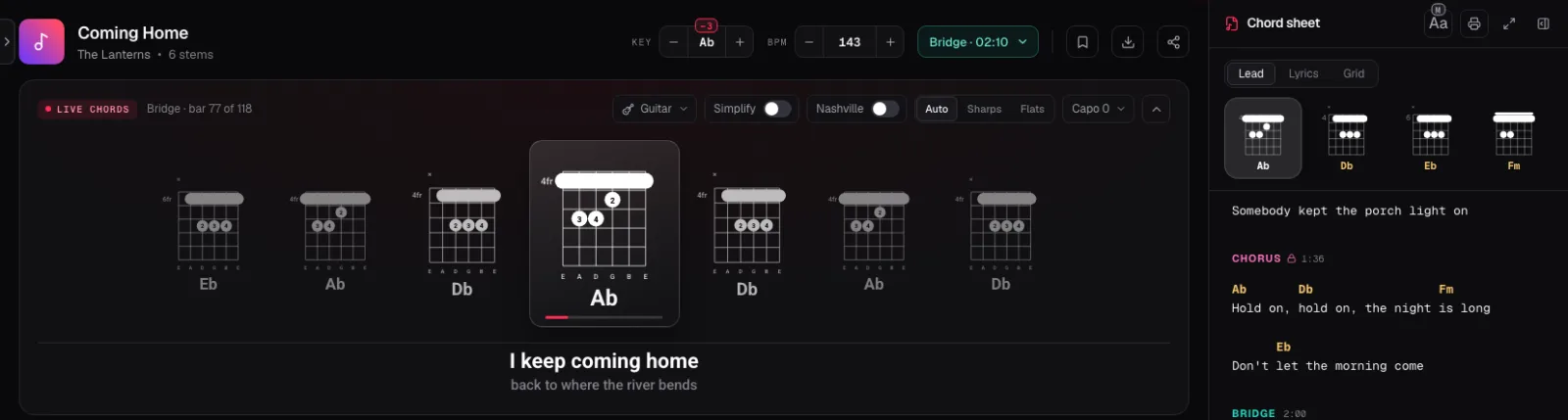
In the Chord Lens Studio, paste the song’s YouTube link or bring a file, and the Change Song Key control sits next to the BPM at the top. Each press of minus or plus moves the whole recording a semitone, up to 12 either way, and the tempo stays where it was. In the screenshot the demo song, in B, has been taken three semitones down to A♭: the key shows a −3 badge, and the chord shapes and the chart are re-spelled for the new key while the words run in time.
Find the highest line
Listen through once and mark the part that goes highest. It is usually the end of the chorus, the bridge, or the last chorus if the song lifts.
Find the lowest line
Then find the lowest part, often the start of a verse. Loop both so you can jump straight to them.
Sing both with the record
Sing each line along with the original key at full voice, the way you would perform it. Notice which end gives you trouble, if either does.
Step the key one semitone
If the top strains, press minus once. If the bottom is mumbled or breathy, press plus once. Move one step at a time, never several at once.
Sing both lines again
After every step, sing the high line and the low line again. Stop when the top feels like singing rather than reaching and the bottom still carries.
Sing the whole song
Run the song top to bottom in the new key. If a middle section feels wrong, adjust by one more step and run it again, then write the key down.
03 / 08 · LISTEN
Listen for strain at the top and mumble at the bottom.
A key that is too high tells you quickly. Your throat tightens, your chin lifts, the top notes come out thin or flat, and you start pushing volume to get there. You might manage it once at the start of a practice. You won’t manage it in the last chorus, which is where most songs put their highest note.
A key that is too low is quieter about it. The verses sound breathy or swallowed, you lose words under the band, and you can’t lean into the line. Low notes rarely hurt, so it is easy to miss. Record yourself on your phone and listen back: if the verses sound like you are talking to yourself, the key wants to come up.
Judge the whole song, not one note. A song with a single high note in the bridge and everything else low can stay where it is if you can land that one note cleanly. A song that sits high for the whole chorus needs to come down even if each note is technically in your range, because you will tire long before the end.
When two keys both feel fine, pick the higher one for energy and the lower one for a long set or a cold voice. Many singers settle a semitone below the key that felt best in a fresh, warmed-up practice, because performance nerves and long nights pull the top down.
Sing the highest line three times in a row. If the third one is still easy, the key is right.
04 / 08 · OTHER VOICES
Songs written for a different voice.
Higher and lower voices often sing the same song an octave apart. Note names repeat every twelve semitones, so a man singing a song recorded by a high female voice usually takes it an octave down without thinking about it. The trouble is that a whole octave can drop the verses below where he can be heard. The fix is to start from that octave-down version and move the key up a few semitones until the verses carry again.
The same works in reverse. A lower female voice singing a song recorded by a high male voice often finds the original octave sits fine in the chorus and too low in the verses, or too high everywhere. Step it, sing the two test lines, and trust what you hear over what the song is “supposed” to be.
Big moves have a cost. Every step away from the original changes the sound of the recording a little: a semitone or two is hard to tell from the record, while five or more can make the band sound thinner going up or heavier going down. When you need a big move, go the shorter way round. Moving up 5 semitones lands on the same key as moving down 7, an octave apart, so try both and keep the one that sounds closer to the song.
Some songs lose their character in a new key. A bright anthem dropped a long way can sound sleepy, and a low ballad pushed up can sound strained. If the only key that fits you robs the song of its feel, that is worth knowing too: some songs are better left for a different voice.
05 / 08 · PLAYING
Make the new key easy to play.
If you accompany yourself, the key you sing best in may not be a friendly key to play in. A song moved to A♭ or E♭ is full of barre chords on guitar. A capo solves this: each fret raises the sound one semitone, so you can keep simple open shapes and still sound in your key. In the Studio, pick your instrument in the live chords panel and set a capo, up to fret 9 on guitar, ukulele or mandolin, and the shapes change to match while the song stays in the key you chose. Our capo chart lists every combination.
Every chord on the chart is re-spelled when you move the key, so what you read matches what you hear: sharps in sharp keys, flats in flat keys. If you are writing the chart out for someone else, our guide on how to transpose chords shows the counting by hand.
Playing with a band? Tell them the key in plain terms, “we’re doing it in G, two down from the record”, and write it at the top of the chart. If the song changes key partway through, move that change by the same amount so the lift still lands where it should.
Under a YouTube video, the Chord Lens Chrome extension moves the key up to 6 semitones either way, which covers most voices, with the chords beside the video. The Studio goes to 12 and moves split stems with it, so you can mute the singer and hear only the band in your key.
06 / 08 · PRACTICE
Practise in the key you will perform.
Once you have a key, rehearse in it from then on. Your muscles learn the exact height of each note, and switching back to the original key for “just one run” undoes some of that work. If you want to sing along with the record for fun, fine, but do your real practice in your key.
Your voice changes through the day. Most people are lower and rougher first thing in the morning and freer in the evening. Test a new key when your voice is warmed up but not tired, and if you sing at a particular time of day, check it then too.
Keep a list of your songs and their keys. It sounds like admin, but it saves the same ten minutes of testing every time you come back to a song, and it shows you patterns. Many singers find most of their songs settle in the same few keys, which tells you a lot about where your voice lives.
When you are ready to sing the whole thing over a backing, take the singer out. Our guide on how to make a karaoke version of a song splits the recording and mutes the voices, and the key you found here carries straight over.
07 / 08 · Do it in one click
Change Song Key
Step the song up or down a semitone at a time, at the same speed, until it fits your voice.
01How do I find the best key for my voice?
Sing the highest and lowest lines of the song with the record. Move the key down a semitone when the top strains, or up when the bottom mumbles, and stop where both ends feel easy.
02Do I need to know my vocal range first?
No. Knowing it helps, but singing the song’s two extreme lines in each key tells you more than a range on paper, because it tests the song you actually want to sing.
03How many semitones should I move a song?
Most singers land within two or three semitones of the original. If you need five or more, try the other direction too: up 5 and down 7 reach the same key.
04Does changing the key change the speed?
Not in Chord Lens. The key and the speed are separate controls, so the song keeps its tempo and its length in any key.
05Should a man sing a woman’s song in a lower key?
Usually he sings it an octave down. If that leaves the verses too low to carry, move the key up a few semitones from there until they do.
06Can Chord Lens detect my voice and pick a key?
No. Chord Lens doesn’t listen to your voice. You find the key by ear, singing along while you step the Key control, which is also the most reliable way.
07How do I go back to the original key?
In the Studio, click the key between minus and plus and the song, the chart and the shapes return to the record’s key.