 Chord Lens
By instrument · 14 of 14
HOW TO PLAY BASS FROM CHORDS. the root is your first note
The short answer
To play bass from a chord chart, play the root of each chord first: the letter name, on the beat the chord starts. Once that holds, add the fifth, then the octave, then a note that leads into the next chord. Lock your rhythm to the kick drum, and read the slash note when a chord has one.
01 / 09 · WHY
A chord chart is a bass part in shorthand.
Most charts a band hands round never show a bass line. They show chord names over the words, or chord names in bars, and the guitarist and the keyboard player read them as shapes. That can leave a bassist feeling they have been given someone else’s part.
They haven’t. A chord name tells a bassist more than it tells anyone else, because its first letter is the note the whole band is built on. In a bar of E, the band is playing an E chord, and the lowest note it wants is E. Play that note, on the beat the chord arrives, and you are already doing the bass player’s main job: telling everyone which chord they are on.
Everything after that is decoration, added a step at a time. The fifth of the chord gives the line movement. The octave gives it lift. A note one step from the next root pulls the band into the change. None of it needs a written part, only the chart and an ear on the drummer.
This guide is about building a line from the chart. If the song has a famous bass line you want to copy note for note, our guide to learning bass lines by ear starts from the bass soloed instead.
02 / 09 · METHOD
Play bass from chords in five steps.
You need the chord chart in time with the song, so you always know which chord is next, and the band without its bassist, so you can hear your line in its place.
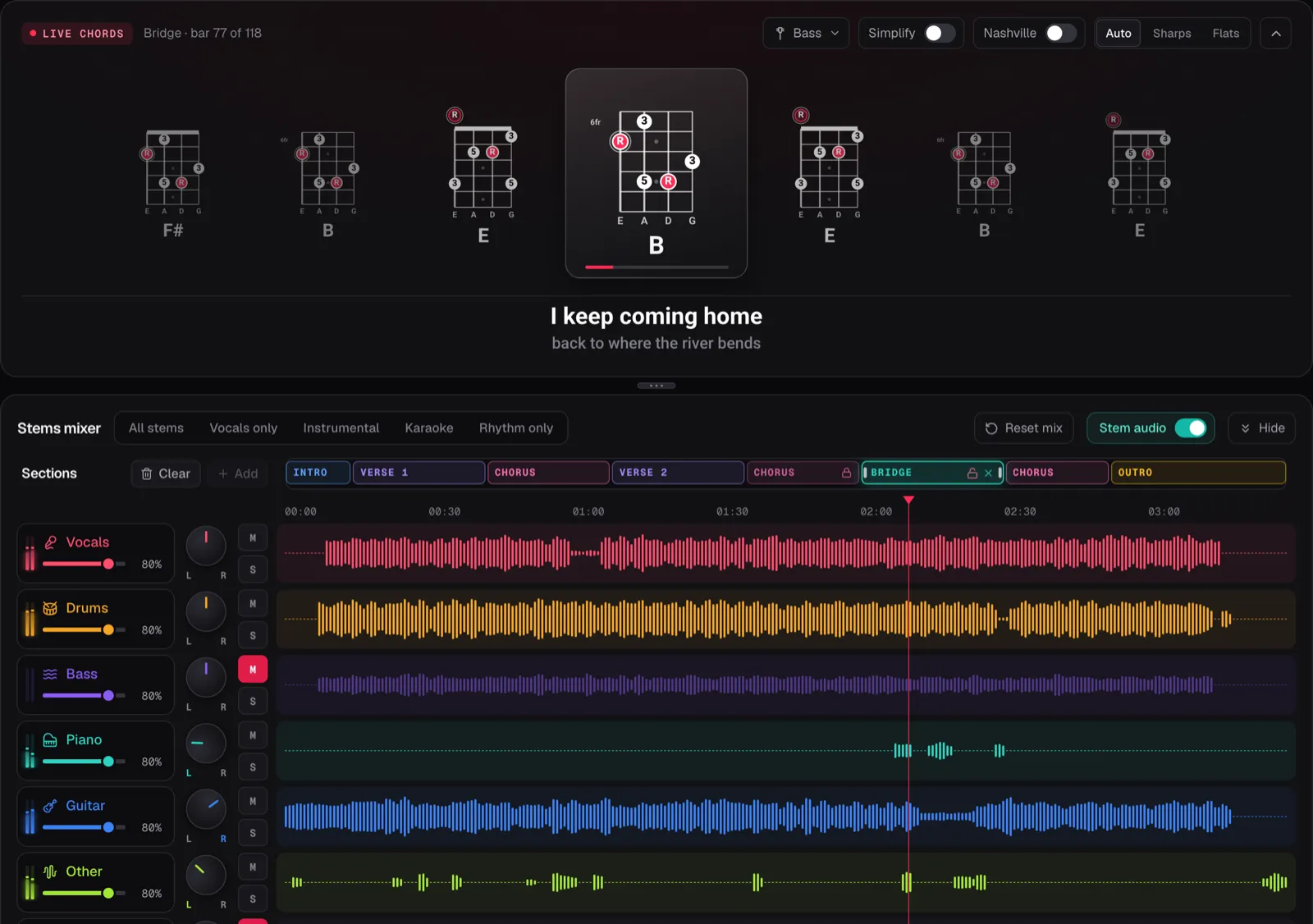
In the screenshot the demo song Coming Home, in Key B at 143 BPM, has its Live chords set to Bass. Each chord is drawn on a four-string neck, E A D G, with the note to start on ringed and every chord tone in reach named by its interval: R for the root, 3 and 5. Below, the M on the Bass row is lit, so the band plays on without the original bass.
Open the song
Paste the YouTube link into the Chord Lens Studio, or drop in an MP3, WAV or M4A file, and read the chords as they come.
Pick Bass
Set the Live chords instrument to Bass. Each chord shows where its root is on the neck, and the chord tones around it.
Play roots on the one
Play only the root of each chord, once, on the first beat of the bar. Then play it on every beat.
Add the fifth and the lead-in
Alternate root and fifth, and on the last beat before a change play a note one fret from the next root.
Mute the bass and play
Split the song into stems, press M on the Bass row, and play your line where the original was.
03 / 09 · ROOTS
Root, fifth, octave: three notes for most songs.
Roots. Take the chorus of Coming Home: B, E, G#m, F#, a bar each. The roots are B, E, G# and F#. On a bass in standard tuning that is the A string at the 2nd fret, the open E string, then the E string at the 4th and 2nd frets. Play each root as four even notes, one on every beat, and you have a bass part a band could play a gig with. A minor chord changes nothing here: G#m and G# share a root.
Fifths. The fifth of a chord sits two frets up on the next string, the same shape wherever you are on the neck. Alternate root and fifth, root on beats one and three, fifth on two and four, and the line starts to move without ever clashing. In the Studio’s bass diagrams it is the dot marked 5.
Octaves. The same note an octave up sits two strings over and two frets up. Root on beat one, octave on the and of two, root again on three: that bounce is the backbone of a lot of pop, disco and rock bass.
Those three notes cover most of what a song needs. The third, marked 3 or ♭3 in the diagram, is what makes a chord major or minor, so use it with care: it is right for this chord and often wrong for the next one. Leave it until the roots and fifths are solid.
Say the chord names out loud as you play the roots, one bar ahead. If you can say “E” before the E bar arrives, your hand will get there in time.
04 / 09 · BETWEEN CHORDS
The note before the change.
Roots tell the band where it is. The notes between them tell the band where it is going. The simplest of these is an approach note: on the last beat before a new chord, play a note one fret above or below its root, then land on the root on the one.
In Coming Home the chorus goes from F# back to B. Play F# for three beats, A# on the fourth, and land on B. A# is one fret under B, so it leans straight into it. From B to E, play D# on the last beat of the B bar. These notes are only there for a beat, so even one that isn’t in the chord sounds right, because it resolves.
Read ahead to use them. The chart shows the next chord before it arrives, and in the Studio the chords coming up are drawn beside the one playing, so you always have a beat to choose your lead-in. When a chord lasts two bars, as B and E do in the verse, that is room to walk: root, fifth, octave, then the approach note into the change.
Slash chords are the chart writing your line for you. G#m/F# means play F# under a G#m chord, and the Studio rings the slash note on the bass neck instead of the root. Our guide to slash chords shows how a run of them makes a walking line.
05 / 09 · RHYTHM
The right note at the wrong time is a wrong note.
A chart gives you the notes and says nothing about rhythm, so take the rhythm from the drummer. Listen for the kick drum and play a root wherever it lands. If the kick plays on one and on the and of two, so do you. That single habit makes a simple line sound like it belongs to the record.
Split the song, as the Bass Stem Splitter does, and the Studio’s mixer helps you hear it. Press Rhythm only and you hear just the drums and the bass from the recording, so you can hear how the original line sits with the kick before you take it out. Then press M on the Bass row and play the same thing yourself.
Keep notes short where the kick is short and long where the song breathes. Long notes in a ballad, tight eighth notes in a rock song. Stopping a note on time matters as much as starting it, so rest your fretting hand’s fingers on the string to cut it off.
If the song is too fast for you yet, slow it. The BPM stepper goes down to half the song’s tempo, one BPM at a time, and the pitch stays where it is, so your bass stays in tune with the band. Loop the four bars of the chorus and play them until the changes are automatic.
06 / 09 · THE CHART
Words, bars or numbers.
The Studio’s Chord sheet reads three ways. Lead puts the chords over the words, line by line, so you can follow the singer. Grid shows the chords in bars without the words, which is the clearest view for a bassist: you see the form of the song, and how long each chord lasts, at a glance. Lyrics shows the words alone.
Lyrics come with YouTube songs that have published, timed lyrics. A file you upload gets its chords and sections, but no words, so read it in Grid.
If the song sits too high or low for your bass, move the key. The Studio shifts the recording and re-spells every chord, and the bass diagrams follow. A bass takes no capo, so if the guitarist uses one, the chart still shows the notes that sound, which are the ones you play. Turn on Nashville to see the chords as numbers: then a 1 4 6m 5 chorus is the same shape on the neck in any key.
07 / 09 · GOOD TO KNOW
What it needs, and what it can’t tell you.
The chords and the bass diagrams work on a phone as well as a computer. Splitting the song to mute the bass needs a computer, in Chrome or Edge. Free splits a 2-minute part of the song that you choose; Premium splits up to 8 minutes and Pro up to 12.
The chart comes from the recording, so it names the chords the band plays, but it doesn’t write out the original bass line. If the bassist on the record plays something more elaborate than roots and fifths, solo the Bass stem to hear it, then decide how much of it you want.
08 / 09 · Do it in one click
Lyrics and Chords
The chords over the words, in time with the song, with a bass neck for every chord.
01How do I play bass from a chord chart?
Play the root of each chord, the letter in its name, on the beat it starts. Then add fifths, octaves and a note leading into the next chord.
02What note do I play on a minor chord?
The same root. G#m and G# both start on G#. The m changes the third, which a simple bass line usually leaves out.
03What does a slash chord mean for a bassist?
Play the note after the slash. G#m/F# is a G#m chord with F# in the bass. The Studio rings that note on the bass neck.
04How do I know what rhythm to play?
Follow the kick drum. Play a root wherever it lands, and stop notes where the drums leave space.
05Can I take the original bass out to play along?
Yes. Split the song into stems and press M on the Bass row. The rest of the band plays on, with the chords in time.
06Do I need a capo chart for bass?
No. A bass takes no capo, so the Studio always shows a bassist the notes that sound.
07Is it free?
The chords and bass diagrams are free. Free splits a 2-minute part of the song to mute the bass; Premium splits up to 8 minutes and Pro up to 12.