 Chord Lens
By instrument · 06 of 14
HOW TO LEARN BASS LINES BY EAR. start from the root
The short answer
To learn a bass line by ear, hear the bass on its own first: split the song into stems and solo the bass. Slow it to about 0.75×, loop one or two bars, and find the first note of each bar, usually the chord’s root. Then fill in the notes between and match the rhythm to the kick drum.
01 / 08 · WHY
The part you feel and can’t quite hear.
Ask most people to hum a song and they hum the vocal. Ask them to hum the bass line and they hesitate, even though they have been nodding along to it the whole time. The bass is the part you feel most and hear least.
There are good reasons for that. The bass sits under the kick drum, so the two blur into one thump. Guitars and keyboards cover its upper edge. And the low notes that carry it are the first thing small speakers, laptops and phone speakers throw away. On a laptop you can lose the bass almost completely and the song still sounds finished.
So the first job in learning a bass line by ear isn’t ear training at all. It’s getting a clear look at the line. Once you can hear the bass by itself, slowly, one bar at a time, the notes are usually simpler than they seemed: most bass lines are built from the chord’s root, its fifth and a few notes that walk between them.
That gives you two tools to work with. Your ears tell you the shape of the line and its rhythm. The chord chart tells you where the line is probably going. Use them together and you’ll find most lines faster than by ear alone.
02 / 08 · METHOD
Learn a bass line in six steps.
This routine works for a simple root-note line and for a busy walking part alike. Do it one short phrase at a time, not the whole song at once.
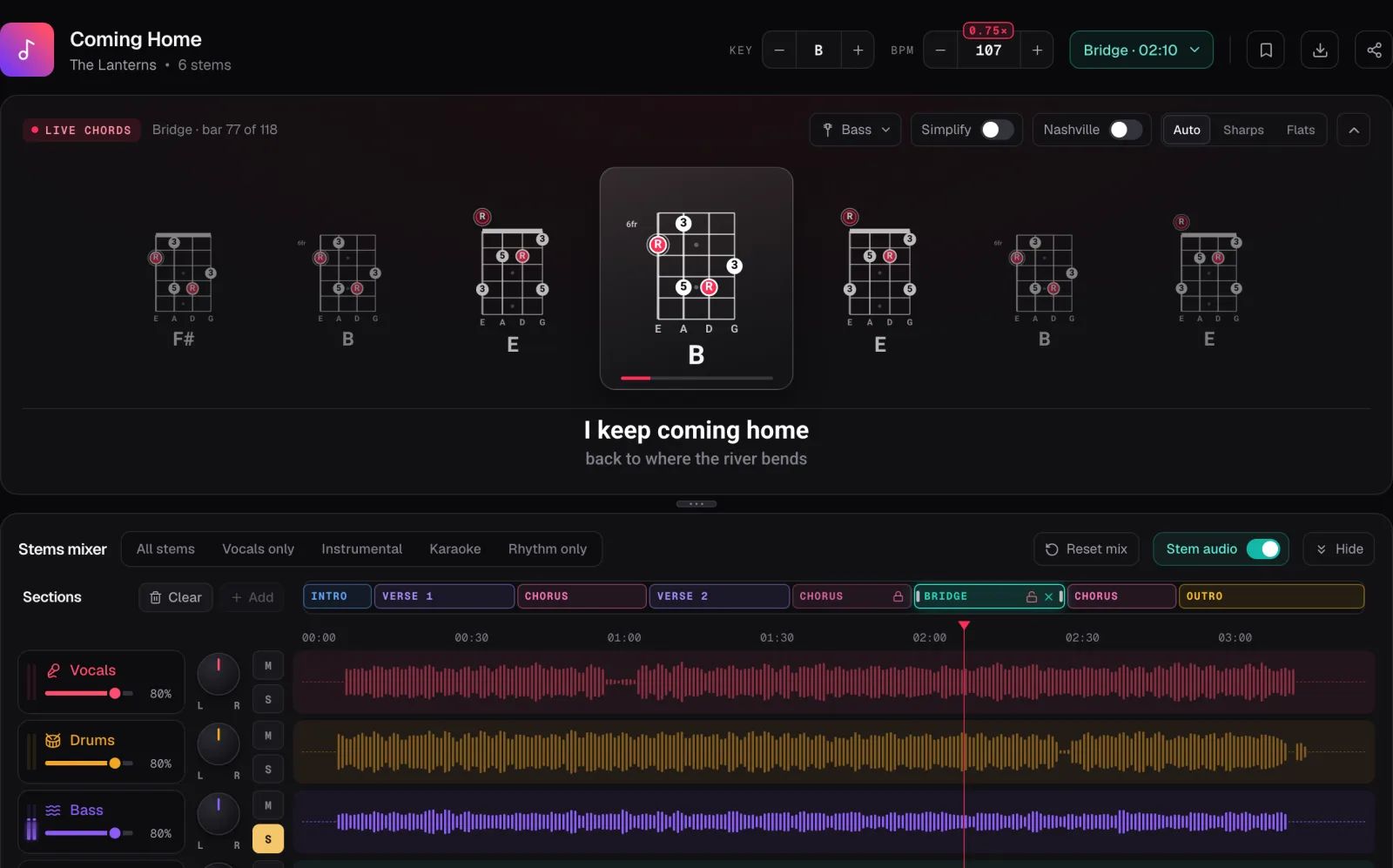
In the screenshot the demo song Coming Home is split into its six stems, with the S on the Bass row lit, so the bass plays alone. The tempo is down from 143 to 107 BPM, which the Studio marks as 0.75×, and Live chords is set to Bass: each chord is drawn on a four-string neck, with the root ringed and the chord tones around it named by interval.
Open the song
Upload an MP3, WAV or M4A file into the Chord Lens Studio on a computer.
Split and solo the bass
Press Split stems, then S on the Bass row. On Free, place the 2-minute window over the part you want to learn first.
Slow it down
Step the BPM down to about 0.75× of the song’s tempo. The pitch stays where the record has it.
Loop one phrase
Turn the loop on and drag A and B around one or two bars. The loop snaps to the beat, so it comes round in time.
Find the first note of each bar
Set Live chords to Bass and check the ringed root under each chord. Play it with the record until it matches.
Fill in the rest
Add the notes between the roots and copy the rhythm, then raise the speed a few BPM at a time.
03 / 08 · ROOTS
The chord tells you where the line is going.
Most bass lines land on the root of the chord when the chord changes. The root is the note the chord is named after: an E under an E chord, an F♯ under F♯m. If you know the chords, you already know where most bars of the bass line start. Our guide to finding the chords of a song covers that part.
So begin with the roots alone. Play one note per chord change, on the beat the chord changes, with the soloed bass running. In the demo song’s bridge that means F♯, then B, then E. It sounds plain, but it is already a bass line, and it locks you to the song’s harmony before you worry about anything else.
Now listen for what the real line does between the roots. The usual moves are few: it repeats the root in a rhythm, jumps to the fifth and back, climbs to the octave, or walks up or down the scale into the next chord’s root. With Live chords set to Bass, the Studio draws each chord on a four-string neck with the root ringed and the other chord tones marked as 3, ♭3, 5 or ♭7. Those dots are where the line most often goes.
Watch for slash chords. A chord written D/F♯ means a D chord with F♯ in the bass, and the bass plays the F♯, not the D. The diagram rings the slash note when there is one. Lines that walk down step by step under a chord progression are usually written this way.
If the bass plays a note the chord doesn’t explain, it is often a passing note on the way to the next root. Find the next root first, then step back to see how the line got there.
Can’t tell which note it is? Hum it, then slide up or down your E string until the note under your finger matches the hum. Finding it on one string first is quicker than hunting the whole neck.
04 / 08 · RHYTHM
Half the line is when you play it.
Two bassists can play the same notes and sound like different songs, because the rhythm is half the line. Where a note starts, how long it rings and where the gaps fall all matter as much as the pitch.
The bass player’s closest partner is the kick drum. In many songs the bass lands with the kick on almost every note. Press Rhythm only in the Stems mixer and you hear just the drums and the bass together, so you can hear exactly where the two lock and where the bass plays on its own between the kicks.
Clap or tap the rhythm before you play it. Loop one bar, tap along until your taps match the bass, then put the notes back on top. If a note starts just before the beat, it is pushing into the next bar, and that push is often what gives the line its feel.
Listen to the length as well. A bass note cut short leaves space for the drums; one held through the bar fills the song out. Mute the string with your fretting hand where the record goes quiet, and the line starts to sound like the record rather than a list of right notes.
Turn on the Studio’s metronome if you lose the count. It clicks on the song’s own beats, beat one accented, and slows down with the song. The metronome for songs guide has the routine.
05 / 08 · SLOW AND LOOP
Slow enough to hear every note.
Fast bass lines are a blur at full speed, and a fast fill is gone before you’ve heard it. At 0.75× most lines open up; for a quick run, go down towards half speed. The Studio’s BPM stepper goes from half the song’s tempo to double, one BPM at a time, and the pitch never moves, so the notes you find slow are the notes you play at full speed. The soloed bass follows the speed with the rest of the stems.
Keep the loop short. One or two bars is plenty, started a beat before the phrase so you can get ready. Once a phrase is clean three times in a row, raise the speed a few BPM and go again. Save the loop and you can come back to it tomorrow; Free keeps 3 saved loops per song. The slow down guide has the whole climb back to full speed.
Use headphones or proper speakers. If the soloed bass sounds thin on a laptop, the notes aren’t missing: the speaker can’t play them. Turn the bass up or plug in headphones and the low end comes back.
Low notes are also easy to hear in the wrong octave. If what you play sounds right but somehow too high or too low, check where on the neck you are. Most lines live in the first seven frets of the E and A strings, which is where the Studio’s bass diagrams draw them.
06 / 08 · GOOD TO KNOW
What the split can and can’t do.
The bass stem is usually one of the cleanest of the six, because little else in a band lives that low. A synth bass can be split between Bass and Other, so solo the two together if notes seem to vanish. A kick drum tuned close to the bass can leave a thump in the stem. Studio versions of a song split more cleanly than live takes.
Chord Lens gives you the bass audio on its own and the chords in time, not tab or notation. Writing the line down is still your job, and doing it is one of the best ways to remember it. The transcribing guide shows how to work bar by bar.
Splitting runs in your browser on a computer, in Chrome or Edge, and the first split downloads the splitting engine once, about 140 MB. Free splits a 2-minute part of the song that you choose; Premium splits up to 8 minutes and Pro up to 12. On a phone you still get the chords. When you know the line, mute the bass instead of soloing it and play your part over the band: that is a backing track made from the record itself.
07 / 08 · Do it in one click
Bass Stem Splitter
Solo the bass from any song, slow it down and loop it, with the chords in time.
01How do I learn a bass line by ear?
Solo the bass, slow it to about 0.75×, and loop one or two bars. Find the first note of each bar, usually the chord’s root, then fill in the notes between and copy the rhythm.
02How can I hear the bass better in a song?
Split the song into stems and solo the bass. Use headphones or real speakers, since laptops and phones drop the low notes.
03Does the bass always play the root of the chord?
Not always, but most lines land on the root when the chord changes. Slash chords such as D/F♯ name a different bass note.
04Can I slow the bass down without changing the pitch?
Yes. The Studio goes from half the song’s tempo to double, and every stem, the bass included, keeps its pitch.
05Does Chord Lens give me bass tab?
No. It gives you the bass on its own and the chords in time, with a diagram of each chord’s root and chord tones on a four-string neck.
06How do I hear how the bass fits with the drums?
Press Rhythm only in the Stems mixer. It plays just the drums and the bass, so you hear where the line locks with the kick.
07Is it free?
Free to try: Free splits a 2-minute part of a song, the part you choose. Premium splits up to 8 minutes and Pro up to 12.