 Chord Lens
Chords and keys · 07 of 07
SLASH CHORDS AND WHAT THE BASS IS DOING. follow the bottom note
The short answer
A slash chord names a chord and the note under it: G/B is a G chord with B as the lowest note. The letter after the slash is the bass player’s note. Read a run of slash chords as a bass line, because that is what it is: the bass walking, holding still, or stepping between chords.
01 / 09 · WHY
The slash is the bass line, written down.
Most chord charts only tell you the chords. A slash chord tells you something extra: which note is at the very bottom. G/B means play a G chord, but put B underneath it. Read it as “G over B”. The part before the slash is the chord; the part after it is the bass.
That single extra letter is there because the bass note changes how a chord sounds and, more than that, how it moves into the next one. A chart writer adds a slash when the bass is doing something you would miss if you played every chord from its root: stepping down a scale, holding one note under changing chords, or landing on a note that isn’t in the chord at all.
So the useful way to read slash chords is not one at a time. Read them as a line. C, G/B, Am is not three unrelated chords; it is a bass walking down C, B, A while the chords on top barely move. Once you hear that, you know why the slash is there, and you know which notes matter most when you play it.
Our guide to chord symbols explains how to spell any symbol, slash included. This guide stays with the bass: the three jobs a slash chord does, how to hear the bass note in a recording, and how to play slash chords on guitar, bass and piano.
02 / 09 · METHOD
From chart to bass line in five steps.
You need the chart and, ideally, the recording. Work through the song a section at a time and write the bass notes out in a row as you go.
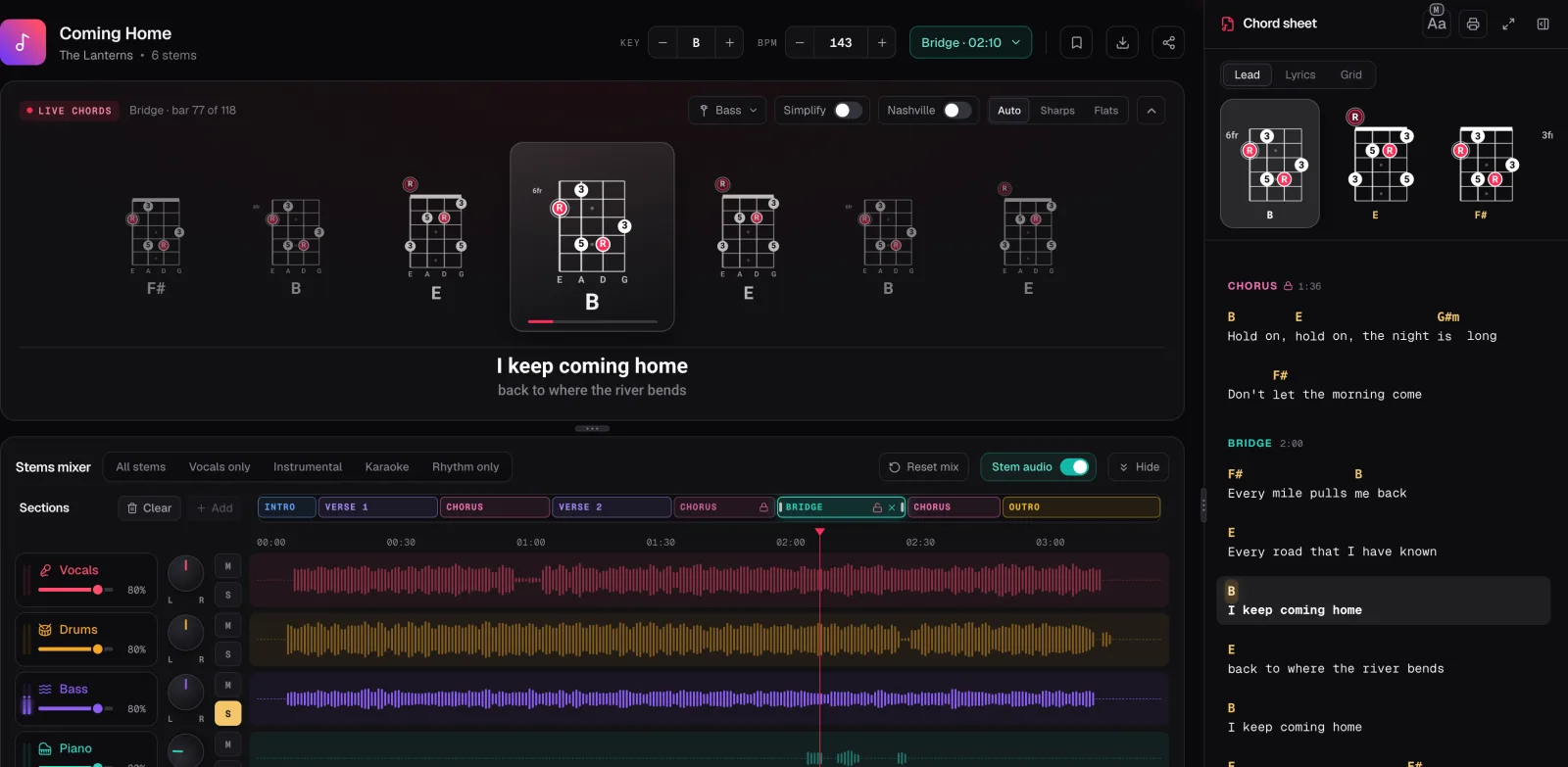
In the screenshot the demo song Coming Home, in B, is open in the Chord Lens Studio with Live chords set to Bass and the Bass stem soloed in the Stems mixer. Each chord is drawn on a four-string bass neck, with the note to start on ringed and marked R. Coming Home has no slash chords, so the ringed note is the root every time; on a chord with a slash, it is the note after the slash.
Split the symbol
Read the part before the slash as the chord and the letter after it as the lowest note.
Write the bass line
List the bass note of every chord in a row, using the root where there is no slash.
Name the job
Look at the row. Is the bass walking by step, holding one note, or jumping to a note outside the chord?
Hear it
Solo the bass in the recording and follow your row along with it, bar by bar.
Play your part
Bassists play the row. Guitarists and pianists play the chord with that note at the bottom, or leave the bass to the bassist.
03 / 09 · THREE JOBS
Walking, holding, or stepping outside.
Almost every slash chord you meet in a pop, folk or worship chart is doing one of three jobs. Learn to spot them and a chart full of slashes stops looking complicated.
Walking. The bass moves by step, one scale note at a time, while the chords change above it. C, G/B, Am walks down C, B, A. G, D/F♯, Em walks down G, F♯, E. Going up, C, C/E, F climbs C, E, F. The slash chords are the in-between chords that let the bass step rather than jump. Without them, the bass would leap from C to A, and the line would lose its pull.
Holding. The bass stays on one note while the chords change on top. This is called a pedal. C, F/C, G/C, C keeps C in the bass the whole way. It sounds settled and anchored, and it often turns up at the start of a song or under a long held vocal. The chord names change; the bass note doesn’t.
Stepping outside. The bass note isn’t in the chord at all. Am/G puts G under A minor, which is a darker colour than Am alone. D/C puts C under D, a tense sound that wants to move on, usually to G/B. F/G puts G under F, a soft, open sound often used just before a chord built on C. These are the slash chords that change the colour of the harmony, not just its movement.
Some charts write the same line two ways. Am/G and Am7 contain the same notes; the slash version tells the bassist to play G, while Am7 leaves it up to them. When a chart takes the trouble to write the slash, the bass note is the point.
When a run of slash chords looks hard, write only the bass notes in a row: C, B, A, G. If they form a scale going one way, you are looking at a walking line, and the chords on top are the easy part.
04 / 09 · HEAR IT
Find the bass note in the recording.
Charts leave slash chords out all the time. A chart may say C, G, Am where the record clearly walks C, B, A. The only way to know is to listen to the bass, and the bass is the hardest instrument in a mix to hear on small speakers.
Split the song so you can hear it alone. The Studio splits a song into six stems: Vocals, Drums, Bass, Piano, Guitar and Other. Press S on the Bass row to solo it, as in the screenshot, and the low line comes out clearly. Our Bass Stem Splitter page shows what that sounds like. Play along with your row of bass notes and check each one against the record.
Listen at the chord changes. A walking line usually moves exactly where the chord changes, or on the beat just before it. A pedal is easiest to hear as the absence of movement: the chords on top shift and the bass hum stays put. A note outside the chord often sounds slightly unsettled until the next chord resolves it.
If the bass moves too fast, slow it down. The BPM stepper goes from half the song’s tempo to double, and the pitch stays where it is, so the notes you hear are still the notes to play. Loop the bar you are checking and listen to it a few times before writing anything down. Our guide to learning bass lines by ear goes further into working out a full line.
05 / 09 · PLAY IT
Guitar, bass and piano, one chord each.
Bass. The slash is written for you. Play the note after the slash on the chord change, then fill the rest of the bar with chord tones as you would anywhere else. In the Studio, set Live chords to Bass: each chord is drawn on an E, A, D, G neck, with the note to start on ringed. When the chart names a slash bass, that ringed note is the slash note, not the root, and the chord’s other notes are marked around it by their interval: R for the root, 3 or ♭3 for the third, 5 for the fifth.
Guitar. Make sure the bass note is the lowest string you play, and leave out any string below it. G/B is the classic case: play the G chord but mute the low E string and fret B on the 2nd fret of the A string. D/F♯ often uses the thumb over the neck to fret F♯ on the low E string. If a shape is too awkward, play the plain chord: in a band, the bassist covers the slash note, and the song still sounds right.
Piano. The left hand takes the bass note; the right hand plays the chord above it. For C/E, play E low in the left hand and C, E, G in the right. A walking line becomes a left-hand line, one note per chord, while the right hand moves as little as it can. Our guide to playing piano by chords covers the right-hand side.
One thing to know about the Studio’s diagrams: the guitar, ukulele and piano shapes draw the chord itself, built from its root. For G/B you see a G shape; putting the B at the bottom is up to you. The bass diagram is the one that starts from the slash note.
06 / 09 · IN THE STUDIO
Read it, simplify it, number it.
When a song’s chart names a slash chord, the Studio writes it the same way everywhere chords appear: in the Live chords row, on the chord sheet and in print, as G/B or D/F♯. Transpose the song or set a capo and the bass note moves with the chord.
If slash chords are slowing you down while you learn the song, switch on Simplify. Every chord drops to its plain major or minor triad, and the slash goes with it: D/F♯ reads as D. That is a fair way to learn a song’s shape before adding the bass movement back in.
With Nashville numbers on, the slash bass is numbered too, counted from the key like the chord. In the key of C, G/B reads 5/7 and C/E reads 1/3, so a band can follow the bass line in any key. Our guide to the Nashville number system explains the counting.
07 / 09 · GOOD TO KNOW
What the Studio can and can’t tell you.
A slash chord only shows when the song’s chart has one. Many charts write plain chords where the bass walks, so if the line you hear doesn’t match the chart, trust your ears and the soloed bass.
The chords and the diagrams for every instrument are free on every plan, with no ads; the Studio asks you to sign in free with Google. Splitting runs in your browser on a computer, in Chrome or Edge. Free splits a 2-minute part of the song that you choose; Premium splits up to 8 minutes and Pro up to 12.
08 / 09 · Do it in one click
Chord Shapes
Every chord of the song drawn for guitar, bass, ukulele, mandolin or piano, in time, the bass starting from the slash note.
01What is a slash chord?
A chord with a named bass note. G/B is a G chord with B as its lowest note. The part before the slash is the chord; the letter after it is the bass.
02How do I read a slash chord?
Say “over”: G/B is “G over B”. Play the chord, and make the note after the slash the lowest one you play.
03Why do songs use slash chords?
To make the bass move smoothly, by walking down or up a scale, to hold one note under changing chords, or to add a colour with a bass note outside the chord.
04Do I have to play the bass note on guitar?
Not always. In a band, the bassist plays it and a plain chord works. Playing alone, the bass note is what makes the line, so play it when you can.
05What is the difference between Am/G and Am7?
They hold the same notes. Am/G says G must be in the bass; Am7 leaves the bottom note up to the player.
06How do I hear the bass note in a song?
Solo the bass. The Studio splits a song into six stems, so you can play the Bass stem alone, slow it down and loop the bar you are checking.
07Can Chord Lens show me the bass note?
Yes. Set Live chords to Bass and each chord is drawn on a bass neck with the note to start on ringed, the slash note when the chart names one.
08What does Simplify do to slash chords?
It drops the bass note and plays the plain major or minor triad, so D/F♯ reads as D. Turn it off again to add the bass movement back.