 Chord Lens
Voice and karaoke · 04 of 04
HOW TO LEARN HARMONIES BY EAR. the line under the tune
The short answer
To learn harmonies by ear, take the band away so only the voices are left, then find the harmony under or over the lead. Split the song, solo Vocals and Other, slow the line down, and hum it against the chord. Learn it phrase by phrase, then sing it over the full band.
01 / 08 · WHY
The tune is easy. The harmony hides.
Most people can sing back the tune of a chorus after hearing it twice. The harmony is a different matter. It is sung quieter than the lead, it moves in the same rhythm, and it sits right next to the guitars and keyboards in pitch. Your ear follows the loudest, highest line, and that is almost always the melody. The harmony melts into the band.
So learning a harmony by ear is mostly about taking things away. Remove the drums, the bass and the guitars, and what is left is the voices. Slow them down, and the line you couldn’t pick out at full speed becomes a set of notes you can hum one by one. Check each note against the chord under it, and you know whether you have it right.
This guide covers backing vocals in a band, a worship team or a choir, and the harmonies you add yourself when you sing with a friend. It assumes you can already sing the lead; if you can’t, learn that first, because every harmony is heard against it.
02 / 08 · METHOD
Learn a harmony in six steps.
You need the song as an MP3, WAV or M4A file, and a computer with Chrome or Edge for the split. Headphones help: the quieter voice is easier to follow when nothing else in the room is making noise.
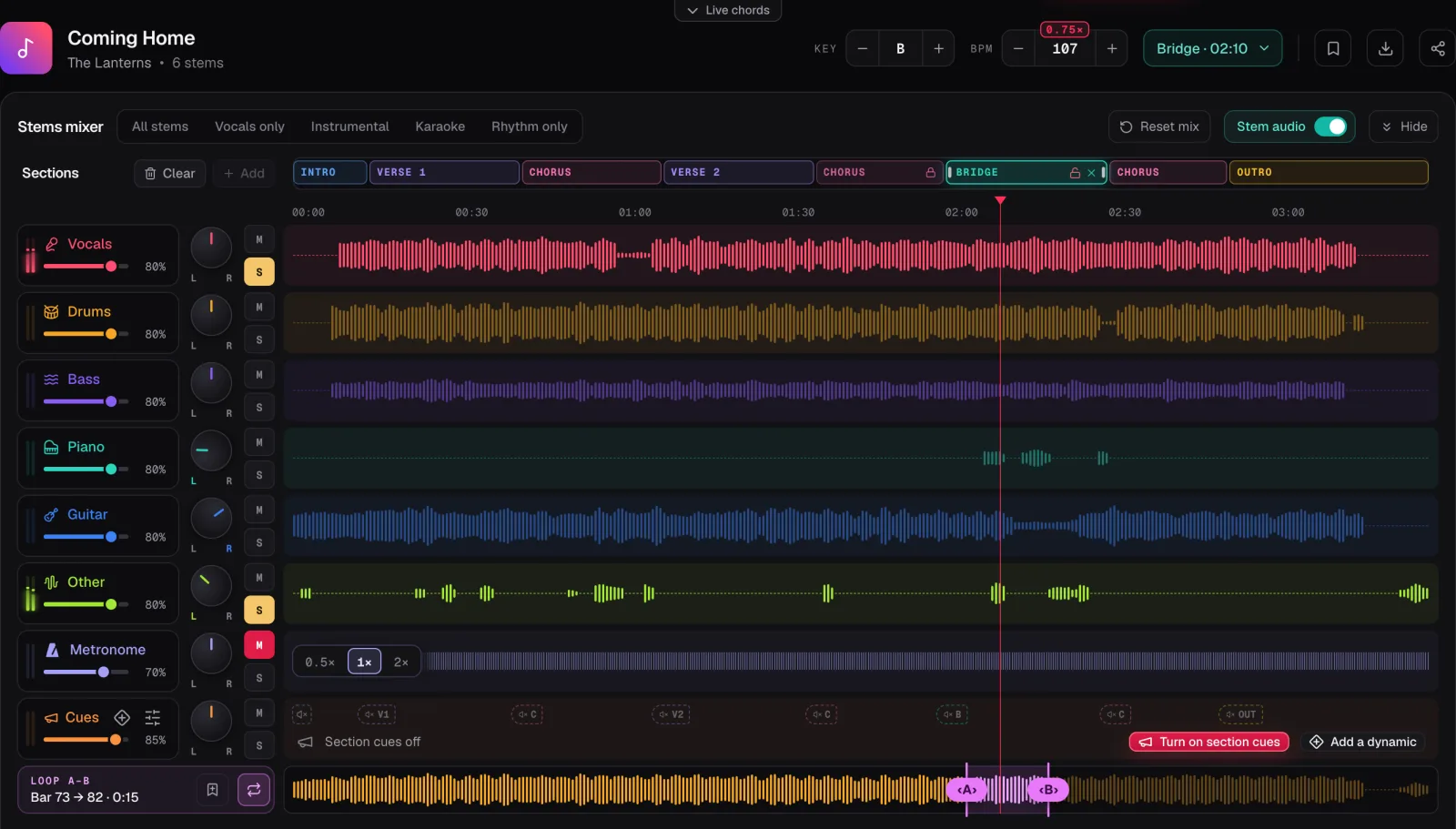
In the screenshot the demo song, Coming Home, is split into six stems with the S lit on both Vocals and Other, so only the voices and the odd leftover pad play. The tempo is stepped down from 143 to 107 BPM, marked 0.75×, and the loop at the bottom holds a short stretch of the bridge.
Open the song
Upload an MP3, WAV or M4A file into the Chord Lens Studio on a computer.
Split it into stems
Press Split stems. On Free, place the 2-minute window over the chorus or whichever part has the harmony.
Solo the voices
Press S on Vocals, then S on Other. Backing voices often land in Other, so both together give you every voice in the song.
Loop one phrase
Set the loop over a single line of two to four bars, so you hear the same harmony again and again.
Slow it down
Step the BPM down to around 0.75x. The voices slow without dropping in pitch, so the notes you hum are the real ones.
Sing it, then add the band
Hum the harmony with the stems, then on its own, then press All stems and sing it over the full band.
03 / 08 · FIND IT
Find the line under the lead.
With only the voices playing, listen to the phrase three or four times without singing. First hum along with the lead, so you know exactly where the melody goes. Then listen for anything that doesn’t move with it: a note held while the lead moves, a voice that starts a beat later, a line that sounds a little lower or higher than the tune.
Most pop, rock and worship harmonies follow one of a few habits. A third above or below. The harmony moves in parallel with the melody, two notes of the scale away, so it has the same shape at a different height. This is the sound of most duets. A held note. The harmony sits on one note, often the root or the fifth of the chord, while the lead moves around it. Answers. The backing voices sing a word or a phrase back after the lead, in the gap at the end of a line.
Pick the one you think you hear, and try it. Hum the lead’s first note, then step down two notes of the scale and hum that. If it blends with the record, you have found the third below. If it rubs, try above, or try holding one note through the bar.
Pan can help too. Every stem has its own pan knob in the mixer. Turning the Other stem to one side and the Vocals stem to the other puts the backing voices in one ear and the lead in the other, which is easier than hearing them stacked in the middle.
Sing the harmony quietly at first. If you sing it louder than the record, you stop hearing whether it blends, and blending is the test.
04 / 08 · CHECK IT
Every harmony note lives in the chord.
Your ear will sometimes fool you, especially near the end of a long practice. The chord tells you if you are right. A harmony note is usually one of the three notes of the chord being played at that moment: the root, the third or the fifth.
The Studio shows the chords in time with the song, so you can see the chord under every word you are singing. In Coming Home the chorus turns around B, E, G#m and F#. If the lead sings a D# over the B chord (B, D#, F#), a harmony a third below would sit on B, and a third above on F#. All three notes belong to the chord, which is why they sound settled together.
If a note you are humming isn’t in the chord, check it again with the voices soloed and the tempo down. Sometimes it is a passing note on the way to the next chord, and that’s fine. If it lands on the strong beat and isn’t in the chord, you probably have the wrong note.
Our guide to finding the chords of a song explains how chords are built from the scale, if the letters are new to you.
05 / 08 · LEARN IT
One phrase, then the next.
Work in short loops. A harmony is easier to remember as a string of short phrases than as one long line. Loop a phrase, sing it with the voices until you don’t need them, then move the loop to the next phrase. In the Studio the loop snaps to the beat, and you can save a loop with a name to come back to later.
Speed it up in steps. Once a phrase is solid at 0.75×, step the BPM back up a few beats at a time. Runs and quick answers are where harmonies fall apart at full speed, so give those the most time.
Take the voices away. When you can sing the phrase with the voices, press Instrumental: the lead vocal goes and the band plays on. Singing the harmony without the lead next to you is harder than it sounds, and it is the best test that you really know it. Then press All stems and sing it against the lead, the way you will on stage.
Move it to your range. If the harmony sits too high or too low for you, move the key with the Key stepper. Every stem moves with it, so you learn the part where you will actually sing it. Small moves sound most natural. Our guide to the best key for your voice shows how to choose.
06 / 08 · GOOD TO KNOW
What the split can and can’t do.
The split gives you all the voices together, not each singer on their own track. When the lead and the harmony are sung at the same time, they stay together in the Vocals stem. That is still a big help, because there is nothing else to listen through, but you are picking the harmony out by ear, not muting the lead.
Stacked backing vocals and choirs can land in Other rather than Vocals, because they blend with pads and keyboards. That is why this guide solos both. If Other also brings back a synth pad, pull its fader down a little rather than muting it.
Splitting runs in your browser on a computer, in Chrome or Edge, and the first split downloads the splitting engine once, about 140 MB. Free splits a 2-minute part of a song that you choose; Premium splits up to 8 minutes and Pro up to 12. On a phone you still get the chords and the words, but not the split. For the voices on their own as a file, see getting an acapella from a song.
07 / 08 · Do it in one click
AI YouTube Vocal Remover
Split any YouTube song and solo the voices, to hear the harmony under the lead. Free to try.
01How do I learn harmonies by ear?
Take the band away so only the voices play, loop one phrase, slow it down and hum the line under or over the lead. Check each note against the chord, then sing it over the full band.
02How do I hear the harmony in a song?
Split the song and solo the vocals and Other stems. With the instruments gone, the quieter voice under the lead is much easier to pick out, especially slowed down.
03Can I remove the lead vocal and keep the harmony?
Not when they are sung at the same time: lead and harmony stay together in the Vocals stem. Backing voices that land in Other can be played on their own by soloing Other.
04What is the most common harmony?
A third above or below the melody, moving in the same shape. Holding one note of the chord while the lead moves is the other common one.
05How do I know if my harmony note is right?
Check it against the chord at that moment. On a strong beat, a harmony note is nearly always the root, third or fifth of the chord being played.
06Can I slow the song down without changing the pitch?
Yes. The BPM stepper goes down to half the song’s tempo and the voices keep their pitch, so you hear the real notes at a speed you can follow.
07Is it free?
Free to try: Free splits a 2-minute part of a song, the part you choose. Premium splits up to 8 minutes and Pro up to 12.