 Chord Lens
Voice and karaoke · 03 of 04
HOW TO GET AN ACAPELLA FROM ANY SONG. just the voice, please
The short answer
To get an acapella from a song, split it into stems with an AI vocal remover and keep only the vocals. In Chord Lens, upload your audio in the Studio on a computer, split it, and press Vocals only. If backing voices are missing, solo the Other stem too. Then loop and slow the line you’re learning.
01 / 07 · WHAT
The voice, lifted out of the band.
An acapella is a song’s vocal on its own: the lead singer, and usually the harmonies, with no instruments under them. Studios keep one for every song they record, but you rarely get to hear it. What you have is the finished mix, with the voice glued to the band.
An acapella extractor pulls them apart. The old trick was to cancel out whatever sat in the middle of the stereo mix. It sometimes worked on a karaoke track, but for an acapella it was hopeless: it removed the voice instead of keeping it, and took the bass and the kick drum along too. Modern extractors use an AI model trained to recognise each kind of sound, and split the song into separate tracks, called stems.
Chord Lens splits a song into six stems: vocals, drums, bass, guitar, piano, and Other for everything else. The vocal becomes one fader among six. Solo it and you have the acapella; mute it and you have the backing track. Because it works from the recording you’re listening to, a cover, a live take or a song that never had an official acapella splits the same way.
Singers use an acapella to hear exactly what the lead is doing with a phrase: where they breathe, where they slide into a note, how they shape the end of a line. Choir members and backing singers use it to pick out a harmony the band hides. Players use it to transcribe a melody without guessing which notes belong to the guitar.
02 / 07 · METHOD
Get the acapella in six steps.
You need a computer with Chrome or Edge and hardware acceleration on: the split runs in your browser, on your own machine, not on a server. The first split sets the splitting engine up once, a download of about 140 MB, and after that each song splits while you watch.
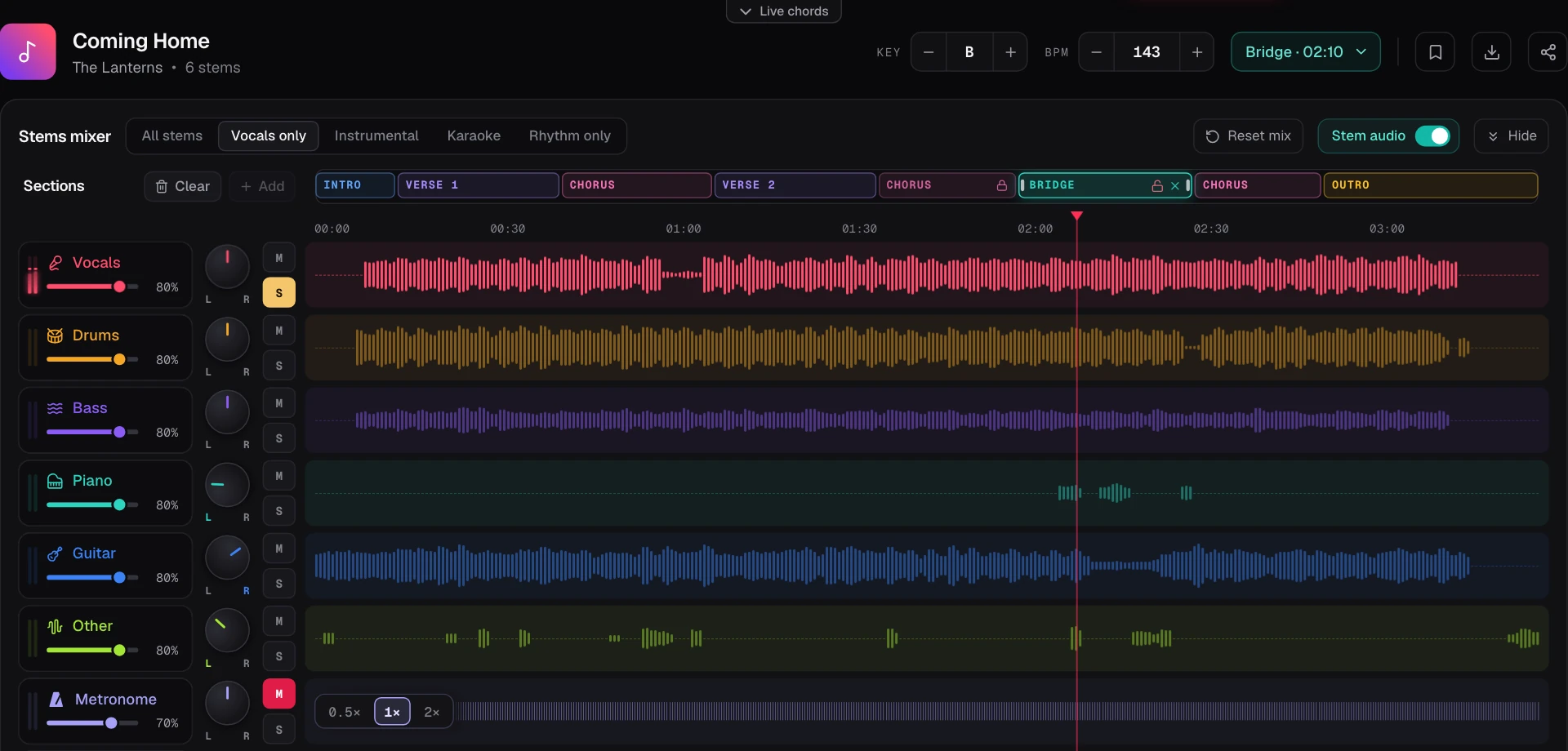
In the screenshot the demo song, Coming Home, is split and Vocals only is pressed. The S on the Vocals row is lit, so only the voice plays, and the drums, bass, piano, guitar and Other sit silent below it with their levels untouched.
Open the song
Go to the Chord Lens Studio on a computer, sign in, and upload an MP3, WAV or M4A file.
Split it
Press Split stems. On Free, place the 2-minute window over the part of the song you want, such as the chorus.
Press Vocals only
Above the faders, pick Vocals only. The vocal stem is soloed and the band goes quiet.
Bring back the harmonies
If backing voices are missing, press S on Other as well. Stray vocal lines often land there, and both stems will play together.
Loop the line
Set a loop over the phrase you’re learning and slow it down if you need to. The pitch stays where the singer put it.
Save it if your plan allows
On Premium, download the vocal stem as MP3; Pro adds WAV. Downloads are for your own practice and study.
03 / 07 · HOW CLEAN
Clean enough to learn from. Not a studio master.
On most songs the voice comes away cleanly: clear enough to hear every word, every breath and every harmony. It isn’t the studio’s own vocal track, though, and some songs show it more than others.
Reverb and echo. A vocal drenched in reverb leaves a little of its tail in the other stems, and a little of the band can ring through in the vocal. You’ll hear it most in the gaps between lines.
Backing voices. Harmonies and stacked backing vocals can land in the Other stem rather than Vocals, because they blend with pads and keyboards. That’s why soloing Other alongside Vocals brings them back. If the lead alone is what you want, leave Other out.
Crowds and choirs. A live audience singing along, or a full choir, is hard to pull apart from the lead. A studio version of the same song nearly always gives a cleaner acapella than a live one.
Old and distorted recordings. Mono records, heavy distortion and lo-fi production split less cleanly. You’ll still hear the melody, with more of the band bleeding through.
For learning a part, none of this matters much. A faint ghost of a guitar under the voice doesn’t stop you hearing where the melody goes. If it bothers you, try a different upload of the same song before anything else.
Hearing a harmony is easier one voice at a time. Play Vocals only, then switch back to the full mix with All stems: the line that disappears into the band is the one to loop.
04 / 07 · LEARN IT
Now learn from it.
Loop one phrase at a time. A line of a melody is usually two to four bars. Loop it, listen three times without singing, then sing it with the record, then without. In the Studio the loop snaps to the beat, and you can save it with a name to come back to.
Slow the hard runs. Step the BPM down and the voice slows without dropping in pitch, from half the song’s tempo up to double. At 0.75× you can hear which way every note of a run goes. Our guide to slowing a song down without changing the pitch has the full routine.
Move it to your key. If the singer sits too high or too low for you, move the key up to 12 semitones either way. The vocal stem moves with it, so you can learn the melody where you’ll actually sing it. Small moves sound most natural. See the best key for your voice for how to pick.
Then sing over the band. Once you have the line, flip the mix: Karaoke mutes the vocals and Other, and you sing the part over the band with the words in time on the chart. Making a karaoke version covers that side.
05 / 07 · USE IT FAIRLY
Yours to learn from, not to publish.
Chord Lens is for practising and studying a song yourself: learning the melody, working out a harmony, checking the words, singing along. That kind of personal use is broadly considered fair use under US copyright law, with similar rules elsewhere.
Stem downloads, MP3 on Premium and WAV on Pro, are for that same personal practice and study, not for redistribution. Don’t share an acapella, sell it or put it in something you publish. If you want to release a remix, a mashup or a cover built on the original vocal, you need a licence from whoever owns the recording, such as a sync licence, or the platform’s own licensing where it offers it.
On Free, the acapella plays in Chord Lens and there is no download, which covers most of what a singer needs: the voice, looped, slowed and in your key, as often as you like.
06 / 07 · Do it in one click
AI YouTube Vocal Remover
Split your own audio and keep only the voice for an acapella, or take it out for karaoke. Free to try.
01How do I get an acapella from a song?
Split the song into stems with an AI vocal remover and keep only the vocals. In the Chord Lens Studio, split the song on a computer and press Vocals only.
02Can I use Chord Lens on my own files, or only YouTube?
Both. The Chrome extension works right on the YouTube video you’re watching, listening to the song as it plays. To split stems, upload your own audio in the Studio (MP3, WAV or M4A, up to 50 MB). Premium exports stems as MP3 and Pro adds WAV, for your own study and practice.
03What is the best acapella extractor?
One that splits a song into several stems with an AI model, rather than cancelling the centre of the mix. Chord Lens splits six stems in your browser, so the vocal is a fader you can solo.
04Why are the backing vocals missing?
Harmonies and stacked voices can land in the Other stem. Press S on Other as well as Vocals and both play together.
05Can I download the acapella?
On Premium you can download the vocal stem as MP3, and Pro adds WAV, for your own practice and study, not to share or publish. On Free it plays in Chord Lens.
06Can I get an acapella on my phone?
No. Splitting needs a computer in Chrome or Edge, because phones don’t give a web page enough memory. On a phone you still get the chords and the words.
07How long a part of the song can I split?
Free splits a 2-minute part of a song, the part you choose. Premium and Pro split longer songs.
08Is it legal to make an acapella of a song?
Studying a song yourself is broadly considered fair use under US copyright law, with similar rules elsewhere. Publishing anything built on the vocal needs a licence from the rights holder.