 Chord Lens
By instrument · 07 of 14
HOW TO PLAY SONGS ON PIANO FROM CHORDS. three notes, one hand
The short answer
To play a song on piano from its chords, turn each chord symbol into three notes: the root, the third and the fifth. Play the root low with your left hand and the three notes with your right, choosing the order that moves your hand least. Then add a rhythm and play along with the record.
01 / 10 · WHY
You don’t need the sheet music.
Most songs you hear were never written out note for note. What a band passes round is a chord chart: the words with a chord name over each change, or a grid of bars with a chord in each. Guitarists read them without thinking. Piano players often don’t, because piano lessons start from sheet music, where every note is written down for you.
Playing from chords is a different skill, and a freeing one. A chord symbol tells you which notes belong together and nothing else. Which octave, which order, which rhythm: that is up to you. Once you can turn a symbol into a chord under your hands, any chart becomes something you can play, and a song you know can be accompanying a singer within the hour.
This guide starts where you have the chords and want to play them. If you need to work out the chords yourself, by listening, our guide to piano chords by ear does that part. Here the chords come from the recording, in time with it, so you can practise with the real song from the first minute.
02 / 10 · METHOD
From chord chart to playing along in six steps.
You need the song, as a YouTube link or an audio file, and a keyboard. Work one section at a time, usually the chorus first, since it tends to repeat.
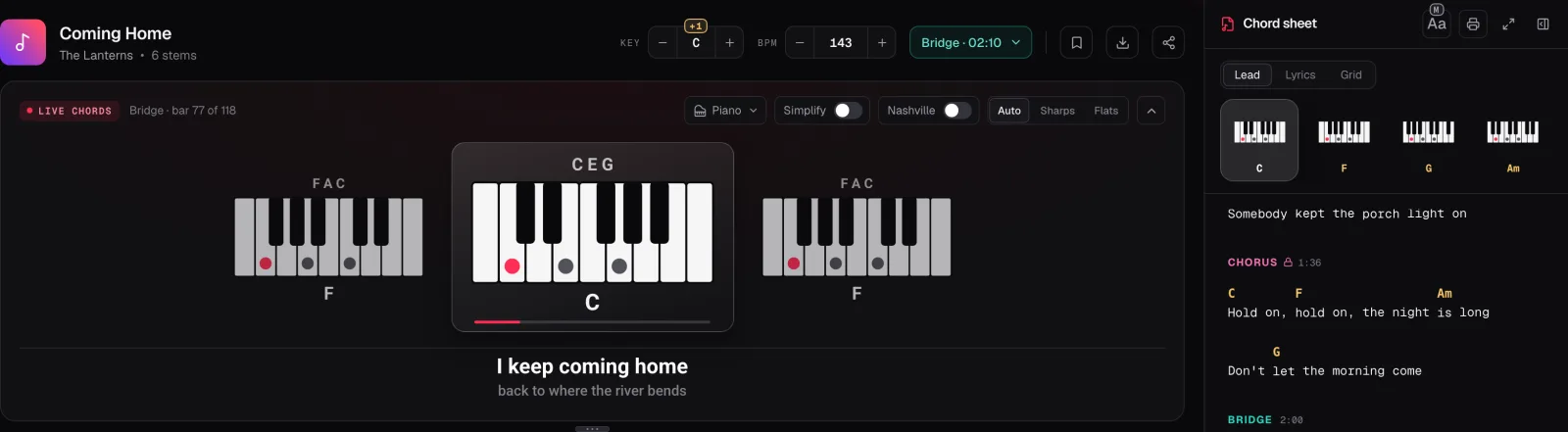
In the screenshot the demo song Coming Home is open in the Chord Lens Studio with Live chords set to Piano. The song is in B, but the Key is raised one semitone to C, so its four chords become C, F, G and Am, all on the white keys. Each chord is drawn on a keyboard with its notes named above it, C, E and G for the C at the playhead, and the chord sheet on the right shows the chords over the words.
Open the song
Paste the YouTube link into the Chord Lens Studio, or drop in an MP3, WAV or M4A file.
Pick piano
Set Live chords to Piano. Each chord is drawn on a keyboard, in time with the song, with its notes named.
Pick a key you can play
Raise or lower the Key until the chords sit in a key you know. The recording moves with them.
Learn the chord list
Play each of the song’s chords in turn with your right hand until you can find them without looking.
Add the left hand
Play each chord’s root low with your left hand, then choose right-hand shapes that move as little as they can.
Play with the record
Read the chords over the words as the song plays, slow it down if you need to, and keep going through mistakes.
03 / 10 · BUILD
Every chord starts as three notes.
A chord symbol names a root and a colour. The root is the letter: C, F♯, B♭. The colour is what comes after it, and most of the time there is nothing, which means major, or a small m, which means minor. Build either one from the root by counting keys, black ones included.
Major: the root, then four keys up, then three more. C major is C, E and G. Minor: the root, three keys up, then four more. A minor is A, C and E. Those three notes, root, third and fifth, are a triad, and a triad is all a pop song needs from you most of the time.
The extras build on the triad. A 7 adds the note two keys below the root’s octave: C7 is C, E, G and B♭. A maj7 adds the note a key under the octave: Cmaj7 adds B. A sus4 swaps the third for the note above it, sus2 for the note below it. A slash chord such as C/E means the chord C with E as the lowest note, which is a job for your left hand. Our guide to chord symbols goes through the rest.
You don’t have to count while the song plays. With Live chords on Piano, the Studio draws each chord on a keyboard with its notes lit and named, the root marked in red, so you can check a chord at a glance. If the chart is full of sevenths and sus chords you don’t know yet, switch on Simplify: every chord drops to its plain major or minor triad, and the song still sounds right under your hands.
Learn a key’s chord family, not single chords. In C, the chords C, F, G and Am cover a huge number of songs, and they use only the white keys. Get those four under your fingers and many charts are already playable.
04 / 10 · TWO HANDS
Root below, triad above, small moves.
The simplest way to split a chord between two hands works for almost every song. The left hand plays the root, alone or as an octave, low on the keyboard. The right hand plays the triad, in the middle. That one change, from a three-note chord to a bass note and a chord, is what makes a keyboard sound like a band.
Now the trick that makes it sound smooth: your right hand doesn’t have to play every chord from its root up. The same three notes in another order are still the same chord. These are called inversions, and they let your hand stay in one place while the chords change around it.
Take Coming Home in C. Play C as C, E and G. For F, don’t jump up to F, A and C: keep the C you already have and play C, F and A. For G, play B, D and G, and for Am play C, E and A. Your right hand barely moves through the whole chorus, while your left hand walks C, F, A, G under it. It sounds like a pianist, and it is easier than jumping.
The rule of thumb is to keep any note two chords share, and move the others to the nearest key. The Studio’s keyboards show each chord’s notes from the root up; the order you play them in is yours to choose. When the chart has a slash chord, play the note after the slash in your left hand instead of the root.
05 / 10 · RHYTHM
The same chords, played four ways.
Holding each chord until the next one is a start, but a song needs movement. Here are four patterns, from easiest to fullest. Try each one over the same chorus.
Whole notes. Play the chord on the first beat of the bar and hold it. Good for slow songs and for learning the changes. Pulses. Play the right-hand chord on every beat, root held in the left. The most common pop accompaniment there is. Broken chords. Play the three notes one after another, low to high, round and round. It suits ballads. Left-hand root and fifth. Alternate the root and the fifth in your left hand on beats one and three while the right hand pulses. It gives the song a bass line.
Let the record tell you which one. Listen to what the drums and the original keys are doing. If the song pulses in eighth notes, so can you. Turn on the Studio’s metronome if you lose the count: it clicks on the song’s own beat, with beat one accented.
Want to hear just what the pianist on the record plays? The Piano Stem Splitter splits the song into six stems, so you can solo the piano and copy its pattern, or mute it and take its place.
06 / 10 · READ ALONG
Chords over the words, in time.
Reading a chart while you play is its own skill. The trick is to look ahead: you should already know the next chord when the current one starts. A chart that scrolls with the song makes that much easier than paper.
The Studio’s chord sheet has three views. Lead puts the chords over the lyrics, line by line, the way most song charts are written; Lyrics shows the words alone; Grid shows the chords in bars, which is handy for intros and instrumental parts that have no words. The line being sung is lit and the sheet scrolls with it. Our Lyrics and Chords page shows the views side by side.
Notice where each chord sits on the word. A chord written over the second syllable lands there, not at the start of the line. Sing or hum along as you play and the timing falls into place.
If the song is too fast to follow, slow it down. The BPM stepper goes from half the song’s tempo to double, and the pitch stays where it is, so the chords on your keyboard still match. Loop a hard line until you can play through it, then raise the speed a few BPM at a time. Free keeps 3 saved loops per song.
07 / 10 · KEYS
Five sharps? Move the song.
Pianists don’t get a capo. A song in B, like Coming Home, has five sharps, and its chords B, E, F♯ and G♯m mean black keys in nearly every shape. You can learn it there, and in the end it’s worth doing, but you don’t have to start there.
Raise the Studio’s Key by one semitone and the recording itself moves up to C, with every chord re-spelled: C, F, G and Am. Now you are playing along with the real record, a semitone higher, in a key that is all white keys. The Key moves up to 12 semitones either way, so any song can land in a key you know. The Auto, Sharps and Flats buttons respell the names if a chart reads more easily one way.
This is also how you fit a singer. Move the key until the melody sits comfortably in their voice, then play the chords the Studio shows for that key. Our guide to transposing chords explains the counting behind it.
08 / 10 · GOOD TO KNOW
What you get, and on which plan.
The chords, the piano diagrams and the lyrics a song already has are free on every plan, with no ads. The Studio asks you to sign in free with Google, and Free has a set number of new songs each month. Key and speed are free once you sign in. In Chrome, the Chord Lens extension shows the same chords and keyboards beside a YouTube video.
Chord Lens gives you the chords in time, not sheet music. The voicing, the rhythm and the left-hand part are yours to choose, which is exactly the skill this guide is about.
09 / 10 · Do it in one click
Chord Shapes
The chords of any song drawn on a piano keyboard, every note named, lit in time with the record.
01How do I play piano by chords?
Turn each chord symbol into a triad: the root, the third and the fifth. Play the root low with your left hand and the triad with your right, then add a rhythm.
02How do I build a chord on piano?
For major, start on the root and count four keys up, then three more. For minor, three up, then four. Count black keys too.
03What are inversions and why use them?
The same three notes in a different order. They let your right hand stay in one place while the chords change, so the song sounds smoother.
04Can Chord Lens show me the notes of each chord?
Yes. Set Live chords to Piano and each chord is drawn on a keyboard with its notes lit and named, in time with the song.
05The song is in a key with lots of sharps. What can I do?
Move the key. The Studio shifts the recording up to 12 semitones either way and re-spells every chord, so you can play along in an easier key.
06What do I do with chords like Cmaj7 or Dsus4?
Learn them in time, or switch on Simplify: every chord drops to its plain major or minor triad and the song still sounds right.
07Is it free?
Chords, piano diagrams and lyrics are free on every plan with no ads. Sign in free to use the Studio; Free has a set number of new songs each month.