 Chord Lens
By instrument · 08 of 14
HOW TO WORK OUT PIANO CHORDS BY EAR. left hand first
The short answer
To work out piano chords by ear, hear the piano on its own: split the song into stems and solo the piano. Find the lowest note of each chord with your left hand, then add the notes above it and listen for major or minor. Check your guess against the chord names, then copy the record’s voicing.
01 / 08 · WHY
Two hands, a full band, one blur.
A piano part is two things at once. The left hand usually plays the bass note, often the root of the chord, low down. The right hand plays the rest of the chord higher up, and in a pop or worship song it often moves those notes around, repeats them in a rhythm, or adds a melody on top.
In a full mix that is hard to hear. The guitars play the same chords in the same range. Pads and strings fill the space around the piano. The vocal sits right on top of the right hand. You know there’s a piano in there, but picking out which notes it plays is like reading a page with three other pages laid over it.
So the job splits into two parts. First get a clear look at the piano, alone and slowly. Then work the chord out from the bottom up: the bass note, then whether it’s major or minor, then any extra colour, then the exact order the pianist stacks the notes in.
You don’t need perfect pitch for any of it. You need to hear one note and match it, and to tell bright from dark. Both get easier every song you work out.
02 / 08 · METHOD
Work out the chords in six steps.
Work through the song one section at a time. Most songs repeat their chords, so once the first verse and chorus are done, much of the rest follows.
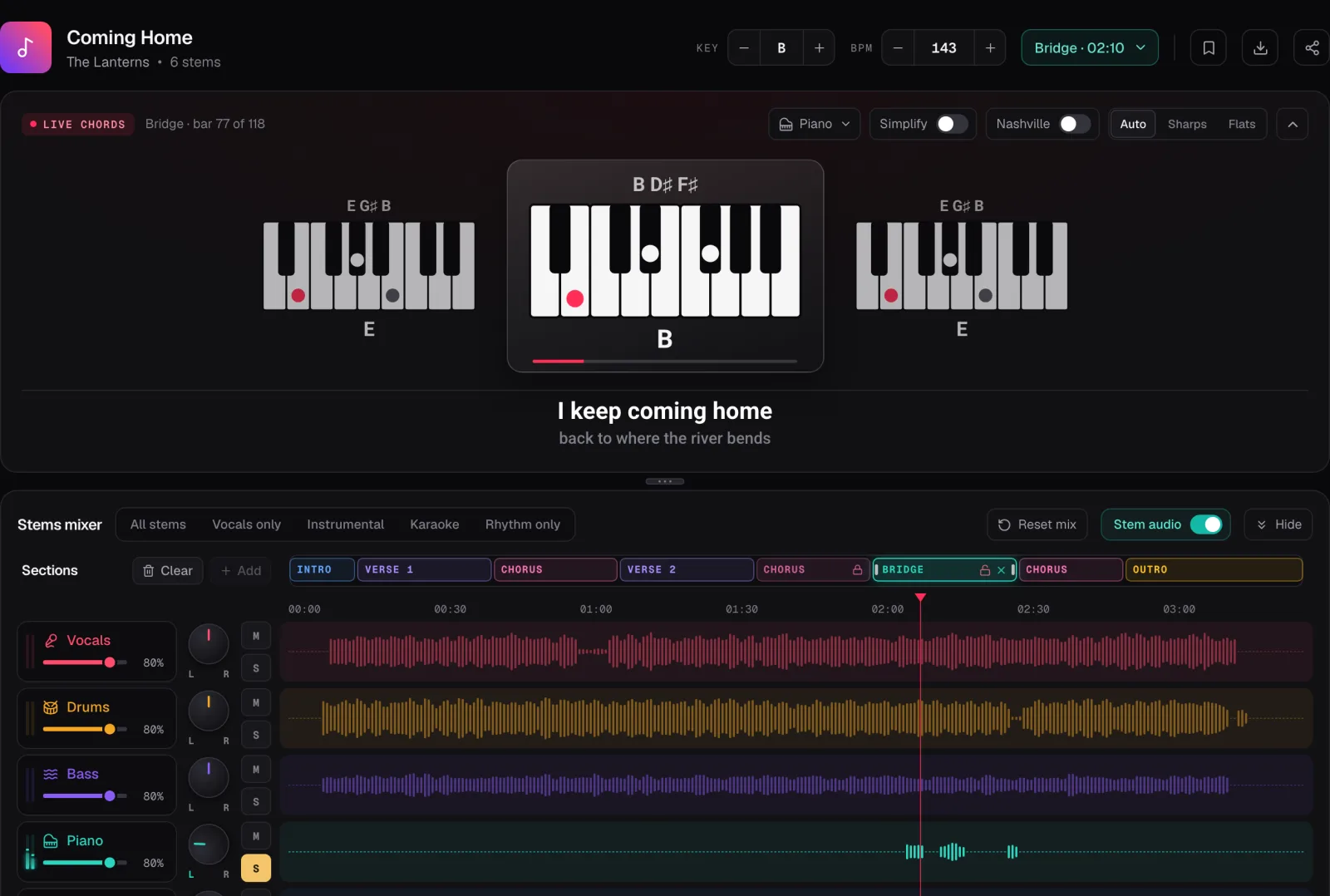
In the screenshot the demo song Coming Home is split into six stems with the S on the Piano row lit, so only the piano plays. Live chords is set to Piano: each chord is drawn on a keyboard with its notes lit and named above it, B, D♯ and F♯ for the B chord at the playhead, with the chord before and after beside it.
Open the song
Upload an MP3, WAV or M4A file into the Chord Lens Studio on a computer.
Split and solo the piano
Press Split stems, then S on the Piano row. If keys seem to be missing, solo Other as well.
Loop one chord change
Turn the loop on and drag A and B around a bar or two. Slow it to 0.75× if the chords move fast.
Find the bass note
With your left hand, find the lowest note the piano plays for each chord. It is usually the root.
Build the chord
Add the third and fifth above it with your right hand, and listen: bright is major, darker is minor.
Check and copy the voicing
Set Live chords to Piano to check your chord, then match the order of notes the record plays.
03 / 08 · BASS NOTE
Start at the bottom.
The lowest note is the easiest one to hear and the most useful one to find. In most bars the pianist’s left hand plays the root, the note the chord is named after, so once you have it you already know the chord’s name, if not yet its type.
Loop one chord, hum the lowest note you hear, and find it on the keyboard by sliding up or down until it matches. Play it with the record. When the bass note and the record ring together without a wobble, you have it. Then move to the next chord change and do the same.
Write the bass notes down as a list, one per chord. For a whole verse that list is already most of the chart. If you know the song’s key, the list also tells you which chords to expect: in the key of G, a bass note of C is probably a C chord and E is probably E minor. Our guide to finding the key of a song shows how.
Sometimes the bass note isn’t the root. A chord written C/E is a C chord with E in the bass, and pianists use these to make a line walk smoothly from one chord to the next. If the bass note you found doesn’t fit the chords around it, try it as a slash chord over the chord you expected.
The bass stem can help here too. Solo Bass for a moment: the bass guitar usually plays the same note as the pianist’s left hand, and it is easier to hear on its own.
04 / 08 · MAJOR OR MINOR
Bright, dark, and the colours on top.
With the bass note in your left hand, play a three-note chord on top of it with your right: the root, the third and the fifth. Try it major, then lower the middle note by one key and try it minor. One of them will sit with the record and the other will clash. That middle note, the third, is the whole difference between bright and dark. Major vs minor explains why.
Once major or minor sits right, listen for a fourth note. A seventh adds a soft, unresolved sound, common in ballads and soul. A sus chord has no third at all: the second or fourth note of the scale takes its place, and it sounds open, as if waiting to resolve. Worship and pop piano parts use sus chords and added notes a lot.
Check your guess against the chord names. The Studio puts the chords in time above the words and draws each one on a keyboard when Live chords is set to Piano, with its notes named: B, D♯ and F♯ for B major. If your chord and the drawing agree on the notes, you’ve found it. If the name says G♯m7 and you hear only G♯m, you are close; the seventh is a colour you can add once the basic chord is right. The Simplify switch shows the plain chord under a harder one if you want to start there.
The chord names come from Chord Lens listening to the whole song, so on a busy arrangement they can disagree with what the piano alone plays. When they do, trust the soloed piano for your part.
05 / 08 · VOICING
Same chord, different order.
The Studio draws each chord in its plain shape: root at the bottom, then the third, then the fifth. Pianists rarely play it that way for long. They play the same notes in another order, called an inversion, so their hand moves as little as possible from one chord to the next.
To copy the record, listen to the top note of the right hand. It is the one you hear most clearly, and it often moves by a single step from chord to chord, almost like a second melody. Find that top note, then fit the other notes of the chord under it within reach of your hand. That gives you the record’s voicing, or very close to it.
Slow the loop down when the right hand moves quickly. At 0.75× you can hear each note of a broken chord, and at half speed even fast arpeggios come apart. The pitch stays where the record has it, so the notes you find slow are the notes you play at full speed. The slow down guide covers the climb back up.
If the song sits in an awkward key for your hands, move it. The Key control shifts the recording and the chords together, up to 12 semitones either way, and the piano drawings follow. A piano takes no capo, so the chords are always shown in the key you hear.
06 / 08 · GOOD TO KNOW
What the split can and can’t do.
A piano that leads the arrangement, as in many ballads and worship songs, usually splits clearly enough to learn the voicings from. Piano is harder to split than drums or bass because it shares its range with guitars and pads, so some of them can bleed in. Synth keys, organ, electric piano and pads often land in Other rather than Piano: solo the two together when a keyboard part seems to be missing.
Chord Lens gives you the piano audio and the chords with their keyboard shapes, not sheet music. If you want the part on paper, write it down as you go; the transcribing guide shows how to work bar by bar.
Splitting runs in your browser on a computer, in Chrome or Edge. Free splits a 2-minute part of the song that you choose; Premium splits up to 8 minutes and Pro up to 12. On a phone you still get the chords and their shapes. Once you know the part, mute the piano instead of soloing it and play it yourself over the rest of the band. The Chord Shapes page has more on the drawings for every instrument.
07 / 08 · Do it in one click
Piano Stem Splitter
Solo the piano from any song, with each chord and its piano shape in time.
01How do I figure out piano chords by ear?
Solo the piano, loop one chord change, and find the lowest note with your left hand. Build the chord above it, listen for major or minor, then check it against the chord names.
02How do I hear the piano in a busy song?
Split the song into stems and solo the piano. Synth keys and pads often land in Other, so solo Other too if part of the keys is missing.
03How can I tell a major chord from a minor one?
Play the chord both ways over the bass note. The one that sits with the record is right: major sounds bright, minor darker.
04Does Chord Lens show piano chord shapes?
Yes. Set Live chords to Piano and each chord is drawn on a keyboard with its notes lit and named, in time with the song.
05Why does the record’s chord sound different from the shape shown?
The drawing is the chord’s plain shape. Pianists often play the same notes in another order, an inversion, or add notes on top.
06Can I slow the piano down?
Yes. The Studio slows the song to as low as half its tempo with the pitch held, and every stem follows the speed.
07Does it give me sheet music?
No. It gives you the piano audio and the chords with their keyboard shapes, not notation.