 Chord Lens
By instrument · 03 of 14
HOW TO FIGURE OUT A STRUMMING PATTERN FROM THE RECORD. count it, then copy it
The short answer
Count the beat out loud as “1 and 2 and 3 and 4 and”. Keep your strumming hand moving down on the numbers and up on the “and”s, all the time. Then listen to one bar of the guitar and only let the strums you hear touch the strings. Slow the song down and isolate the guitar to hear it.
01 / 08 · THE IDEA
A pattern is a steady hand with gaps.
Most strumming patterns look complicated written down and are simple underneath. The strumming hand moves like a pendulum: down, up, down, up, in time with the music, and it never stops. The pattern is just which of those movements hit the strings and which ones miss.
In most pop, rock, folk and worship songs in 4/4, the hand moves down on every beat (1, 2, 3, 4) and up on every “and” in between. That gives eight slots a bar. A pattern such as “down, down-up, up-down-up” is those eight slots with two of them missed. Once you hear it that way, working one out is a matter of finding which slots are empty.
This is why you can’t learn a strum by copying the hand in a video frame by frame. Copy the rhythm, keep the pendulum going, and the right movements come by themselves.
02 / 08 · METHOD
Work out the pattern in six steps.
Pick one section, usually the verse, and work on a single bar of it. Most songs repeat the same one- or two-bar pattern through a whole section, so one bar is often the whole job.
Find the beat
Tap your foot with the song and count “1, 2, 3, 4” out loud until beat one lands where the chords change.
Add the “and”s
Count “1 and 2 and 3 and 4 and”. Those eight counts are the eight slots your hand moves through.
Move without strumming
Mute the strings with your fretting hand and strum the full down-up motion on the counts, so the pendulum is steady.
Hear one bar
Listen to the guitar for one bar and say which counts it plays on, for example “1, 2 and, and, 4 and”.
Let only those hit
Keep the pendulum going and let only those counts touch the strings. Downs on numbers, ups on “and”s.
Check against the record
Play along with the guitar on its own, then with the full band. If it feels different, find the slot you are missing.
Write it under the counts: 1 & 2 & 3 & 4 &, then D or U under each strum you hear and a dash for each miss. Seeing the gaps makes the pattern obvious.
03 / 08 · HEAR IT
Hear the guitar alone, slower, on a click.
The hard part is hearing the strums at all. In a full mix the drums sit right on top of them, a second guitar or a piano fills the same space, and the vocal takes your attention. Three things fix that.
Isolate the guitar. The Guitar Stem Splitter splits the song into six stems: vocals, drums, bass, guitar, piano and the rest. Press S on Guitar in the Studio’s Stems mixer and you hear it alone. Acoustic and electric guitars both land in the Guitar stem; a second guitar can land in Other, so turn that up if a part seems to be missing. Splitting runs on a computer, in Chrome or Edge.
Slow it down. The BPM stepper in the Studio header moves the tempo one BPM at a time, from half the song’s speed to double, and the pitch stays where it is. At about three-quarter speed the gaps between strums open up. Slow Down Songs covers the speed control in detail.
Add a click on the eighths. The Studio’s metronome clicks on the song’s own beats, and at 2× it clicks twice a beat: on every number and every “and”. That is your eight slots, out loud. Beat one of each bar clicks higher, so you never lose the start of the bar.
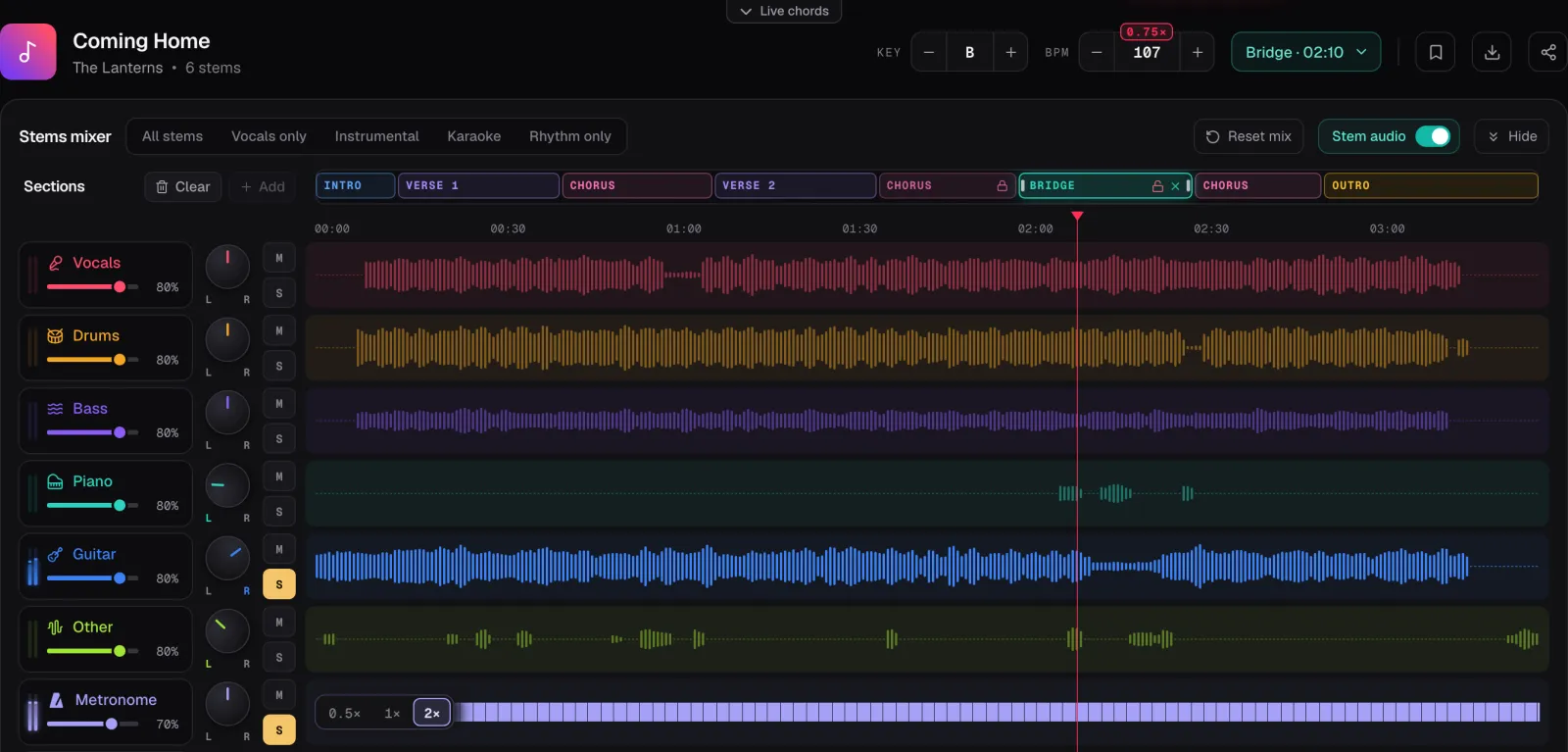
In the screenshot, the demo song Coming Home is slowed from 143 to 107 BPM, 0.75×, with Guitar soloed and the Metronome row at 2×. When a stem is soloed, only soloed rows play, so the Metronome is soloed too. Now every strum lands against a click, and you can hear which slots it fills.
04 / 08 · PATTERNS
Four patterns you will hear again and again.
Thousands of songs use a handful of patterns, or small changes to them. Learn to recognise these and you will often name a pattern on the first listen. D is a down strum, U an up strum, and a dash is a slot your hand moves through without touching the strings.
All downs: D - D - D - D - . Four even strums. Driving rock and punk songs often play this, and at a fast tempo it becomes eight downs, one on every slot.
Down, down-up: D - D U D - D U. A gentle, rocking pattern for ballads and folk songs.
The common one: D - D U - U D U. Down, down-up, up-down-up. It skips the strum on beat three, and that missed down is what gives it its lift. It turns up in pop, folk and worship songs everywhere.
Swung or in 6/8: songs that lilt count “1 2 3 4 5 6”, with the hand going down-up-down, down-up-down or simply down on 1 and 4. If “1 and 2 and” feels wrong for a song, try counting it in six. Our guide on how to find the BPM of a song covers how to tell a song’s pulse.
05 / 08 · DETAILS
The details that make it sound right.
Getting the slots right gets you most of the way. The rest is in three details that make a pattern sound like the record rather than like an exercise.
Accents. Some strums are louder than others, usually the ones on beats two and four, where the snare drum hits. Listen to the guitar alone and notice which strums jump out. Strum those harder.
Muted strums. The “chk” sound in funk, reggae and a lot of acoustic pop is a strum with the fretting hand relaxed so the strings are muted. It still takes a slot. Count it as a strum, just a percussive one.
Pushes. Often the chord changes half a beat early, on the “and” before the beat, so it is already sounding when the beat arrives. If your changes feel late, listen for this. Put the A–B loop round the change and play just those two beats until you catch it.
06 / 08 · PRACTISE
Make it automatic.
Once you know the pattern, set an A–B loop round the section in the Studio. The loop snaps to the song’s beat grid, so it comes round on the downbeat. Play along with the guitar soloed at a slow speed until the pattern runs without you thinking about it.
Then bring the band back in: press S on Guitar again to unsolo it, or press M on it to mute it and play the part yourself, which turns the song into a backing track. Raise the speed a few BPM at a time until you are back at the record’s tempo. Our guide to the metronome for songs has exercises for when your time drifts.
Everything here works on ukulele too. Ukulele strums the same pendulum, often with a lighter touch and more up strums, and the counting, the slow speed and the click help just as much. Play along with the chords in time: pick Ukulele in the Studio’s Live chords bar and every diagram is drawn for ukulele.
07 / 08 · Do it in one click
Guitar Stem Splitter
Hear the guitar on its own, slow it down and count the strums against a click.
01How do I figure out a strumming pattern by ear?
Count “1 and 2 and 3 and 4 and”, keep your hand moving down and up on those counts, and let only the strums you hear touch the strings.
02Should my hand keep moving when I miss a strum?
Yes. Keep the down-up motion going and just miss the strings. That keeps every strum in time.
03What is the most common strumming pattern?
Down, down-up, up-down-up (D - D U - U D U) in 4/4. It skips the strum on beat three.
04How do I hear the guitar clearly in a song?
Split the song into stems on a computer and solo the guitar, then slow it to about 0.75×. The strums stand out once the drums and vocal are gone.
05How do I count strums at a slower speed?
Slow the song in the Studio and turn on the metronome at 2×. It clicks on every beat and every “and”, and follows the slower tempo.
06Why does my strumming sound right but feel wrong?
Check the accents and pushes. The record may hit beats two and four harder, or change chord on the “and” before the beat.
07Does this work for ukulele?
Yes. Ukulele strumming uses the same down-up motion and the same counting.