 Chord Lens
By instrument · 02 of 14
HOW TO USE A CAPO, AND WHEN TO MOVE IT. same shapes, new key
The short answer
Clamp the capo just behind a fret, straight across, with only enough pressure to stop buzzing, then check your tuning. Play the shapes you know: each fret raises the sound a semitone. Move it to put a song in a singer’s range, to turn barre chords into open ones, or to get a brighter sound.
01 / 09 · WHAT IT DOES
A capo is a movable nut.
A capo clamps across every string at one fret and shortens them all by the same amount. The guitar now behaves as if its nut were at that fret: the open strings sound higher, and every shape you play above the capo sounds higher by the same amount. One fret is one semitone.
The point is that your hands don’t change. A G shape is still a G shape, with the same fingers in the same places relative to the capo. Only the sound moves. So a capo lets you play a song in a key you can’t comfortably reach with open chords, without learning new shapes.
That gives every chord two names: the shape your fingers make and the chord that sounds. With a capo on the 2nd fret, a G shape sounds as A. When you read a chart, check which one it gives you. Our capo chart lists the sounding key for every shape and fret, so you don’t have to count.
02 / 09 · METHOD
Put a capo on in five steps.
Most capo trouble comes from how it’s put on, not from the capo itself. A capo that buzzes, pulls the strings sharp or sits at an angle makes a good guitar sound out of tune. These five steps fix almost all of it.
Tune without it
Tune the guitar open first. A capo can’t fix a string that is already out.
Sit it behind the fret
Place the capo just behind the fret wire, as close as it will go without sitting on top of it, the way your finger would press.
Keep it straight
Line the bar up parallel with the fret, so every string is pressed at the same point.
Use light pressure
Tighten until no string buzzes, and stop there. Too much pressure bends the strings sharp.
Check and retune
Strum each string and check the tuning again with the capo on. Nudge any string that has drifted.
Pull the strings straight again after clamping: run a thumb along them just above the capo. It undoes the sideways tug that pulls one string sharp.
03 / 09 · WHICH FRET
Pick the fret from the key you need.
To put a capo on for a song, start from the key the song sounds in, then find a shape key a few semitones below it that you play well. The gap between them is the fret. A song in A? Play G shapes with a capo on 2. A song in B? A shapes on 2, or G shapes on 4. A song in E♭? D shapes on 1, or C shapes on 3.
If you don’t know the song’s key, find that first. Our guide on how to find the key of a song shows how, and the Song Key Finder names it from the recording.
Chord Lens can do the sums for you. In the Studio, pick Guitar, Ukulele or Mandolin in the Live chords bar and choose a capo from 0 to 9. The song keeps its key, and every chord on the chart and every diagram changes to the shape you play above that fret. Step through the frets and watch the shapes: the fret where most of them turn into open chords is usually the one to use. On a phone, the Studio’s Instrument sheet goes one further and suggests the capo that turns the most of the song’s chords into open shapes.
04 / 09 · WHEN TO MOVE IT
Four reasons to move the capo.
The singer needs another key. If the chorus sits too high or too low for the voice, move the capo rather than relearning the song. Each fret up raises it a semitone. To go lower, take the capo off, or move it down and switch to a lower shape key, because a capo can only raise the pitch. Our guide to the best key for your voice shows how to find where a song should sit.
You want to dodge barre chords. A song in B on guitar is full of barre chords. Capo 2 with A shapes, or capo 4 with G shapes, turns them into open chords that ring out and are easier to change between.
You want a different sound. High on the neck, open shapes sound bright and light, closer to a mandolin. Two guitars in the same band often play the same song in different shapes, one open and one capoed high, so their parts don’t blur together.
The key changes in the song. Some songs move up a semitone or a tone for the last chorus. Move the capo up a fret or two in the gap before it and keep the same shapes. Practise that move: it has to happen in a bar or less.
05 / 09 · KEY AND CAPO
Move the key, then let the capo follow.
Sometimes the song itself has to move: you are singing it lower than the record, or the band plays it in another key. Then you want two things at once, the recording in the new key so you can play along, and shapes that are easy in that key.
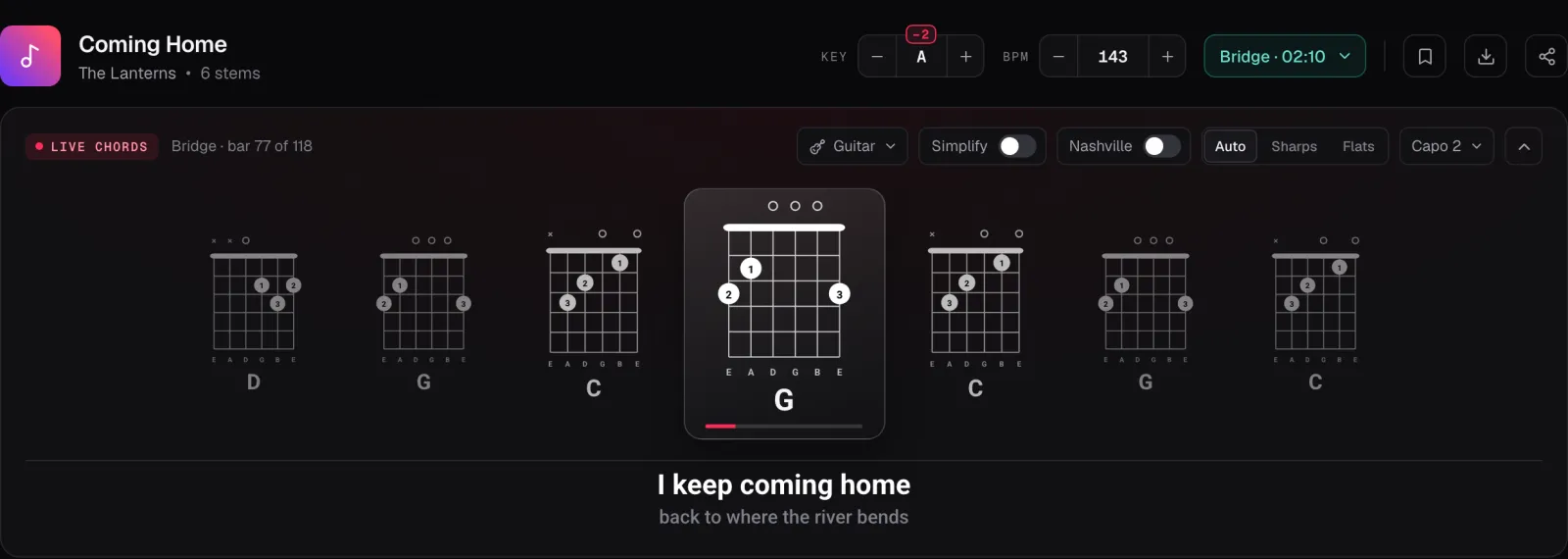
In the screenshot, the demo song Coming Home is in B. The Key stepper in the Studio header has taken it down two semitones to A, which moves the recording and every chord on the chart. With Guitar picked in Live chords and Capo 2 set, the shapes to play are G, C and D, all open chords, and the chord playing now is drawn large with its fingering. The key moves the sound; the capo moves the shapes; the chart adds the two up.
The Key stepper goes up to 12 semitones either way and keeps the song at its own speed. Change Song Key explains how it shifts the recording, and our guide on how to transpose chords covers the arithmetic if you would rather work it out on paper.
06 / 09 · UKULELE
It works the same on ukulele.
A ukulele capo is smaller and lighter, but it does the same job: one fret, one semitone, same shapes. Ukulele players use it for the same reasons, mostly to dodge awkward chords such as E and B♭, which are hard on a ukulele in standard GCEA tuning. In the Studio, pick Ukulele in Live chords and the capo works the same way, with ukulele diagrams. Our guide on how to play any song on ukulele goes through it.
07 / 09 · MISTAKES
Four mistakes to avoid.
Clamping too hard. A spring capo on a thin neck, or a screw capo cranked tight, bends the strings sharp. Use the least pressure that stops the buzz.
Sitting in the middle of the fret. The further the capo sits from the fret wire, the more it pulls the strings out of tune and the more it buzzes. Get it close.
Mixing up shape and sound. If the singer asks for A and you’re playing G shapes on capo 2, you’re right. If you tell the bass player “G”, you’ve just put them a tone away from you. Call out the sounding chord to other players, and keep the shapes to yourself.
Leaving it in the way. Clamp it with the handle up or to the side so it doesn’t catch your fretting hand. Between songs, park it on the headstock, behind the nut, so you can grab it.
08 / 09 · Do it in one click
Change Song Key
Move the song into your key and set a capo; the chart shows the shapes to play.
01Where exactly do I put a capo?
Just behind the fret wire, as close as it will go without sitting on it, and straight across the strings.
02Why does my guitar sound out of tune with a capo?
Usually the capo is too tight or too far from the fret, which pulls the strings sharp. Loosen it, move it closer and retune with it on.
03What fret should I put my capo on?
Take the song’s key and pick a shape key a few semitones below it. The difference is the fret: G shapes on 2 for a song in A.
04Does a capo change the key?
It changes the key you sound in, one semitone per fret. The shapes you play stay the same.
05Can a capo make a song lower?
No. A capo only raises the pitch. To go lower, use a lower shape key, or change the key of the recording you play along with.
06Do I need a capo for ukulele?
Not often, but it helps with hard chords such as E and B♭. It works the same as on guitar.
07Does Chord Lens show the shapes for my capo?
Yes. In the Studio, pick guitar, ukulele or mandolin and set a capo from 0 to 9. The chart and diagrams show the shapes for that fret, and they follow if you change the key.