 Chord Lens
By instrument · 04 of 14
LEARN A GUITAR SOLO BY EAR, ONE PHRASE AT A TIME. sing it, then find it
The short answer
Learn a solo phrase by phrase, not note by note. Sing each phrase until you know it, find its first note on the neck from the song’s key, then work out the rest. Loop the phrase with the guitar on its own and slow it down to hear every note, then bring it back up to speed.
01 / 08 · WHY BY EAR
A solo is a melody. Learn it like one.
Tab tells you where to put your fingers. It doesn’t tell you how the notes are bent, slid, held or let go, and that is most of what makes a solo sound like the record. Learning a solo by ear makes you listen for all of it, and every solo you learn that way makes the next one faster.
It also trains the thing a guitarist needs most: hearing a note and knowing where it is on the neck. After a few solos you start to recognise the shapes players reach for, the box positions, the bends to the next note of the scale, the phrases that end on a chord tone.
The trick is to work on small pieces. A solo that sounds impossible at full speed is usually a handful of short phrases, each two to four seconds long, and each one is learnable on its own.
02 / 08 · METHOD
Learn the solo in six steps.
Set aside a session for each eight bars or so. Work through them in order, and don’t move on until the phrase you are on is clean at a slow speed.
Listen and sing
Play the solo several times through and sing or hum it. If you can’t sing a phrase yet, you aren’t ready to play it.
Find the key
Note the song’s key and the chords under the solo. Most solos stay in the scale of that key.
Split it into phrases
Mark where the player breathes: the gaps between licks. Each phrase is one piece to learn.
Loop one phrase
Loop the first phrase, from a beat before it to a beat after, with the guitar on its own.
Slow it and find it
Slow the loop until you can hear every note, then find them on the neck, starting from the first.
Bring it up to speed
Raise the tempo a few BPM each time the phrase is clean, until you can play it with the record.
03 / 08 · HEAR IT
Get the solo alone, slowed and looped.
A fast run in a full mix is a blur. The drums and the vocal reverb cover the quiet notes, and the rhythm guitar plays in the same range. Hearing the lead alone, slower and on repeat, is what makes the notes countable.
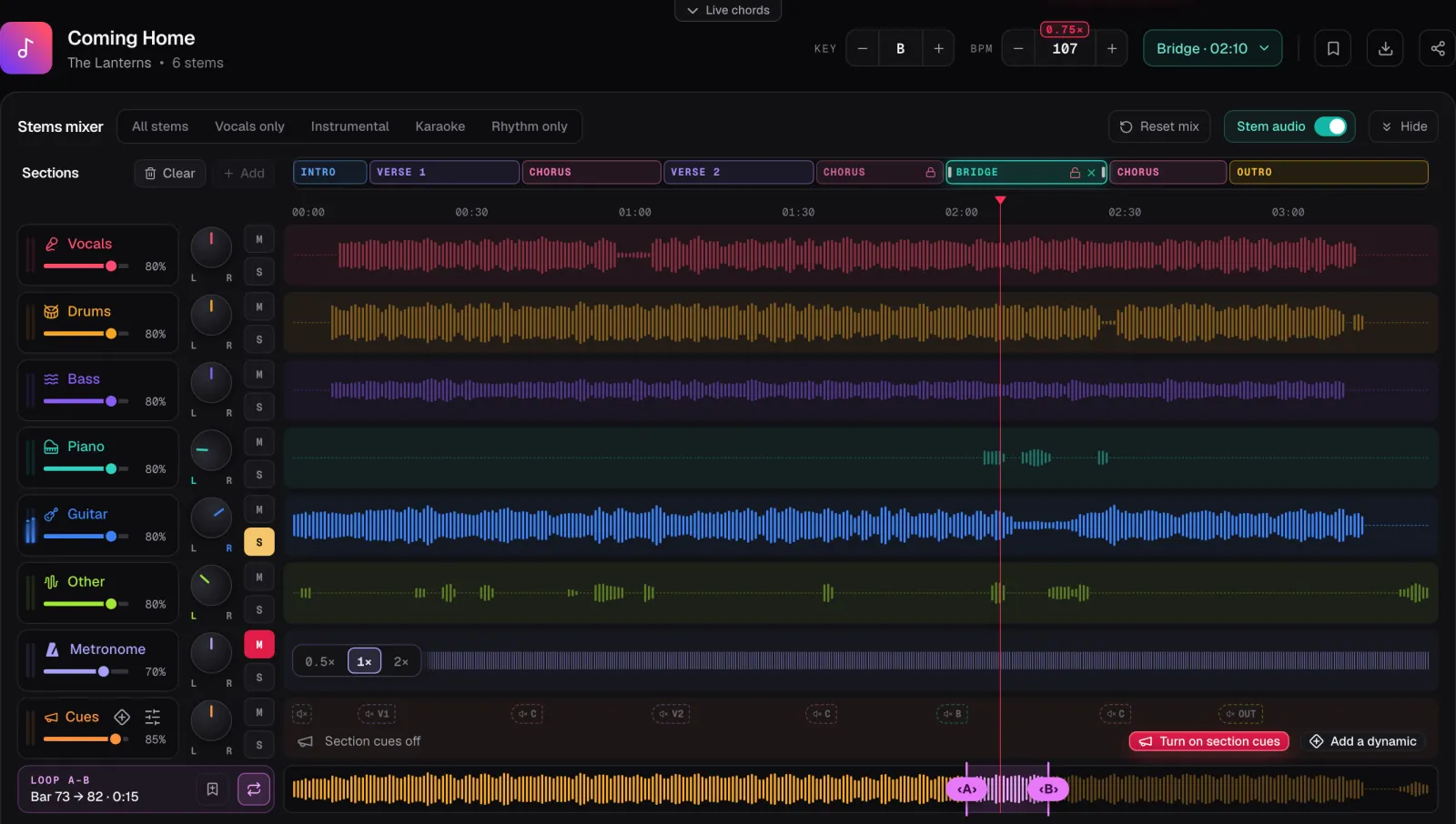
In the screenshot, the demo song Coming Home is split into stems in the Chord Lens Studio. Guitar is soloed in the Stems mixer, so only the guitar plays. The tempo is down from 143 to 107 BPM, three-quarter speed, and the pitch hasn’t moved, so the notes are still where they are on the record. At the bottom, the Loop A–B row is on, with its handles round the bridge riff, bars 73 to 82.
The Guitar Stem Splitter does the split, on a computer in Chrome or Edge. Acoustic and electric guitars both land in the Guitar stem, so the lead and the rhythm part can share it; a second guitar can land in Other, so solo that too if a note seems missing. The BPM stepper moves the tempo one BPM at a time, down to half the song’s speed.
Below about half speed, slowed audio starts to smear. If a fast run blurs at 0.5×, loop fewer notes at 0.6× instead.
04 / 08 · THE LOOP
Loop small, and save every loop.
Switch the loop on and it starts at the playhead. Drag the A and B handles to the edges of the phrase, or drag across the strip to draw a new one; drag inside it to move the whole loop. The ends snap to the song’s beat grid, so the loop comes round on the beat and you can play straight back in. With a handle selected, the arrow keys nudge it a beat, or a bar with Shift.
Start each loop a beat before the phrase. You learn how the phrase begins against the band, which is often the hardest part: many solo phrases start on an off-beat, or just before the bar.
Save each loop as you finish it and give it a name, such as “solo bar 1–2”. Saved loops sit in the player bar, one press away, so next session you can run the whole solo phrase by phrase. On Free you can keep three saved loops per song; Premium and Pro keep as many as you like. Slow Down Songs covers the loop and the speed in more detail.
05 / 08 · ON THE NECK
Find the notes faster.
Start from the key. The Studio header shows the song’s key, and the chords play in time on the chart. Most rock, blues and pop solos sit in the minor or major pentatonic scale of that key. Put your hand in that box and the first note is usually under one of your fingers. Our guide to finding the key of a song shows how to check it by ear.
Find the last note first. Phrases often end on a note of the chord playing under them. Look at the chord on the chart at that moment, find its root or third near your hand, and work backwards.
Listen for the technique. A note that slides into pitch is a slide or a bend. A bend sounds like one note smoothly turning into the next. A note that wobbles is vibrato. Repeated notes that don’t sound picked are hammer-ons and pull-offs. Play it the way you hear it, not just the right fret.
Pick the position from the sound. The same note can be played in several places on the neck. If the record sounds fat and warm, try lower strings higher up the neck; if it’s bright, try the higher strings lower down. If a phrase is awkward under your fingers, try the next position.
06 / 08 · GOOD TO KNOW
What the split can and can’t do.
Chord Lens gives you the guitar as audio and the chords in time. It doesn’t write out the solo as tab or notation: the notes are yours to find, which is the point of learning by ear. Write the tab yourself as you go, a phrase at a time, so you have it when you forget.
A lead that stands out in the mix usually comes out clear. A guitar buried under synths, a heavily distorted tone or a live recording can bleed more, and a studio version of the song usually splits more cleanly. On a phone you get the chords and the sections, but not the split.
For more ear training, our guide on how to learn songs by ear starts from the chords and the melody, and how to transcribe a song covers writing a whole part down.
07 / 08 · Do it in one click
Guitar Stem Splitter
Hear the guitar on its own, loop the lick and slow it down without changing the pitch.
01How do I learn a guitar solo by ear?
Sing it first, find the key, then loop one short phrase at a time with the guitar on its own, slowed down, until you can play it.
02How do I hear a guitar solo clearly?
Split the song into stems on a computer and solo the guitar, then slow it to about 0.75×. The drums and vocal stop covering the notes.
03Does slowing a solo down change its pitch?
Not in Chord Lens. The tempo moves and the notes stay where they are, so what you find on the neck matches the record.
04What scale are most guitar solos in?
Most rock, blues and pop solos use the minor or major pentatonic scale of the song’s key. Start there and listen for notes outside it.
05How long should each loop be?
One phrase, usually two to four seconds. Start it a beat before the phrase so you learn how it comes in.
06Can Chord Lens write out the solo as tab?
No. It gives you the guitar on its own and the chords in time. Finding the notes is the ear training.
07How many loops can I save?
Three per song on Free, and as many as you like on Premium and Pro.