 Chord Lens
Start here · 05 of 06
LEARN A SONG FAST: THE 30-MINUTE METHOD BEFORE REHEARSAL. map it, loop it, play it
The short answer
To learn a song quickly, don’t start at bar one. Spend five minutes mapping its sections, ten learning the chord loops each section repeats, ten drilling the two hardest bars slowly, and five setting your key and writing the chart. You’ll walk into rehearsal knowing the form, the changes and the parts that would have tripped you.
01 / 09 · THE PLAN
You don’t need to master it. You need to not get lost.
The message arrives the night before: “New song Sunday, here’s the link.” You have half an hour, maybe less. The instinct is to play along from the top over and over, getting a little further each time. It’s the slowest way to learn a song, because you spend most of the half hour on the bits you already have and only a few seconds on the bars that will actually go wrong.
What a band needs from you at a first rehearsal is smaller than it looks. You need to know the form, so you don’t play a chorus when everyone else goes to the bridge. You need the chords of each section. You need the two or three moments that would catch you out, a push, a stop, an odd bar, played at least once without thinking. And you need to be in the key the band is playing in. Polish comes later, with the band.
So split the half hour into four jobs, in that order: the map, the chords, the hard bits, the key and the chart. Each job builds on the one before, and if time runs out at minute 20 you still have the parts that matter most.
02 / 09 · METHOD
The 30 minutes, step by step.
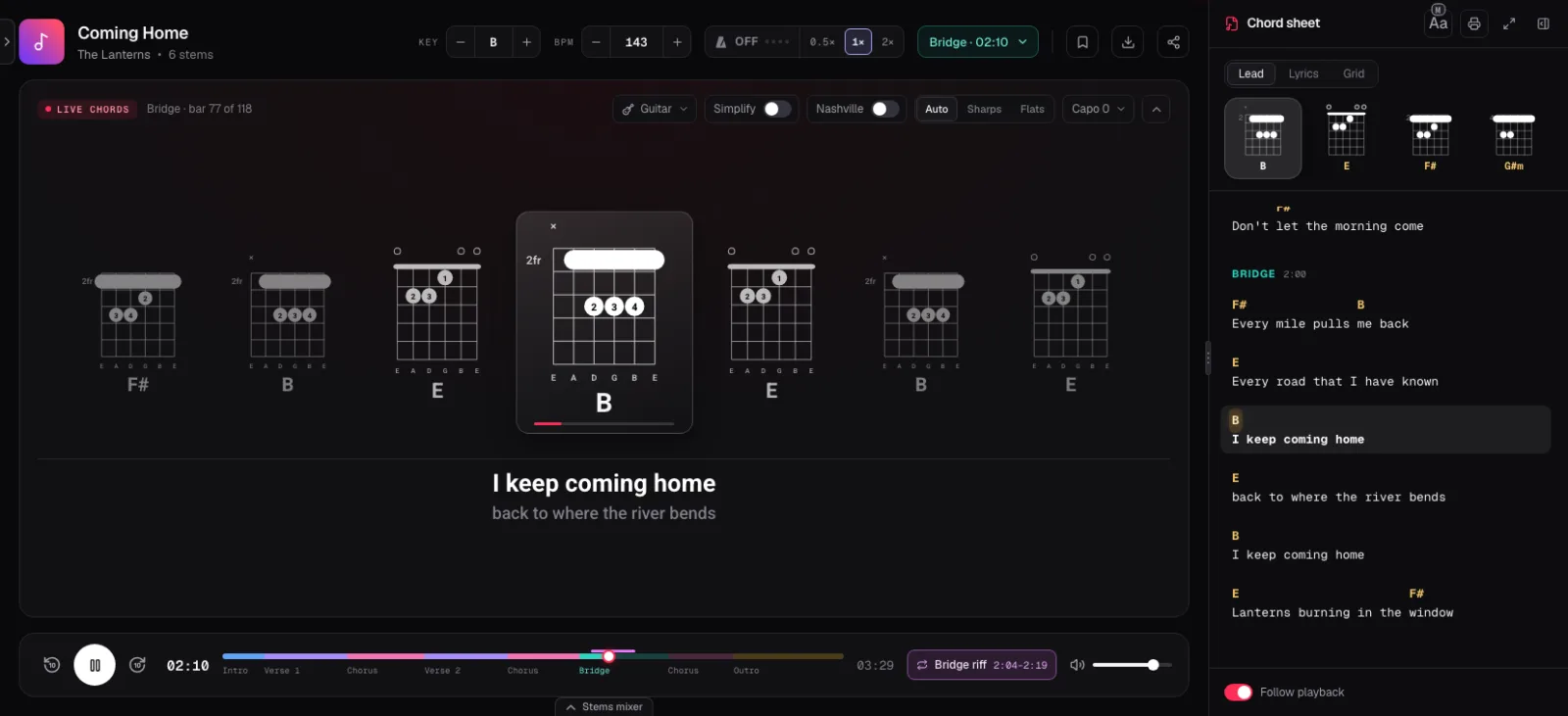
Set a timer and keep moving when it goes off. Running over on one job is how the half hour becomes two hours. The screenshot is the Studio’s Play along layout with the demo song, Coming Home: the song’s sections run along the player bar, the chords are coming up large in the middle, the chart sits on the right, and a saved loop over the bridge is one press away.
Map the song (minutes 0 to 5)
Listen once with the sections showing and write the form down the side of a page: intro, verse, chorus, verse, chorus, bridge, chorus, outro.
Find the loops (minutes 5 to 10)
For each section, find the short chord pattern it repeats. Most sections are one pattern of two to four bars, played several times.
Play through the chords (minutes 10 to 15)
Play the whole song along with the record, chords only, no fills. Mark every place you stumbled.
Drill the hard bars (minutes 15 to 25)
Loop the worst two bars, slow them to about 0.75×, play them clean three times, then step the speed back up.
Set the key and the chart (minutes 25 to 30)
Move the song to the key the band will play in, set a capo if you want one, and print or save the chart.
03 / 09 · THE MAP
First, the map.
Before you play a note, listen to the song once from start to finish with a pen in your hand. Write each section as it goes by, and next to it how many times the main pattern goes round. The demo song comes out as intro, verse, chorus, verse, chorus, bridge, chorus, outro. That is a very common shape, and once you’ve written it you can see that you only have four different things to learn.
Listen for the things that break the pattern. A chorus that’s longer the last time. A verse that skips its last line. A bar of 2/4 before the bridge, or a stop where the whole band drops out. These are the moments a band gets lost, so put a star next to each one. They become your hard bars later.
Chord Lens marks the sections on the song for you: intro, verse, chorus, bridge and the rest, along the player bar and above the chart. The position menu in the header jumps straight to any of them, which makes it quick to compare the first chorus with the last. If a section is marked in the wrong place, you can move it, rename it or add one in the Sections row of the mixer, so the map matches what you hear.
04 / 09 · THE CHORDS
Learn loops, not bars.
Most songs are built from a handful of chord patterns repeated. Learn the pattern once and you’ve learned twenty bars. In the demo song, the intro, verse and chorus all use the same four chords, B, E, G♯m and F♯, the I, IV, vi and V of B major. The verse holds B and E for two bars each; the chorus changes chord every bar. The bridge is the one section that starts somewhere new, on F♯. That is the whole harmonic content of a three-and-a-half minute song, and it fits in the margin of a page.
So for each section, find its loop and say it out loud: “verse is B, E, G♯m, F♯, twice round.” Then play through the whole song with the record, chords only, with no strumming pattern beyond a steady down-strum. You’re checking the map, not performing. Every time you stumble, mark it.
The Studio gives you the chords in time with the song, with a shape for guitar, bass, ukulele, mandolin or piano, so this step is mostly reading and listening. If a chord is a stretch, turn on Simplify: a G♯m7 shows as G♯m, a Bsus4 as B, a D/F♯ as D, the plain triad a band can always use at a first rehearsal. Want the theory behind those loops? Common chord progressions explains why the same four chords keep turning up.
If the chords on a chart and the chords you hear disagree, trust your ears and the bass. The guide to finding the chords of a song shows how to check one by ear.
05 / 09 · HARD BITS
Spend ten minutes on ten seconds.
Now go back to your stars. Pick the worst one: the bar you missed every time, or the change that came too fast. Loop just that passage, from a beat before it to a beat after, so you practise getting in and getting out.
Slow it down to about 0.75×. In the Chord Lens Studio, set A at the start and B at the end of the bars, then step the BPM down; the pitch stays where it is, so your instrument still matches the record. Play the loop three times in a row without a mistake, then raise the speed a few BPM and do it again. When it’s clean at the record’s tempo, move to the next star. Save each loop with a name, so on the morning of the rehearsal you can run them again in a couple of minutes. Free keeps 3 saved loops per song.
If you can’t hear your part under the band, split the song into stems and solo it, or mute it and play in its place. The stem splitter gives you vocals, drums, bass, guitar, piano and the rest, each on its own fader. Splitting runs in your browser on a computer, and on Free you choose a 2-minute part of the song to split, so put the window over the section you need.
Ten minutes won’t make every bar perfect. It will make the bars that would have stopped you playable, which is what the first rehearsal needs.
06 / 09 · KEY & CHART
Last, the key and the chart.
Ask what key the band is playing the song in. Singers often take a song down a step or two from the record, and finding that out at rehearsal costs everyone a few minutes. If it’s different, move the song with the Key control in the Studio: the recording plays in the new key and every chord on the chart is re-spelled. Guitarists can set a capo and play the new key with the shapes they already know. Our guide to the best key for your voice helps if you’re the one choosing.
Then get the chart in front of you. On Premium and Pro, Print prints the chord sheet in the view you have open: chords over the words, the words alone, or a grid of bars. The printed header says which key, capo and tempo the chords are named for, so nobody plays from the wrong version. On Free, keep the chart open on a laptop or a phone instead; the Studio shows the chords on a phone too.
Finally, play the whole song once more from the top, at full speed, with the record. Don’t stop for mistakes. That last run is what tells you the song is ready to bring to the band.
07 / 09 · REHEARSAL
At rehearsal, listen more than you play.
You’ll know the form and the chords; now the job changes. Watch whoever leads the band for the signal into each section, keep the starred bars in mind, and play simpler than you think you need to. A part that’s right and plain beats a part that’s clever and late.
Afterwards, note what changed: a chorus repeated, an ending cut, a new key. Spend five minutes on the song the next day with the same loops, and it will be solid by the second rehearsal. If you want to go deeper than the chords, learning a song by ear walks through the melody, the bass and the chords from scratch.
08 / 09 · Do it in one click
Chord Lens Studio
Paste a YouTube link: the chords in time, the sections, loops, speed and key, all on one screen. Free to start.
01How can I learn a song quickly?
Map its sections first, then learn the chord loop each section repeats, then drill only the bars you miss, slowly. Finish by setting the key and running the song once at full speed.
02How long does it take to learn a song for rehearsal?
About 30 minutes for a typical pop or worship song if you already play the chords it uses. A song with unfamiliar chords or an odd form may take two sessions.
03Should I learn a song by playing it from the top?
Not at first. Playing from the top spends most of your time on parts you know. Loop the hard bars on their own, then play it through.
04What if the band plays it in a different key?
Move the song with the Key control in the Studio. The recording plays in the new key and every chord is re-spelled, with a capo to match on guitar.
05Can I print the chord chart?
Yes, on Premium and Pro. Print prints the chord sheet in the view you have open, with the key, capo and tempo in its header.
06Can I learn just my part?
Yes. Split the song into stems on a computer and solo your instrument, or mute it and play in its place. Free splits a 2-minute part you choose.
07Does this work on my own recordings?
Yes. Drop an MP3, WAV or M4A into the Studio and you get the chords, sections and key the same way as a YouTube song.