 Chord Lens
By instrument · 05 of 14
UKULELE CHORDS: THE BASICS, THEN ANY SONG. the guitar song, on your uke
The short answer
The basic chords of a ukulele in standard G, C, E, A tuning are C (0003), Am (2000), F (2010) and G (0232): each digit is the fret on one string, G string first. For any song, play each chord as a ukulele shape; a capo or a key change dodges hard ones such as E or B♭.
01 / 09 · THE IDEA
Same chord names, different shapes.
Almost every song you hear was written on guitar or piano, but that doesn’t stop it working on ukulele. A chord is a set of notes: a G chord is G, B and D whether a guitar, a piano or a ukulele plays it. So the chords of any song are the ukulele chords for that song. You just need the ukulele shape for each name.
What changes is how easy those shapes are. A standard ukulele is tuned G, C, E, A, and a few keys suit it far better than others. Songs in C, G, F, D and A, and their relative minors, are full of open shapes that use one, two or three fingers. Songs in E, B or E♭ are full of barres and four-finger stretches. Most of this guide is about getting a song into a key where the shapes are easy.
02 / 09 · THE BASICS
The basic chords of a ukulele.
Ukulele chords are written as four fret numbers, one per string, from the G string nearest your chin to the A string nearest the floor; 0 means the string is played open. These are the shapes most songs need, in standard G, C, E, A tuning.
The first four: C, Am, F and G. C is 0003: ring finger on the third fret of the A string. Am is 2000: middle finger on the second fret of the G string. F is 2010: keep that finger and add your index on the first fret of the E string. G is 0232: index on the second fret of the C string, middle on the second fret of the A string, ring on the third fret of the E string. Those four, in different orders, cover a huge number of songs.
The next five: D, Em, Dm, A and G7. D is 2220, three fingers side by side on the second fret (some players use 2225). Em is 0432, Dm is 2210 and A is 2100. G7 is 0212, the chord that pulls back home to C. Add the sevenths C7 (0001), A7 (0100) and E7 (1202), and most songs in C, G, F and A are open to you.
The hard ones: E, B and B♭. E is 4442 or 1402, B is 4322 and B♭ is 3211: barres and stretches. When a song is full of them, move it to an easier key or put a capo on, as below, rather than fighting the shapes.
03 / 09 · METHOD
Play any song on ukulele in five steps.
This is the whole process for a new song, from hearing it to playing along with it. Chord Lens does the first three steps for you, and the steps work the same with a chart you found elsewhere.
Get the chords
Find the chords of the song, from a chart or with Chord Lens from the recording itself.
Pick Ukulele
In the Studio’s Live chords bar, set the instrument to Ukulele. Every chord is drawn as a ukulele shape.
Look for hard shapes
Step through the chords. If most are open shapes, play the song as it is.
Fix the key
If several are barre chords, set a capo or change the key until most of them turn into open shapes.
Play along
Play with the record. The shape for the chord playing now is drawn large, with the next ones beside it.
04 / 09 · SEE THE SHAPES
See every chord as a ukulele shape.
Chord Lens finds the chords from the recording you are playing, a YouTube video or your own MP3, WAV or M4A, and puts them in time on a chart. Chord Shapes then draws each one for the instrument you pick: Guitar, Bass, Ukulele, Mandolin or Piano. On Ukulele, each diagram shows the four strings, labelled G, C, E and A, with the frets and a number for the finger that goes on each.
The shapes are the ones ukulele players know: C is one finger on the A string at the third fret, G is the triangle shape on the second and third frets. Where a chord has no open shape, such as B, you get the barre shape, with a bar across the strings. The chord playing now sits in the middle, drawn larger, and lights up in time with the song.
If a chart is full of long names such as G♯m7 or Bsus4, switch on Simplify. It turns every chord into the triad a beginner plays, G♯m and B, which on ukulele is often the difference between a stretch and a shape you know. Slash chords such as D/F♯ become plain D, which suits a ukulele anyway: it has no low string to play the bass note on.
05 / 09 · CAPO OR KEY
Too many barre chords? Move the key.
There are two ways to turn a hard key into an easy one. Both work in the Studio, and the shapes follow either one.
Put a capo on. A capo raises everything you play by one semitone per fret, so you can play easy shapes in a harder key. The demo song Coming Home, in the screenshot, is in B: on ukulele that’s B, E, G♯m and F♯, a barre B and three four-finger stretches. Set Capo 4 in the Live chords bar and the shapes become G, C, Em and D, the first four chords most ukulele players learn, while the song still sounds in B. The capo goes from 0 to 9.
Change the key. If you are singing as well, the record’s key may be too high or low for you anyway. The Key stepper in the Studio header moves the recording up or down a semitone at a time, up to 12 either way, and the chords and every ukulele shape move with it. Take Coming Home up one semitone to C and the chords become C, F, Am and G: every one an open shape, no capo needed. Change Song Key has the detail, and our guide to the best key for your voice helps you pick.
On a phone, the Studio’s Instrument sheet does the search for you: it suggests the capo that turns the most of the song’s chords into open shapes, with a button to use it.
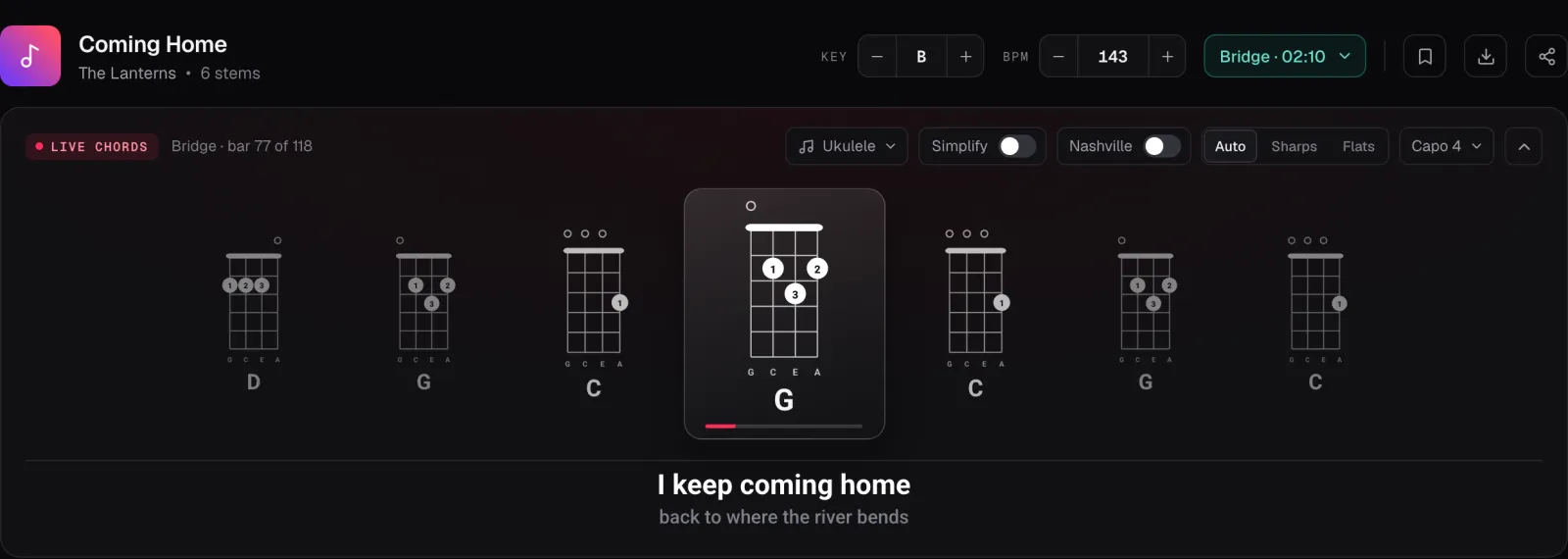
The four chord shapes G, C, Em and D, or C, G, Am and F, cover a huge number of songs. Learn those first and use a capo or a key change to bring songs to them.
06 / 09 · PRACTISE
Learn it with the record, not just the chart.
A chord sheet tells you which chord; the record tells you when. Play along with the song itself, chord by chord, and you learn the changes in time from the start.
If the changes come too fast, slow the song down with the BPM stepper: the tempo goes as low as half speed and the key stays the same, so your shapes still match. Loop the bars with the hard change and play them until the change is smooth, then step the speed back up. Our guide on how to figure out a strumming pattern shows how to work out the rhythm your strumming hand plays.
If you are new to chord names, chord symbols explained covers what the m, 7, sus and slash in a name mean, and how to use a capo covers putting one on so it stays in tune.
07 / 09 · GOOD TO KNOW
Good to know.
Chord Lens draws one common shape per chord. It’s a good place to start, not the only way to play it, and the player on a ukulele recording may use another voicing higher up the neck.
The diagrams are for a standard GCEA ukulele, drawn for right-handed players. A baritone ukulele is tuned D, G, B, E, so these diagrams don’t fit it.
A shape is only as right as the chord under it. Songs with a clear band and steady chords come out right most of the time; when one sounds wrong, loop the bar and listen at a slower speed.
08 / 09 · Do it in one click
Chord Shapes
Every chord of the song as a ukulele shape, lit in time, following your capo and key.
01What are the basic chords on a ukulele?
C, Am, F and G first, then D, Em, Dm, A and G7. As fret numbers from the G string: C 0003, Am 2000, F 2010, G 0232.
02How do I play a guitar song on ukulele?
Use the same chord names and play the ukulele shape for each one. A G chord has the same notes on both instruments.
03What are the easiest keys for ukulele?
C, G, F, D and A, and their relative minors. Songs in those keys use mostly open shapes.
04What do I do when a song has hard ukulele chords?
Put a capo on, or change the key, so the chords turn into open shapes. Coming Home in B becomes G, C, Em and D with a capo on 4.
05Can I use a capo on a ukulele?
Yes. It works the same as on guitar: each fret raises the sound one semitone and you keep your shapes.
06Does Chord Lens show ukulele chord shapes?
Yes. Pick Ukulele in the Studio’s Live chords bar and every chord in the song is drawn as a ukulele shape, lit in time.
07What tuning do the ukulele diagrams use?
Standard G, C, E, A tuning, for soprano, concert and tenor ukuleles.
08Do the shapes change if I change the key?
Yes. Move the key and every diagram is redrawn in the new key, with your capo still applied.