 Chord Lens
By instrument · 12 of 14
PIANO CHORD INVERSIONS FOR SMOOTH CHORD CHANGES. keep the common note
The short answer
A piano chord inversion is the same three notes in a different order: root position starts on the root, first inversion on the third, second inversion on the fifth. To change chords smoothly, keep any note the two chords share and move the others to the nearest key, so your hand barely moves.
01 / 09 · WHY
Jumping chords sound like jumping chords.
Most people learn piano chords in root position: the root at the bottom, then the third, then the fifth. C is C, E, G. F is F, A, C. G is G, B, D. That is the right way to learn what a chord is. It is the wrong way to play a song, because moving from one root-position chord to the next means lifting your whole hand and landing somewhere else, chord after chord.
It sounds the way it feels. Every chord change is a leap, every leap is a chance to land late, and the chords sound like separate blocks rather than one line of music. Listen to a pianist in a band and you will hear the opposite: chords that seem to slide into each other, with the right hand hardly moving at all.
The difference is inversions. Any chord can be played with any of its notes at the bottom, and choosing the right one for each change keeps your hand in one place. Our guide to playing piano by chords introduces the idea in a few lines. This guide goes through it properly: the three positions, how to find the nearest one quickly, and how to practise it until you stop thinking about it.
02 / 09 · METHOD
From root position to smooth changes in five steps.
Take one section of a song, usually four chords that repeat. You will choose one shape for each chord, write it down, and play the loop until it is automatic.
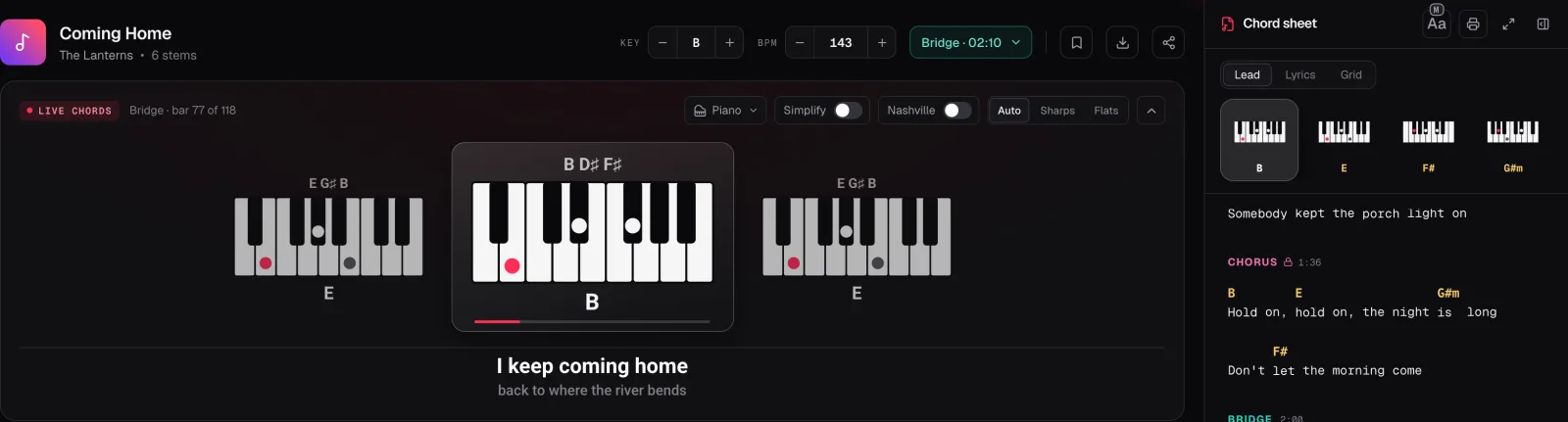
In the screenshot the demo song Coming Home is open in the Chord Lens Studio in its own key of B, with Live chords set to Piano. The chord playing now is B, drawn with B, D♯ and F♯ named above it and the root marked in red; E, either side, shows E, G♯ and B. The Studio draws every chord in root position, from the root up. Which inversion you play is up to you, and that is what the steps below are for.
Pick a home chord
Play the first chord of the loop in root position, in the middle of the keyboard.
Find the shared notes
For the next chord, find any note it shares with the one you are holding, and keep that finger where it is.
Move the rest by step
Move the other notes to the nearest notes of the new chord, a key or two away, never a jump.
Write the shapes down
Note each chord with its bottom note, for example E over B, so you play the same shape every time.
Loop it with the record
Play the loop along with the song, slowed if needed, until the changes happen without looking.
03 / 09 · THREE POSITIONS
Three notes, three orders.
A major or minor chord has three notes: the root, the third and the fifth. Stack them in any order and it is still the same chord. What changes is which note is at the bottom, and that note gives the position its name.
Root position: the root at the bottom. C, E, G. It sounds solid and complete, and it is where every chord starts. First inversion: move the root up an octave, so the third is at the bottom. E, G, C. It sounds lighter and a little less settled. Second inversion: move the third up as well, so the fifth is at the bottom. G, C, E. It sounds open and slightly suspended, as if it wants to go somewhere.
Find any inversion the same way: take the bottom note of the shape you are holding and move it up to the next copy of that note above the top. Root position becomes first inversion, first becomes second, and second becomes root position an octave higher. Your hand walks up the keyboard through the same three notes.
Look at the shapes, not just the notes. In root position the notes are evenly spaced, two gaps of about the same size. In both inversions there is one wide gap of a fourth: between the top two notes in first inversion, between the bottom two in second. When the gap is at the top, the root is the top note; when it is at the bottom, the root is the top of the gap. That is how to name an inversion at a glance.
Four-note chords have one more position. G7 is G, B, D, F; play it from B, from D or from F and you have its first, second and third inversions. The rule for moving between them is the same.
Learn every chord in a key in all three positions before you play songs in it. Ten minutes on C, F, G and Am, up and down through their inversions, covers a huge share of pop songs.
04 / 09 · SMOOTH CHANGES
Keep what stays, move what changes.
The idea behind smooth changes has a name, voice leading, and one rule: from each chord to the next, keep any shared note where it is, and move every other note to the nearest note of the new chord. Do that and the right inversion picks itself.
Try it in Coming Home, in B. The chorus uses B, E, G♯m and F♯. Start with B in root position: B, D♯, F♯. E is E, G♯, B, and it shares B with the chord you hold. Keep B, move D♯ up to E and F♯ up to G♯: you are playing E in second inversion, B, E, G♯, and two fingers moved one key each.
From there to G♯m, G♯, B, D♯: keep B and G♯, move E down to D♯. That is G♯m in first inversion, B, D♯, G♯. Then to F♯, F♯, A♯, C♯: no notes shared, so move each to its nearest. B down to A♯, D♯ down to C♯, G♯ down to F♯. That is F♯ in second inversion, A♯, C♯, F♯, and back to B, B, D♯, F♯, by stepping each note up again.
Four chords, and your hand never left the same few keys. Played in root position, the same loop would jump between three different places on the keyboard. The Studio’s diagrams show you each chord’s notes; the order above is one you work out once and then play from memory.
If a song is in a key with many black keys, like B, you can practise the same method in an easier key first. Raise the Studio’s Key by one semitone and the record moves up to C, with the chords re-spelled as C, F, Am and G. The same inversions are then all white keys: C, E, G; C, F, A; C, E, A; B, D, G.
05 / 09 · PRACTISE
Ten minutes a day, one progression.
Inversions only help when you can find them without thinking. This drill gets you there.
Up and down. Take one chord. Play root position, first inversion, second inversion and root position an octave up, then come back down. Do it with each chord of the key, slowly, saying the bottom note aloud.
One progression, three starts. Take a loop of four chords and play it with the smooth shapes from the section above. Then start the first chord in first inversion and work out the loop again from there, then from second inversion. You now know the loop in three places on the keyboard, which is useful when a singer or another player is already using one register.
With the record. Play the loop along with the song. If you can’t keep up, slow it down: the Studio’s BPM stepper goes from half the song’s tempo to double, and the pitch stays where it is, so the notes you play still match. Loop the section and raise the speed a few BPM at a time. Free keeps 3 saved loops per song.
Hear the real part. Solo the piano with the Piano Stem Splitter and listen to which notes the pianist on the record keeps on top. Copying the top line is the quickest way to make your inversions sound like the record.
06 / 09 · LEFT HAND
Inversions in the right hand, the root in the left.
With the left hand playing each chord’s root low on the keyboard, any right-hand inversion still sounds like the chord itself, because the root is at the very bottom. That is why most players keep inversions in the right hand and roots in the left.
A slash chord is the exception, and it is an inversion written down for the whole band. C/E means the bass plays E: put E in your left hand and play the C chord above it. Our guide to slash chords explains what the bass is doing when a chart writes one. The Studio’s keyboard draws the chord itself from its root; the note after the slash is yours to add in the left hand.
07 / 09 · GOOD TO KNOW
What you get, and on which plan.
The chords and the piano keyboards are free on every plan, with no ads; the Studio asks you to sign in free with Google. Key and speed are free once you sign in. If a chart is full of sevenths and sus chords, switch on Simplify and every chord drops to its plain major or minor triad, which makes the inversions simpler too.
Chord Lens shows each chord’s notes in time with the song, not sheet music or a fixed voicing. The order of the notes, and the left-hand part, are the skill this guide is about.
08 / 09 · Do it in one click
Chord Shapes
Every chord of the song on a piano keyboard, notes named and the root in red, lit in time with the record.
01What is a piano chord inversion?
The same notes of a chord in a different order. Root position has the root at the bottom, first inversion the third, second inversion the fifth.
02Why use inversions on piano?
They let your hand stay in one place while the chords change, so the song sounds smoother and the changes are easier to make in time.
03How do I find the nearest inversion?
Keep any note the two chords share, then move the others to the nearest notes of the new chord. The shape you end up with is the inversion to play.
04How do I tell which inversion I am playing?
Look at the lowest note. If it is the root, it is root position; the third, first inversion; the fifth, second inversion.
05Does Chord Lens show inversions?
The Studio draws every piano chord in root position, with its notes named and the root in red, in time with the song. You choose the inversion.
06Are slash chords inversions?
Often. C/E is C with its third in the bass, first inversion. Play the note after the slash in your left hand and the chord above it.
07Do seventh chords have inversions?
Yes, three: a four-note chord can have its third, fifth or seventh at the bottom. The same nearest-note rule applies.