 Chord Lens
By instrument · 11 of 14
SKIP THE BARRE CHORD: EASIER SHAPES WITH A CAPO. no barre, same song
The short answer
The easiest barre chord alternative is a capo. Find the fret that turns the song’s chords into open shapes such as G, C, D and Em, and the record still sounds in its key. For a single hard chord, play a small shape on the top strings instead: F as xx3211, Bm as xx4432.
01 / 08 · WHY
One finger, six strings, every chord.
A barre chord asks your index finger to hold down every string at one fret while the other three fingers make a shape above it. Done well, it gives you any chord anywhere on the neck. Done early, it hurts, it buzzes, and it slows every change in the song to a crawl.
Beginners meet barre chords sooner than they expect. F is in half the songs in C. B and F♯ turn up in any song in E or B. Bm and F♯m appear in nearly every song in D or A. Each one stops a strum along at exactly the moment you were starting to enjoy it.
You will want barre chords one day, and practising them a few minutes a day gets you there. But you don’t need them to play songs now. Guitarists have always worked around them: with a capo, with smaller shapes, and by moving songs to friendlier keys. This guide shows all three, and how to choose between them for a given song.
02 / 08 · METHOD
From barre chords to open shapes in five steps.
Start with the song’s chord list, not the chart line by line. The goal is to find one capo fret or one key where every chord, or nearly every chord, becomes a shape you already know.
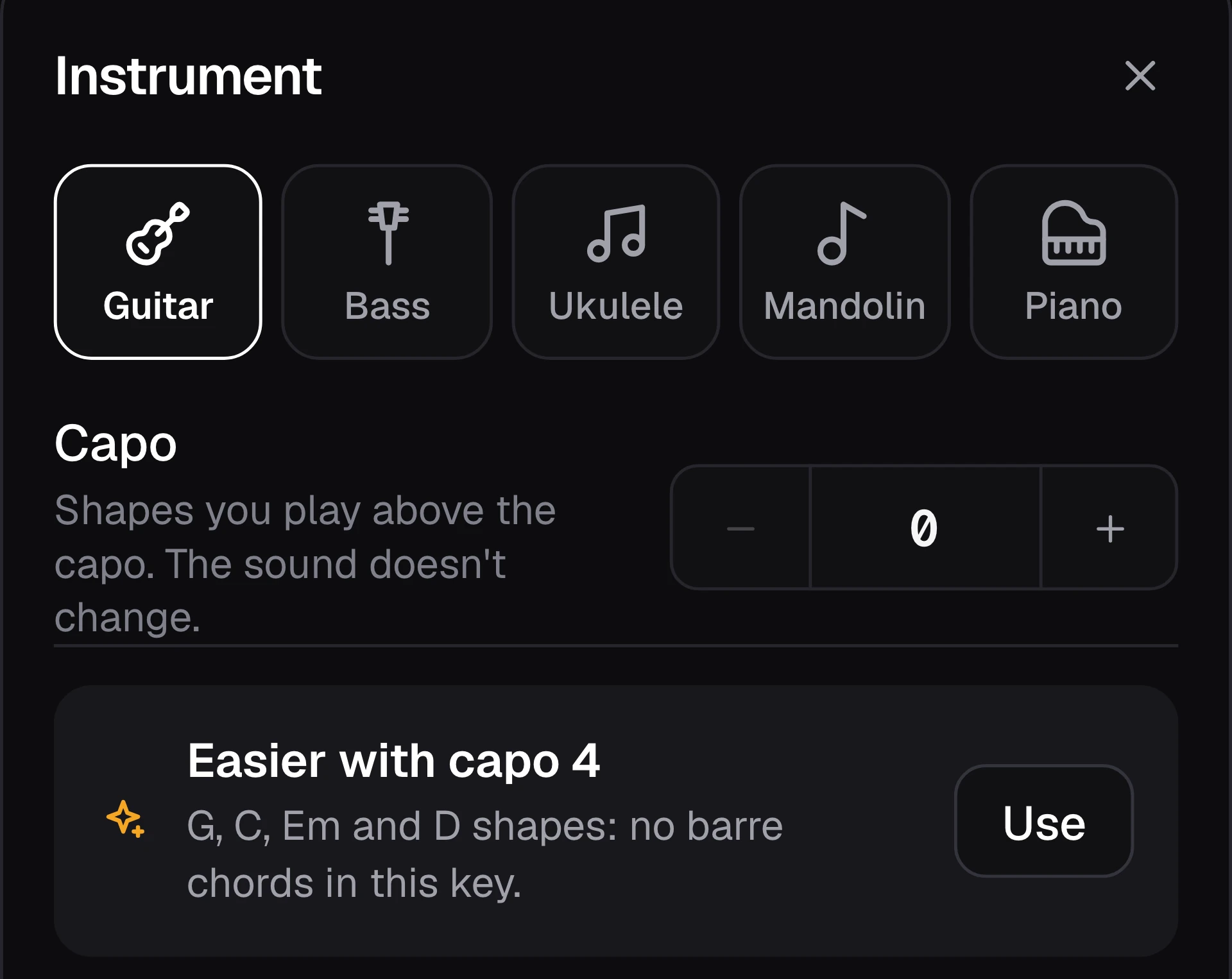
In the screenshot the demo song Coming Home is open in the Chord Lens Studio on a phone, with the Instrument sheet up and Guitar picked. The song is in B, and its chords B, E, F♯ and G♯m include three barre chords. The sheet suggests capo 4, which turns them into G, C, Em and D shapes, with no barre chords in the key. Use sets it.
List the chords
Write down every chord the song uses, once each, and mark the ones you can’t play yet.
Try a capo
Move the capo up a fret at a time and watch the shapes change. Stop at the fret where most of them are open chords.
Swap the one left over
If one barre chord remains, play a small shape on the top strings instead of the full barre.
Change the key if you sing
If the capo makes the song too high or low for your voice, move the key of the recording instead.
Play along
Play the new shapes along with the record. With a capo they sound in the song’s own key.
03 / 08 · CAPO
Find the fret where the barres disappear.
A capo is a barre that never gets tired. Clamp it at a fret and it holds every string for you, so the shapes you play above it are open shapes again. A G shape with a capo on the 4th fret sounds as B. The record stays where it is; your hands move to shapes they know.
The trick is finding the right fret, and the answer comes from the song’s chord list. Coming Home in B uses B, E, F♯ and G♯m. Without a capo, three of those are barres. Capo 2 gives A, D, E and F♯m: better, but F♯m is still a barre. Capo 4 gives G, C, D and Em, the first four chords most people learn. That is the fret.
You don’t have to work it out on paper. In the Studio, set Live chords to Guitar and pick a capo from 0 to 9. Every diagram and every chord name on the sheet changes at once to the shape you play above that fret, so you can step through the frets and stop where the shapes look friendliest. Diagrams with a barre draw it as a bar across the strings, so it is easy to see when they’re gone.
On a phone the Studio goes further. Open the Instrument sheet and it works through every capo for the song and suggests the one that turns the most chords into open shapes, with the shapes it gives, as in the screenshot. When there is a fret that removes every barre, it says so. Tap Use and the diagrams change. Our capo chart lists the fret for every key if you want to check by hand.
Keys whose chords are mostly open shapes: G, C, D, A and E, and their minor partners Em and Am. When you set a capo, you are really looking for the fret that puts the song in one of those shape keys.
04 / 08 · SMALL SHAPES
When one barre is left, play less of it.
Sometimes no capo clears every barre. A song in C with an F, a song in G with a Bm. The rest of the song is open, and one chord isn’t. You don’t need the full six-string barre for that chord; you need its notes, and three or four strings are enough.
F. Play xx3211: the D string at the 3rd fret, G at the 2nd, and your index finger flat across the B and high E at the 1st. It is a tiny barre over two strings, which most beginners manage within a week. Even easier, Fmaj7 is xx3210, with the high E left open. It isn’t quite the same chord, but in many songs it sounds fine.
Bm. Play xx4432: the D and G strings at the 4th fret, B at the 3rd, and a small barre at the 2nd on the high E. Easier still, Bm7, x20202, needs only two fingers and suits most songs where Bm is a passing chord.
B, F♯ and other major barres. Play just the middle of the A-shape barre: for B, xx444x, one finger flat across the D, G and B strings at the 4th fret, with the high E muted. Move the same shape up two frets for C♯, down to the 2nd for A. Strum lightly and leave the low strings silent.
These small shapes leave out the low root, which a full barre gives you. Playing alone, the chord sounds lighter. In a band, the bass player covers the low notes, and the small shape often sits better in the mix than a full barre would.
05 / 08 · CHANGE THE KEY
When the capo puts the song out of your range.
A capo keeps the song in its key, which is right when you play along with the record or with a singer who likes that key. But if you sing it yourself, the key may not suit you. Then move the song.
The Studio’s Key stepper moves the recording itself, up to 12 semitones either way, with the pitch shifted and the tempo unchanged, and every chord moves with it. Move Coming Home down four semitones and it plays in G: open chords with no capo at all, in a lower key that many voices find easier. Our Change Song Key page shows it working.
You can use both together: put the song in the key that suits your voice, then set the capo that gives open shapes in that key. Our guide on how to use a capo covers that balance, and putting the capo on so it doesn’t buzz.
06 / 08 · GOOD TO KNOW
What the Studio draws, and what it doesn’t.
The Studio draws each guitar chord as an open shape when there is a common one, and otherwise as the lower of the two usual barre shapes, rooted on the low E or the A string. It doesn’t draw the small three- and four-string shapes above; those are yours to swap in. On a phone, a chord with more than one shape shows dots under its diagram: swipe for its other open or barre shapes.
Under a capo the phone’s big card names the shape and the sound, for example “G shape · sounds B”, so you can talk to a bandmate in real chord names while you play shapes.
The chords, the guitar diagrams and the capo are free on every plan, with no ads; the Studio asks you to sign in free with Google. Key and speed are free once you sign in.
07 / 08 · Do it in one click
Chord Shapes
Every chord of the song as a guitar shape, lit in time, redrawn for whatever capo you set.
01What can I play instead of a barre chord?
Use a capo to turn the song’s chords into open shapes, or play a small shape on the top three or four strings, such as xx3211 for F.
02How do I pick the capo fret that removes barre chords?
Step the capo up a fret at a time and stop where most chords are open shapes. On a phone, the Studio’s Instrument sheet suggests the fret for you.
03Does a capo change the key of the song?
No. The shapes change, the sound doesn’t: a G shape at capo 4 sounds as B, so you still play along in the song’s key.
04What is an easy F chord on guitar?
xx3211, with a small barre over the top two strings. Fmaj7, xx3210, is easier still and works in many songs.
05What is an easy Bm chord?
xx4432 for Bm, or x20202 for Bm7, which needs only two fingers and suits most songs where Bm is a passing chord.
06Should I still learn barre chords?
Yes, in time. They let you play any chord anywhere on the neck. A few minutes a day builds the strength, while capos and small shapes let you play songs now.
07What if the capo makes the song too high to sing?
Change the key of the recording instead. The Studio’s Key stepper moves the song itself up to 12 semitones either way, and the chords move with it.